Construction Quality Management Under New Regulations: What Documents Should Contractors Prepare?
 In construction projects, contractors need to prepare quality management records alongside construction activities. This approach helps ensure that information on materials, inspections, acceptance activities, and arising changes remains complete, consistent, and traceable.
From July 1, 2026, Decree No. 207/2026/ND-CP and Circular No. 32/2026/TT-BXD take effect and set out requirements for construction quality management, construction activities, and building maintenance. Therefore, what responsibilities should contractors pay attention to, and which document groups should they prepare at each stage? This article explains these key requirements.
What Should Contractors Know About Construction Quality Management From July 1, 2026?
Decree No. 207/2026/ND-CP provides detailed provisions for several aspects of the Law on Construction concerning quality management, construction activities, and building maintenance. Meanwhile, Circular No. 32/2026/TT-BXD provides guidance on implementation matters such as laboratory testing plans, monitoring during construction, construction inspection, and expert assessment.
These regulations directly affect how contractors organize construction activities, control materials, conduct tests, perform acceptance activities, prepare as-built drawings, and hand over documents within their scope of work. However, the specific documents may vary depending on the nature of the project, design documents, applicable standards, and contractual requirements.
Most importantly, the records must reflect the actual construction process. Contractors need to prepare, review, and update documents at the relevant work milestones, particularly for work that later becomes concealed, materials before use, or project items before moving to the next construction stage.
What Responsibilities Do Project Owners and Contractors Have for Construction Records?
A construction completion dossier contains documents from multiple parties, so contractors do not prepare the entire dossier themselves. Clear allocation of responsibilities allows contractors to prepare their own documents proactively while coordinating with project owners and subcontractors in a timely manner.
Organizes the preparation and retention of the construction completion dossier and takes responsibility for its accuracy and integrity.
Prepares and hands over documents within its assigned scope in accordance with the contract, project requirements, and the main contractor’s management procedures.
| Party | Main Responsibilities |
| Project owner | Organizes the preparation and retention of the construction completion dossier and takes responsibility for its accuracy and integrity. |
| Contractor | Prepares documents related to its scope of work, takes responsibility for the accuracy and integrity of the documents it prepares, and retains records related to that scope. |
| Subcontractor | Prepares and hands over documents within its assigned scope in accordance with the contract, project requirements, and the main contractor’s management procedures. |
Note: The documents that a contractor prepares do not represent the entire construction completion dossier. Therefore, the main contractor should establish the document list, templates, deadlines, and designated recipient for each subcontractor from the beginning. This approach helps the contractor compile documents in line with project progress and reduces the risk of missing records during acceptance or handover.
What Documents Should Contractors Prepare at Each Stage?
Contractors should manage records by work package or project item and link each document to the time when the relevant activity occurs. In addition, they should adjust each document group below according to the design documents, technical specifications, applicable codes and standards, and contractual requirements of the project.
1. Before Construction Begins
At this stage, contractors need to define how they will organize, control, and inspect their work on site. Preparing these documents from the outset gives all relevant teams a common basis for assigning responsibilities and identifying key inspection milestones.
The document group commonly includes:
- The site construction management system and documents assigning responsibilities.
- Measures for inspecting and controlling the quality of materials, products, components, and equipment used in the project.
- Construction method statements, safety measures, and construction schedules.
- Inspection and acceptance plans for construction work, construction stages, structural sections or project items, as well as completion acceptance for project items and the overall project.
- Laboratory testing plans.
- Monitoring plans for projects or project items that require monitoring under the design documents.
The laboratory testing plan should follow the design documents, technical regulations, applicable standards, technical specifications, and contractual requirements. Its main contents include the testing subjects, corresponding test methods, expected testing schedule, and the specialized construction laboratories that the contractor plans to use.
If the contractor needs to revise the laboratory testing plan, it must submit the revised plan to the project owner for approval before implementation. Likewise, when the design documents require monitoring for a project or project item, the contractor needs to prepare a monitoring plan and submit it to the project owner for approval.
2. Before Using Materials, Components, and Equipment
Before using any material, product, component, or equipment, the contractor needs evidence showing that it complies with the design, technical specifications, applicable codes and standards, and contractual requirements. Therefore, records at this stage support input control rather than merely serving as purchasing documents.
Contractors should review the following documents:
- Documents on origin and quality, including certificates of origin or relevant certifications where applicable.
- Technical documentation for products, components, or equipment.
- Test results, inspection results, assessment records, or other documents demonstrating conformity with technical requirements.
- Acceptance records for materials, products, components, and equipment before the contractor uses them in the project.
- Documents showing the required assessment and acceptance when the contractor changes the product type, origin, source, or technical specifications.
Contractors should also link each material batch to its installation location, inspection record, and relevant test results. When a traceability check or document review occurs, this document chain can show which materials the contractor used for each work item and which technical basis supported their use.
3. During Construction and Acceptance
Records at this stage need to show how construction and quality control actually took place. Contractors should update documents in line with construction progress, particularly for work that later becomes concealed or before moving to the next construction stage.
Depending on the applicable scope, contractors need to prepare and retain:
- Construction site logs.
- Surveying, testing, monitoring, inspection, commissioning, and related technical records.
- Acceptance records for construction work, construction stages, or parts of the project.
- Records on the handling of errors, defects, and nonconformities that arise during construction.
- Documents relating to design changes or technical adjustments that the competent parties have reviewed and accepted in accordance with their authority.
- As-built drawings that reflect the actual completed work.
Construction logs, test results, acceptance records, and as-built drawings should consistently refer to the same work scope and corresponding timeline. If contractors prepare these documents separately without cross-checking them, they may face difficulties during acceptance activities or when they need to provide explanations later.
4. At Completion and Handover
When a project item, project, or work package reaches completion, the contractor needs to compile and hand over the documents within its area of responsibility. At this stage, the contractor should verify the completeness, consistency, and traceability of records that arose throughout the project rather than recreate evidence that it should have prepared on site earlier.
Depending on project requirements, contractors should review and compile:
- Quality management records for the completed work and the corresponding as-built drawings.
- Operating procedures, where applicable, and building maintenance procedures.
- Lists of equipment, spare parts, and replacement materials.
- Documents confirming that the contractor has corrected outstanding issues, defects, or remaining acceptance conditions, where applicable.
- A document index and handover records for submission to the project owner or the designated recipient under the project requirements.
Record retention note: Article 28 requires the parties to prepare all components of the construction completion dossier in Vietnamese. For projects involving foreign parties, the parties may also agree to use English or another foreign language. The project owner must retain the completion dossier in original form and as an electronic copy. If no original exists, the parties may use an official copy or a legally valid copy instead.
Construction Quality Management Record Checklist for Contractors
The following table provides a starting checklist that contractors can use for task assignment and progress tracking. However, contractors should supplement the final list according to each project item, construction method, and project-specific requirement.
Prepare it in accordance with the design documents, technical regulations, applicable standards, technical specifications, and contract; submit it to the project owner for approval
|
Document Group |
Preparation/Implementation Stage |
Main Requirement |
| Laboratory testing plan | Before testing activities begin | Prepare it in accordance with the design documents, technical regulations, applicable standards, technical specifications, and contract; submit it to the project owner for approval |
| Construction method statements and inspection–acceptance plans | Before the relevant work begins | Prepare and submit them to the project owner for approval in accordance with applicable requirements |
| Material, component, and equipment records | Before use | Inspect, accept, and retain documents that demonstrate conformity |
| Construction site log | During construction | Record actual activities and developments on site |
| Testing, surveying, and monitoring records | According to project progress and technical requirements | Conduct activities in accordance with the design, applicable standards, and relevant plans |
| Acceptance records and as-built drawings | At the relevant acceptance/completion milestone | Accurately reflect the work performed and actual site conditions |
| Handover records | At completion | Compile and hand over documents within the contractor’s scope of responsibility |
Common Issues That Require Contractors to Supplement Quality Records
1. Records Do Not Match Actual Construction Activities
Construction logs, acceptance records, test results, and as-built drawings may all exist, but they can still contain inconsistencies in timing, location, or work quantities. These discrepancies weaken the evidentiary value of the records, and project teams often discover them late when preparing for completion acceptance.
2. Incomplete Material Records Before Use
Contractors commonly use materials before completing technical documentation, test results, or incoming inspection records. In such cases, adding the missing documents later becomes more difficult because the contractor may no longer have the opportunity to conduct checks at the correct stage or clearly identify the material batch that it used.
3. Technical Changes Without Corresponding Record Updates
Changes to material types, construction methods, technical parameters, or designs require assessment and acceptance by the relevant authorized parties before contractors reflect them in project records. If the as-built drawings and acceptance records still contain outdated information, the documentation will no longer accurately reflect the actual condition of the project.
4. Waiting Until the End of the Project to Compile Records
When contractors postpone document compilation until the end of the project, they lose opportunities to perform checks at critical milestones. Concealed work, tests that need to follow the construction schedule, and subcontractor documents often become the most difficult records to reconstruct later.
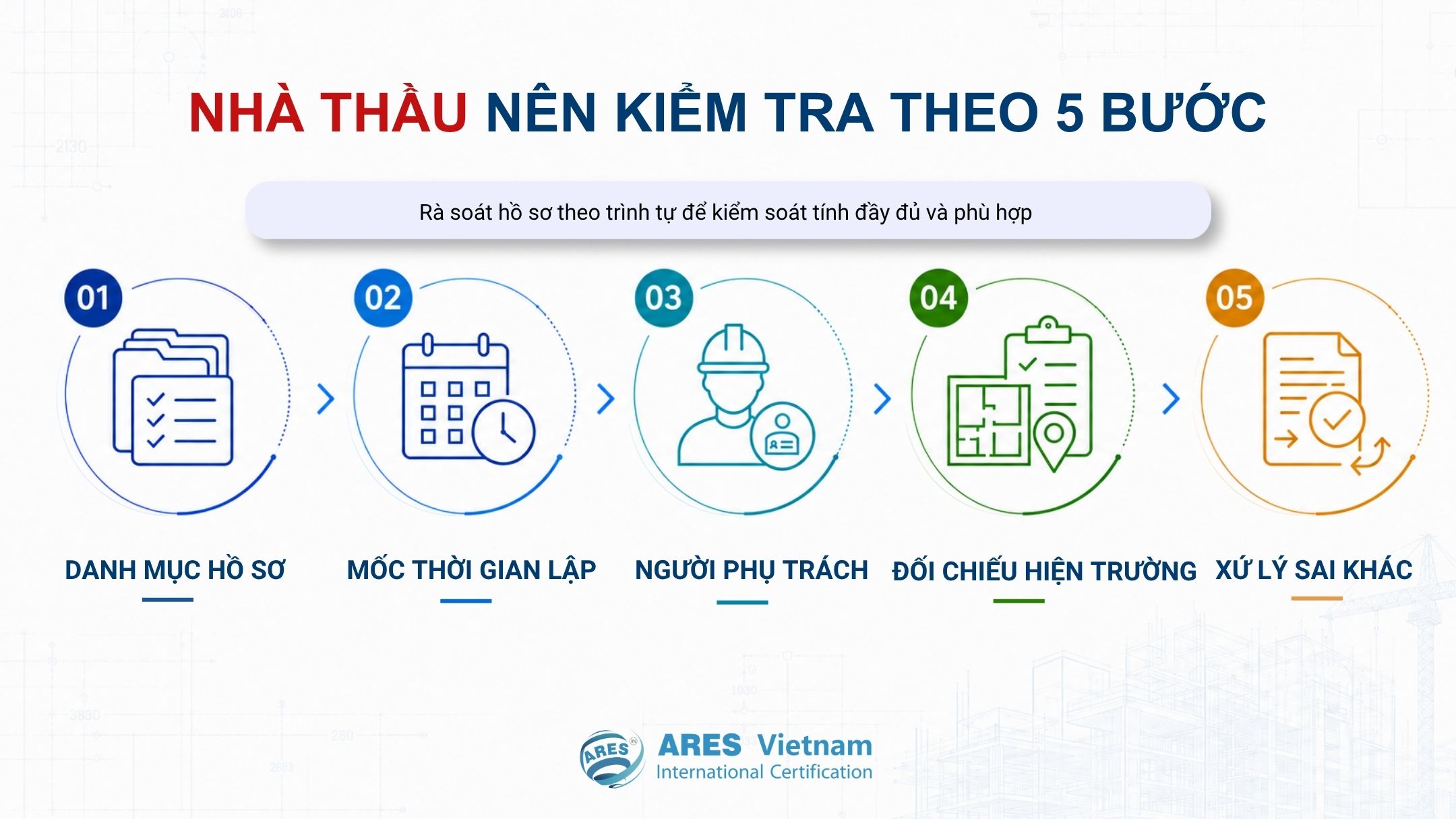
Contractors should follow five review steps: Document List → Preparation Timeline → Person in Charge → Site Cross-Check → Discrepancy Resolution. Repeating these steps at each stage helps contractors identify missing documents before moving to the next construction phase.
How Can ISO 9001 Help Contractors Control Construction Quality?
ISO 9001 does not replace contractors’ obligations to comply with construction laws, design requirements, applicable codes and standards, or the documentation requirements of each project. However, the standard can help contractors establish a consistent management approach across their offices, construction sites, suppliers, and subcontractors.
Accordingly, companies can standardize the following areas:
- Control of documented information, forms, document versions, and revision history.
- Assignment of responsibilities for preparing, reviewing, approving, retaining, and handing over records.
- Control of suppliers, subcontractors, and incoming materials.
- Control of construction processes and nonconforming outputs.
- Management of nonconformities and corrective actions.
- Management of changes involving materials, construction methods, documentation, or technical requirements.
- Monitoring of record traceability by work item, project component, or project.
For construction site safety management, companies may also consider ISO 45001 as a complementary management system. It can help them identify hazards, control risks, and clarify safety responsibilities throughout construction activities.
ARES Vietnam provides ISO 9001 and ISO 45001 audit and certification services for construction companies based on their registered scope of operations. By applying an appropriate management system, companies can standardize how they control processes and records while continuing to meet the specific requirements of each project.
Contact info:
- Hotline: 085.3858.553
- Email: Service@aresvietnam.vn

Frequently Asked Questions (FAQ)
The parties must prepare the dossier in Vietnamese. The project owner retains one complete set, while other parties retain the records related to their own scope of work. The project owner must keep the records in original form and as electronic copies. If no original exists, an official copy or legally valid copy may replace it.
| Frequently Asked Question | Short Answer |
| Who takes responsibility for preparing the construction completion dossier? | The project owner organizes the preparation of the construction completion dossier and takes responsibility for its accuracy and integrity. Contractors take responsibility for the dossier components that they prepare. |
| Do contractors need to prepare construction site logs and as-built drawings? | Yes. Construction contractors must prepare construction site logs and as-built drawings in accordance with Appendix II of Decree No. 207/2026/ND-CP. |
| How should the parties prepare and retain the construction completion dossier? | The parties must prepare the dossier in Vietnamese. The project owner retains one complete set, while other parties retain the records related to their own scope of work. The project owner must keep the records in original form and as electronic copies. If no original exists, an official copy or legally valid copy may replace it. |
| Is ISO 9001 mandatory for construction contractors? | No. Decree No. 207/2026/ND-CP does not establish ISO 9001 as a general mandatory requirement. Contractors may adopt the standard to standardize their management systems or meet specific tender, customer, or project requirements. |
Related news

Circular 49/2026/TT-BCT Takes Effect Soon: Which Environmental Records Should Factories Review?
Read more


ARES Vietnam Conducts the Second ISO 9001:2015 Surveillance Audit at KAISER 1 & KAISER 2 (Vietnam)
Read more

National Single Window and ASEAN Single Window: What Documents Should Import–Export Businesses Prepare?
Read more

ARES Vietnam Awards ISO 9001:2015 Certification to Simona Leather Company Limited
Read more

ARES Vietnam Conducts ISO 9001:2015 Surveillance Audit at Simona Leather Company Limited
Read more