Rice Export and Import Business Under Decree 365/2026/ND-CP: What Should Enterprises Control?
Updated: October 6, 2026
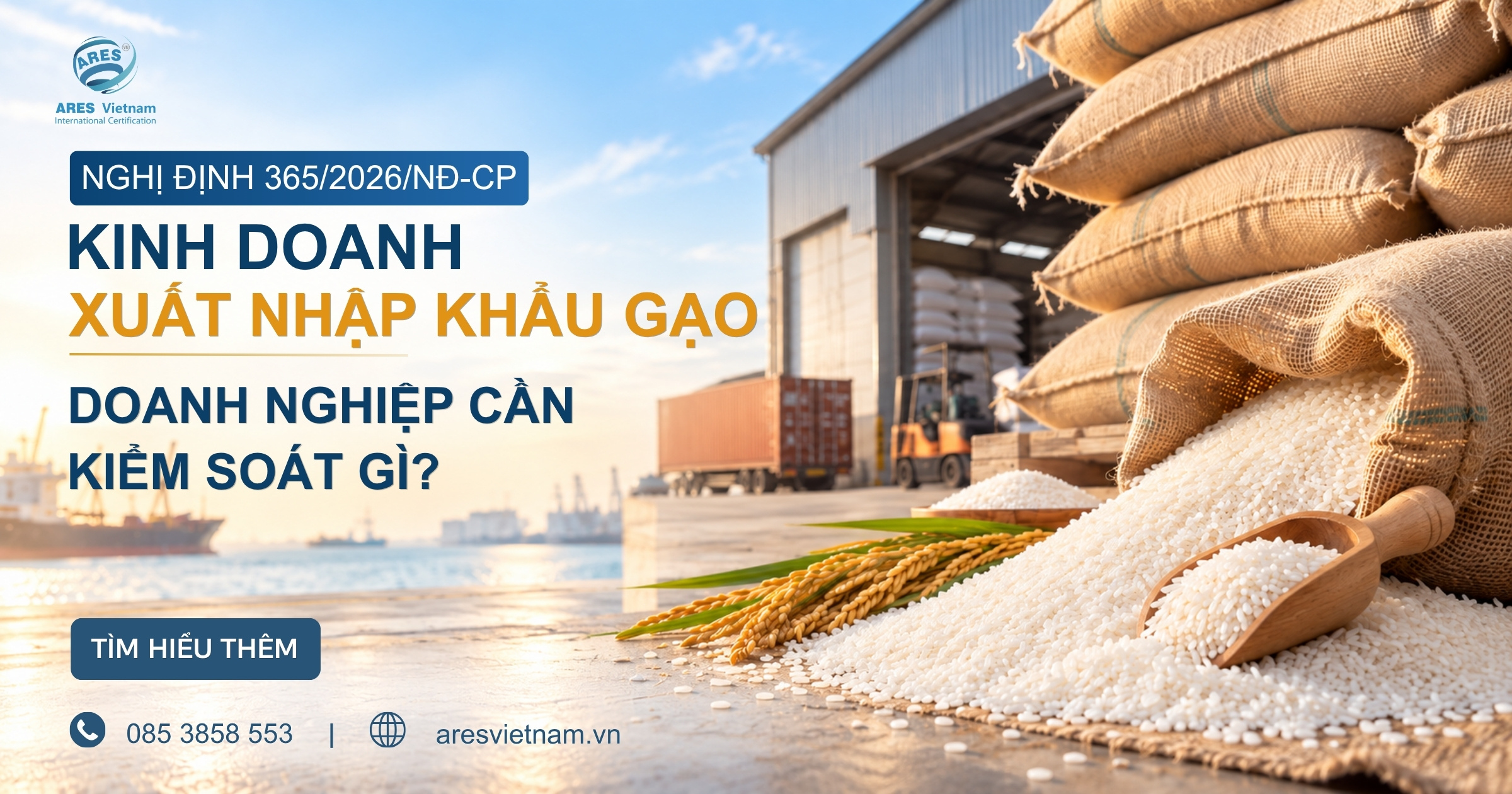
On September 23, 2026, the Vietnamese Government issued Decree 365/2026/ND-CP on rice export and import business, effective from October 1, 2026.
Enterprises should first define the scope of their operations. Based on this scope, they can review business conditions, shipment quality, warehouses and reserve requirements, traceability, import plans, and reporting obligations. Specific requirements vary depending on export activities, import activities, and the rice products involved.
Which Activities Are Covered by Decree 365/2026/ND-CP?
Decree 365/2026/ND-CP regulates the export and import business of paddy and various types of rice, collectively referred to as rice. Therefore, enterprises should determine whether they conduct export activities, import activities, or both before reviewing the corresponding obligations.
| Activity/
Product Group |
Key Points to Determine |
| Rice exports subject to business conditions |
Applicable conditions, Certificate requirements, and ongoing obligations
|
| Export of organic rice, parboiled rice, and micronutrient-fortified rice |
Applicable exemptions and remaining responsibilities
|
| Rice imports | Import plans and reporting obligations |
| Both rice exports and imports |
Separate obligations applicable to each activity
|
For traders exporting organic rice, parboiled rice, or micronutrient-fortified rice, specific exemptions apply.
Exemptions include: business conditions and the Certificate under Clause 4, Article 3; circulation reserve requirements under Article 12; and reporting responsibilities under Article 25.
Requirements that remain applicable: traders must comply with processes, standards, and technical regulations on paddy and rice production, processing, and storage issued by competent authorities under Clause 2, Article 17.
The following activities fall outside the regulatory scope of the Decree: temporary import for re-export, temporary export for re-import, border-gate transfer, transit, rice processing for foreign parties, and non-commercial exports such as aid, donations, or gifts. These activities remain subject to other relevant laws and regulations.
What Should Rice Export and Import Enterprises Control?
After determining the applicable scope, enterprises should compare each legal requirement with their actual operations and records. The internal control points below serve as practical references and should be adjusted according to the product, target market, and business scope.
1. Business Conditions, Certificates, and Facilities
For traders engaged in rice export business within the regulated scope, Article 4 requires at least one dedicated warehouse for paddy and rice storage and one rice milling facilitythat meets applicable food safety requirements, standards, and technical regulations.
Applicable traders must obtain a Certificate of Eligibility for Rice Export Business and continuously maintain the required conditions throughout their operations. Key items for review include:
- Information on declared warehouses and rice milling facilities;
- Documents proving ownership or legal right of use. For leased warehouses or milling facilities, a written lease agreement is required, and the lease term must cover the validity period of the Certificate;
- Continuous maintenance of business conditions throughout operations.
If the declared business conditions cease to be met or information relating to a warehouse or milling facility changes, the trader must immediately submit a written report to the Ministry of Industry and Trade and the provincial-level People’s Committee where the warehouse or milling facility is located, in accordance with Point a, Clause 1, Article 25. Where information stated on the Certificate changes, the enterprise must follow the amendment and supplementation procedures under Article 7.
Recommended records for review: Certificate of Eligibility for Rice Export Business; ownership documents or lease agreements; warehouse and milling facility records; and records relating to any subsequent changes.
2. Rice Quality, Packaging, and Market-Specific Labelling
Article 17 establishes the key requirements for exported rice, including compliance with applicable standards, technical regulations, and requirements of the importing market.
Before shipment, enterprises should verify:
- Applicable legal requirements, standards, and technical regulations;
- Requirements of the importing country;
- Specific importer requirements and contractual provisions;
- Agreed rice type, grade, and quality specifications;
- Packaging specifications, packing method, and weight;
- Labelling information and shipment identification;
- Inspection or testing results where required.
When an importer specifies additional requirements, the enterprise should clearly define their scope and compare them with the mandatory requirements that continue to apply.
For a shipment that fails to meet defined requirements, the enterprise should identify and segregate the affected products, determine the nonconformity, and complete appropriate handling before delivery.
Recommended records for review: purchase order requirements, contracts, product specifications, applicable inspection or testing results, approved label samples, and pre-shipment inspection records.
3. Storage Conditions, Inventory, and Circulation Reserves
During operations, enterprises should control storage conditions, inventory data, and circulation reserve levels within the applicable scope.
For storage activities, enterprises can review hygiene conditions, pest control, shipment status, storage locations, and storage periods. Specific criteria should reflect the type of rice, warehouse conditions, and applicable requirements.
For inventory and reserve management, enterprises should review:
- Recorded quantities of goods received, dispatched, and remaining in stock;
- Actual physical inventory;
- Any differences between recorded and actual quantities;
- Export data from the previous six months;
- The required circulation reserve level.
Under Article 12, rice exporters within the applicable scope must continuously maintain a minimum circulation reserve equivalent to 5% of the quantity of rice exported during the previous six months.
This reserve requirement falls outside the obligations applicable to exporters of organic rice, parboiled rice, and micronutrient-fortified rice specified in Clause 4, Article 3.
Recommended records for review: inventory ledgers, physical inventory records, warehouse inspection logs, and export data used to calculate the required circulation reserve.
4. Traceability and Shipment Data Linkage
Article 17 establishes traceability requirements for exported rice. Enterprises may select their own software, coding system, or traceability model as long as the required information can be effectively traced.
From an internal management perspective, the enterprise should be able to identify where the rice originated and where the shipment was delivered. At the same time, relevant data should remain linked throughout the following process:
Receipt → Production/Processing → Storage → Packaging → Delivery
When a shipment is split, mixed, or repacked, the resulting records should retain a clear connection with the original lot. Therefore, a lot code provides value only when it can lead back to the relevant supporting records.
Enterprises can test their traceability system by selecting a sample lot and verifying:
- Source of goods or supplier;
- Receipt date;
- Production or processing records;
- Storage location and period;
- Packaging records;
- Warehouse dispatch documents and delivery information.
5. Import Plans, Records, and Reporting Requirements
Exporters and importers have different obligations. Enterprises performing both activities should manage reporting periods, forms, and consolidated data separately to maintain clear control over each group of requirements.
| Obligation | Key Requirements |
| Monthly export report | Submitted periodically on the 5th day of each month using Forms No. 06 and 07. The report covers the signing and performance of export contracts and actual paddy and rice inventories by product type. |
| Quarterly and annual export reports | Form No. 08 is used to summarize quarterly and annual export business activities. Ad hoc reports must also be submitted when requested. |
| Notification of the import plan | For the initial notification, Form No. 09 is submitted to the Ministry of Industry and Trade. When the plan changes, Form No. 09 must be resubmitted as a supplementary notification together with the rice import business report under Form No. 10. Periodic and ad hoc reporting obligations continue to apply after the initial notification. |
| Import reports | Form No. 10 is used for quarterly and annual reporting on rice import business activities, together with ad hoc reports when requested. |
For import planning, enterprises should retain the data used to prepare the notification, actual import figures, and evidence of submission for future verification.
Transitional provision: Clause 2, Article 26 requires traders already engaged in rice import business to register their import plans with the Ministry of Industry and Trade within 45 days from October 1, 2026.
Each group of obligations should have a designated responsible person, a defined data collection point, and supporting records for verification before submission.
How Can ISO 9001 and ISO 22000 Support Rice Enterprises?
After identifying the applicable legal obligations, enterprises can use management systems to standardize controls over quality, food safety, and records. ISO 9001 and ISO 22000 have different areas of focus. Therefore, the appropriate standard should be selected based on the enterprise’s activities, management objectives, and customer requirements.
| Control Area | ISO 9001 | ISO 22000 |
| Identification and traceability | Supports product identification and traceability control where applicable |
Maintains a traceability system linking raw materials, production processes, and distribution
|
| Records | Controls documented information and retains evidence of process and product conformity |
Controls documented information and retains evidence related to hazard control, food safety, and traceability
|
The decision to apply either one or both standards depends on the enterprise’s management needs and certification objectives.
ISO 9001 or ISO 22000 certification serves as a management system framework. Legal requirements under Decree 365/2026/ND-CP, including the Certificate of Eligibility for Rice Export Business, circulation reserve requirements, import planning, and reporting obligations, continue to apply to enterprises within the corresponding scope.
Frequently Asked Questions (FAQ)
| Question | Answer |
| Does a Certificate issued before October 1, 2026 need to be reissued? | A Certificate issued under Decree 107/2018/ND-CP, as amended and supplemented by Decree 01/2025/ND-CP, remains valid until its expiry date under Clause 1, Article 26. Where reissuance, amendment, or supplementation is required, the procedures under Article 7 apply. |
| Does an enterprise that only imports rice need a Certificate of Eligibility for Rice Export Business? | The Certificate of Eligibility for Rice Export Business applies to rice export activities. An enterprise engaged only in rice imports should instead determine its corresponding obligations relating to import planning, reporting, and other requirements applicable to import activities. |
| Can a trader without a Certificate accept entrusted rice export activities? | Under Clause 3, Article 3, a trader may accept entrusted rice export activities only after obtaining the required Certificate. Therefore, the trader should first ensure that the applicable business conditions have been met and the Certificate has been issued. |
| Can ISO 22000 certification replace the business conditions for rice exports? | ISO 22000 is a food safety management system standard. The Certificate of Eligibility for Rice Export Business is a separate legal requirement. Enterprises within the regulated scope must continue to meet the applicable business conditions and corresponding obligations under Decree 365/2026/ND-CP. |
ISO Audit and Certification for Rice Enterprises at ARES Vietnam
ARES Vietnam provides ISO 9001 and ISO 22000 audit and certification services for enterprises engaged in rice export and import business.
Enterprises seeking certification may contact ARES Vietnam and provide information about their production and business activities, operating locations, and standards of interest. Based on this information, ARES Vietnam can discuss the appropriate certification scope and audit plan.
- Hotline:085.3858.553
- Email:service@aresvietnam.vn
Related news

Emissions Data & CBAM: 5 Practical Questions from Factory Operations
Read more


Greenhouse Gas Inventory Challenges: What Data Should Businesses Prepare?
Read more

ARES Vietnam Conducts ISO 45001:2018 Surveillance Audit at A&J (VIETNAM) CO., LTD.
Read more
ARES Vietnam Verifies Greenhouse Gas Report under ISO 14064-1:2018 at GE LAN Vietnam
Read more
ISO 9001:2026 Has Been Officially Published
Read more