Emissions Data & CBAM: 5 Practical Questions from Factory Operations

Factories may have production and energy consumption data, yet calculating emissions accurately requires clearly defined boundaries, production processes, emission factors, and reporting periods.
Through five practical scenarios, this article helps businesses identify key areas for review, avoid calculation errors, and prepare supporting documentation for verification. The discussion of the EU Carbon Border Adjustment Mechanism (CBAM) follows the requirements of its definitive phase beginning in 2026. The section on refrigerants separately addresses the assessment of direct emission reductions.
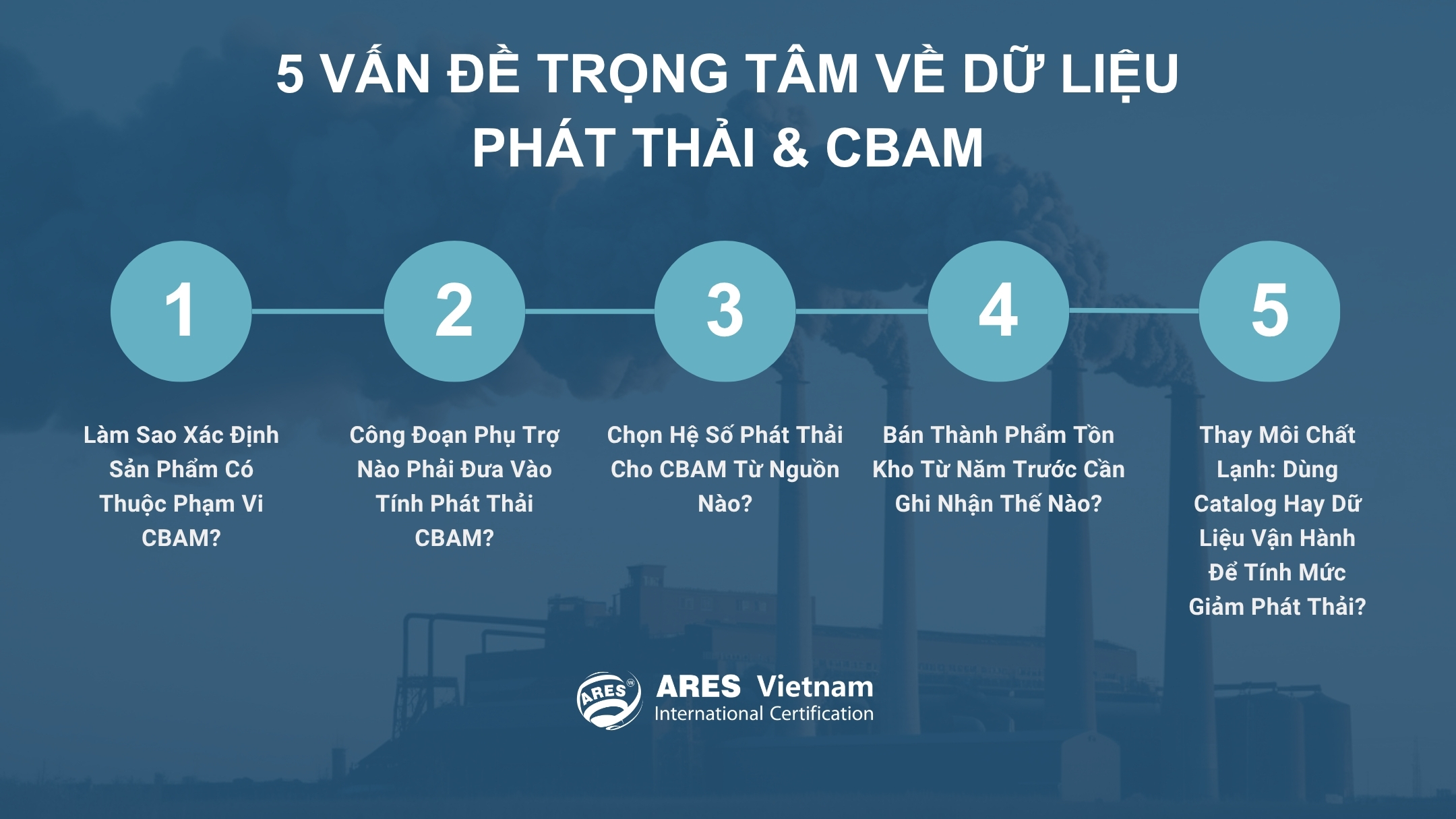
How Can Businesses Determine Whether a Product Falls Within the Scope of CBAM?
CBAM applicability must be assessed based on the specific goods and their corresponding Combined Nomenclature (CN) codes, rather than solely on the manufacturing industry. Businesses should follow three steps:
- Identify the goods and CN codes: Prepare product descriptions, composition details, technical specifications, and processing information. Coordinate with the importer to determine the CN codes used when importing the goods into the EU.
- Check the CBAM product list: Review both the CN codes and goods descriptions in Annex I of Regulation (EU) 2023/956, including amendments applicable at the time of importation.
- Review applicable conditions and exemptions: For goods listed under CBAM, assess the relevant conditions and exemptions before determining specific obligations.
For example, rutile, ilmenite, and processed products derived from titanium ores require separate assessments for each product. A single conclusion should not be applied to the entire product group.
Factories provide production and emissions data, while the responsible party in the EU handles CBAM declarations and the purchase and surrender of CBAM certificates. Both parties should agree on the product list and data requirements from the outset.
Which Auxiliary Processes Must Be Included in CBAM Emissions Calculations?
The inclusion of auxiliary processes depends on the requirements applicable to each product category. Cooling systems, compressed air, wastewater treatment, and packaging must be assessed based on the system boundaries, production routes, and emission types specified for the relevant goods.
Under Section 3.1 of Annex I to Commission Implementing Regulation (EU) 2025/2547, the procurement and maintenance of infrastructure and equipment are excluded from the system boundaries. These activities must be distinguished from the operation of equipment supporting production.
Factories can conduct their assessment using the following checklist:
| Review Area | Key Question |
| Product category and production route | How do the applicable regulations define the boundaries of this production process? |
| Role of the process | Which stage of production does the auxiliary activity support? |
| Shared resources | Are measurements or allocation methods available for electricity, heat, and compressed air used by individual processes? |
| Emission types | Do emissions from this activity fall within the emission categories required for the goods concerned? |
| Basis for determination | Which regulatory provisions and records support the inclusion or exclusion of each emission source? |
The role of an auxiliary process provides information for the assessment. However, the final determination must comply with the system boundary and emissions requirements applicable to the product category, rather than relying solely on the operational importance of the activity.
The assessment results should be documented in a process flow diagram with clearly marked system boundaries, supported by the rationale for including or excluding each emission source. For shared systems, the allocation methodology should also be documented to prevent omissions or double counting.
Which Sources Should Be Used to Select Emission Factors for CBAM?
Emission factors must align with the CBAM calculation methodology and satisfy the applicable data source selection requirements. The credibility of a publishing organization alone does not establish whether a factor is appropriate for CBAM calculations.
First, businesses must distinguish between emission factors, which are combined with activity data to calculate greenhouse gas emissions, and default emission values for goods, which are used to determine embedded emissions under CBAM. These values serve different purposes and are subject to different conditions of use.
For standard values used as CO₂ calculation factors, Section B.5.2 of Annex II to Commission Implementing Regulation (EU) 2025/2547 distinguishes between:
- Type II: Includes factors used in the latest national greenhouse gas inventory report submitted to the UNFCCC and other sources that meet the specified conditions.
- Type I: Includes factors from the latest IPCC guidelines. These may only be used when no Type II values are available for the same parameter and material or fuel.
This selection rule is specific to the relevant calculation factors. Electricity emission factors are subject to separate CBAM provisions and must be assessed accordingly.
Before selecting an emission factor, businesses should verify:
- Source and version: Retain the original reference document and identify its publication year or latest update.
- Applicability: Confirm that the factor matches the actual fuel, material, and relevant characteristics.
- Units: Ensure consistency with activity data and maintain supporting conversion calculations.
- Scope of use: Confirm that the factor applies to the relevant emission source and calculation methodology.
- Selection conditions: Verify compliance with regulatory requirements, including the conditions governing Type I or Type II values where applicable.
Businesses should maintain an emission factor register containing factor name – value – unit – source – version – applicability, together with notes on the conditions for use.
How Should Semi-Finished Products Carried Over from the Previous Year Be Accounted For?
Businesses must distinguish between production output during the reporting period, actual material inputs, and inventory. They must also determine the appropriate emissions data reporting period permitted under CBAM.
Activity Level refers to the quantity of goods produced within the boundaries of a production process during the reporting period, expressed in the applicable functional unit. Therefore, production output should be recorded separately from sales or export volumes.
For factories involving multiple production stages, data should be tracked according to the processes defined within the calculation boundaries.
| Data Category | Information to Record | Supporting Records |
| Production output during the reporting period | Product type, quantity produced, production process, and reporting period | Production reports, warehouse receipt records, and measurement or weighing records |
| Raw materials and semi-finished products actually consumed | Quantity used in production, batch identification, timing, and receiving process | Material issue slips, warehouse dispatch records, and inter-process transfer records |
| Opening and closing inventory | Quantities of each type of raw material, semi-finished product, and finished product | Inventory ledgers and physical stocktaking reports |
| Semi-finished products carried over from the previous year whose embedded emissions must be accounted for | Production year, production installation, quantity used, applicable data period, and emission values | Batch records; corresponding verification reports when actual values are used; sources and justification when default values are applied |
Illustrative example: A and B are two separate production processes defined within the CBAM boundaries. Semi-finished products manufactured in Process A in 2026, stored, and subsequently used in Process B in 2027 are recorded as inputs to Process B. They are not counted again as Process A output in 2027. The output of Process B is determined separately.
Which year’s emissions data should be used? For semi-finished products classified as precursors whose embedded emissions must be accounted for, Article 13 of Commission Implementing Regulation (EU) 2025/2547 establishes the default reporting period based on the production year of the complex goods. In the example above, the default reporting period is 2027. Using the 2026 reporting period requires sufficient evidence of the production date to be provided to the verifier, together with emissions data that meet the applicable requirements. Reporting periods before 2026 are not permitted.
For externally purchased precursors: When actual values are used, verified data for the applicable period are required. When default values are used, they must be selected in accordance with CBAM requirements. Supplier-provided information must also be assessed against the applicable data eligibility requirements.
Refrigerant Replacement: Should Emission Reductions Be Calculated Using Catalog Data or Operational Data?
This section focuses exclusively on direct emissions from refrigerant leakage and is separate from the scope of CBAM emissions calculations. When assessing emission reductions across an entire refrigeration system, businesses must also account for the effects of changes in energy consumption.
Actual emission reductions should be calculated using operational data, including refrigerant top-up quantities, recovered quantities, and inventory changes, in accordance with an appropriate calculation methodology. Catalog data can support preliminary estimates, while actual emission quantities must be established using suitable operational evidence. Where sufficient data are unavailable, the results should be identified as estimated emission reductions, accompanied by the relevant calculation assumptions.
Before-and-after comparisons must consider both the quantity of refrigerant emitted and its corresponding Global Warming Potential (GWP). The assessment should apply consistent boundaries, comparison periods, and a consistent basis for selecting GWP values. Where operating conditions have changed significantly, their effects must be assessed before attributing the difference in emissions to refrigerant replacement. A lower GWP alone is insufficient to establish actual emission reductions.
Supporting documentation should include:
- Refrigerant type and equipment:Refrigerants used before and after replacement, designed full-charge quantities, and the applicable GWP references.
- Refrigerant charging: Quantities, dates, and reasons for charging, with initial charging distinguished from subsequent top-ups.
- Refrigerant recovery: Quantities recovered during maintenance, equipment replacement, or decommissioning.
- Inventory and transfers: Opening inventory, receipts, issues, closing inventory, and quantities transferred off-site for treatment.
- Operation and maintenance logs: Leakage incidents, repairs, equipment modifications, and refrigerant conversion dates.
Purchased or charged refrigerant quantities should be distinguished from actual emissions. Refrigerants remaining in storage, contained within equipment, or recovered must be accounted for using the selected quantification methodology.
Conclusion
Each reporting purpose has its own requirements for assessment boundaries, methodologies, and supporting data. Businesses should clearly identify the applicable requirements before selecting verification services.
For organization-level greenhouse gas inventory reports prepared in accordance with ISO 14064-1:2018, businesses can contact ARES Vietnam to discuss the scope and verification plan under ISO 14064-3:2019. This verification serves a different purpose from the verification of embedded emissions in goods under CBAM and does not automatically replace CBAM-specific verification requirements.
Related news
Greenhouse Gas Inventory Challenges: What Data Should Businesses Prepare?
Read more


ARES Vietnam Conducts ISO 45001:2018 Surveillance Audit at A&J (VIETNAM) CO., LTD.
Read more

Rice Export and Import Business Under Decree 365/2026/ND-CP: What Should Enterprises Control?
Read more

ARES Vietnam Verifies Greenhouse Gas Report under ISO 14064-1:2018 at GE LAN Vietnam
Read more
ISO 9001:2026 Has Been Officially Published
Read more