Maintaining ISO Certification In Manufacturing: Benefits, Risks, And How To Implement It Effectively
In manufacturing businesses, achieving ISO certification is an important milestone in standardizing operations and establishing a structured management foundation. However, the core value of ISO does not lie in the moment the certificate is granted. Instead, it lies in how the system is maintained and operated in practice.
In reality, many companies gradually loosen control after certification. As a result, the system becomes formalistic and disconnected from production activities. At that point, ISO no longer serves its control function. On the contrary, it may become a burden in terms of procedures and documentation.
Therefore, the key issue is no longer obtaining ISO certification, but how to maintain the ISO system to create real value. This article clarifies the benefits, risks, and effective implementation from an operational perspective.
Why Do Manufacturing Businesses Need To Maintain ISO Certification?
In a production environment, where every deviation can create chain impacts, maintaining an ISO-based management system acts as an operational control mechanism. As a result, it helps ensure stability and consistency across the entire process.
Core benefits of effective ISO maintenance include:
• Stabilized production processes: Reduced dependency on individuals and minimized inconsistencies between shifts and departments
• End-to-end quality control: Early detection of issues, prevention of error escalation, and reduction in defect rates
• Better audit readiness: Continuous preparedness for requirements from customers and certification bodies
• Foundation for system expansion: Easier integration of advanced standards or scaling of operations
Manufacturing companies do not gain a competitive advantage simply by holding a certificate. Instead, the advantage comes from maintaining operational discipline over the long term—especially as the business grows and market requirements become stricter.
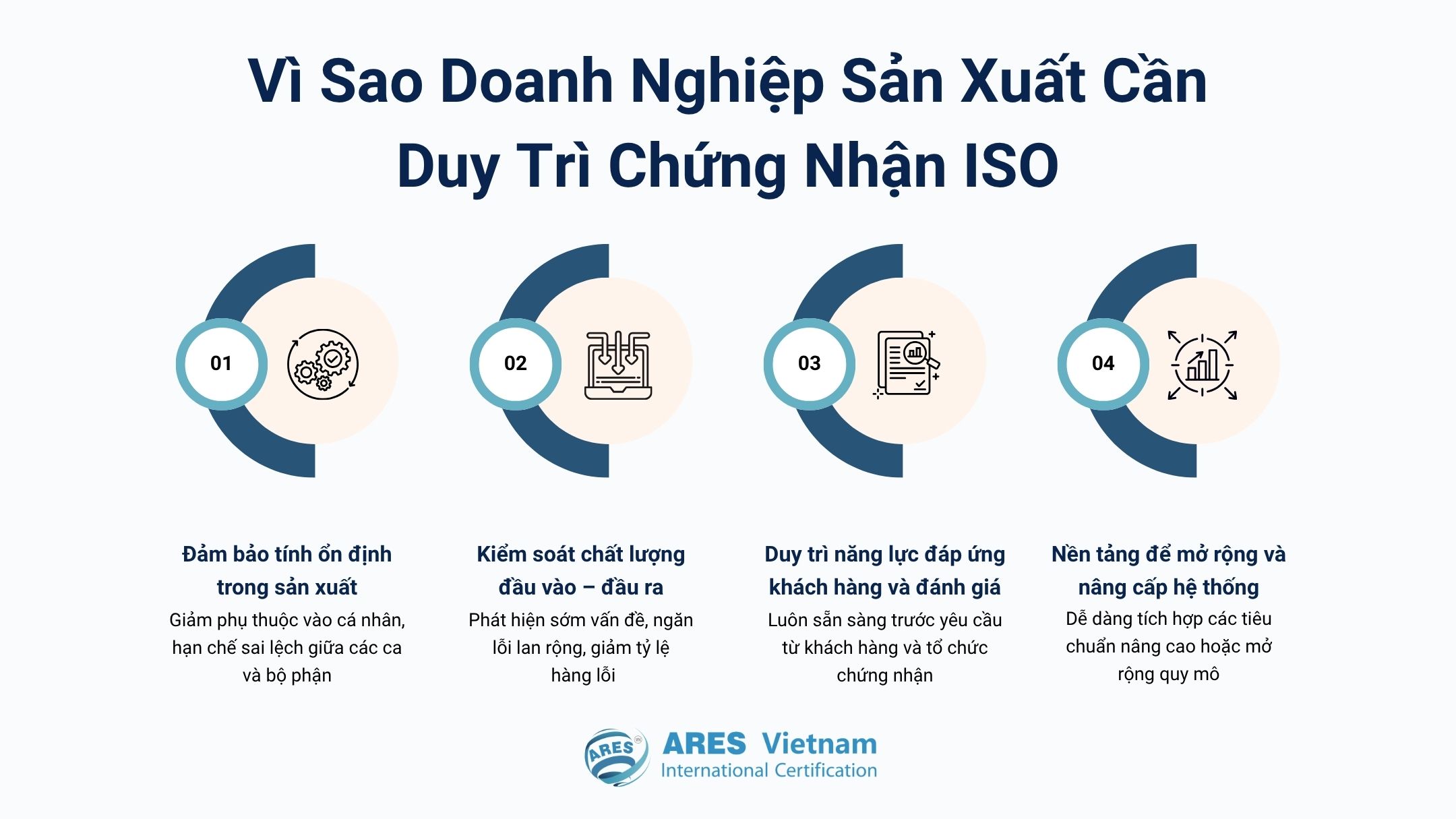
The practical benefits for manufacturing companies of maintaining ISO certification
Risks Of Not Maintaining ISO In Manufacturing
Failing to maintain ISO is not just about certification. It is a sign that the operational system is gradually losing control—often silently, until the consequences become visible.
1. The ISO system becomes formalistic and loses value
When documents no longer reflect reality and employees rely on personal experience, the system loses its control function.
- Processes are no longer followed consistently
- Documents become outdated and difficult to apply
- Documentation increases without improving performance
At this stage, ISO turns into an administrative burden rather than a management tool.
2. Failure in surveillance or recertification audits
Audits do not only review documents. They also compare them directly with actual operations.
- Systemic nonconformities arise
- High pressure to implement corrective actions within a short time
- Risk of suspension or loss of certification validity
3. Increased production errors and hidden costs
When control mechanisms are ineffective, small deviations are repeated and accumulate over time.
- Material losses increase
- Costs for rework and reproduction rise
- Root causes of losses become difficult to identify
These losses are often overlooked, yet they directly impact financial performance.
4. Loss of credibility with customers and partners
In a B2B environment, credibility is built on actual performance.
- Failure to meet customer audit requirements
- Removal from preferred supplier lists
- Reduced opportunities to participate in new projects or markets
In many cases, companies do not face issues when obtaining certification. Instead, risks arise when they fail to maintain the system afterward.
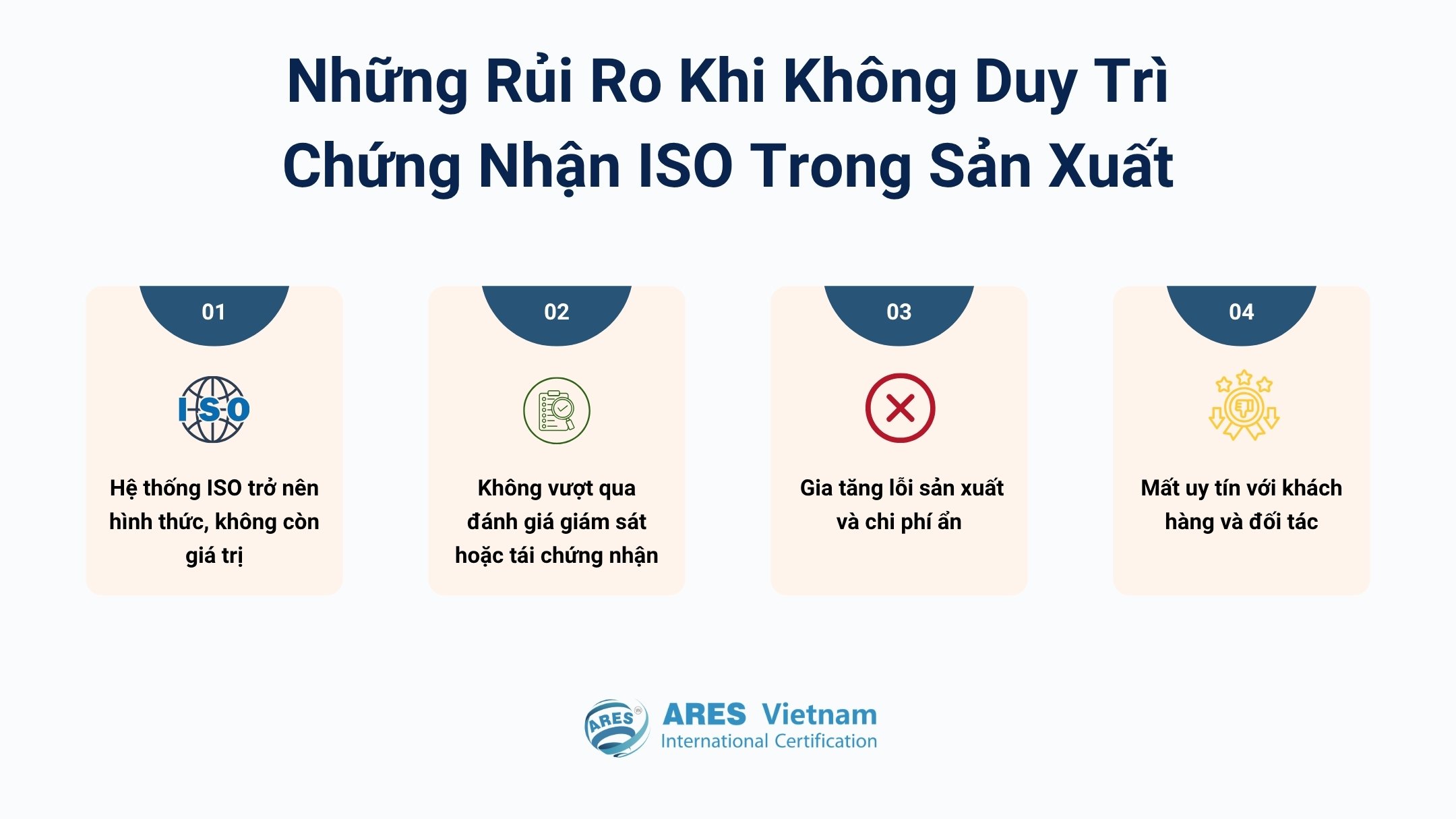
The risks of failing to maintain ISO compliance in manufacturing
What Should Businesses Do to Maintain ISO Effectively?
Maintaining ISO is not complex. However, it requires the right approach. The system must be aligned with actual operations, rather than existing separately.
1. Turn ISO into an operational tool
- First, link processes with the KPIs of each department.
- Then, apply them directly to daily production activities.
- At the same time, measure performance instead of only checking compliance.
As a result, ISO becomes a management foundation rather than an administrative procedure.
2. Maintain regular internal audits
- Proactively identify issues before external audits.
- Focus on operational weaknesses.
- Also, track corrective actions until completion.
This is a critical control layer. However, it is often overlooked.
3. Update documentation based on actual production
- Adjust documents when processes change.
- Avoid building overly theoretical documentation.
- Ensure consistency between requirements and execution.
In practice, a system is only effective when documents are properly implemented.
4. Proactively prepare for audits
- Maintain continuous readiness.
- Review the system periodically.
- Clearly assign responsibilities.
In addition, support from a professional organization helps identify gaps accurately and optimize maintenance effectiveness.
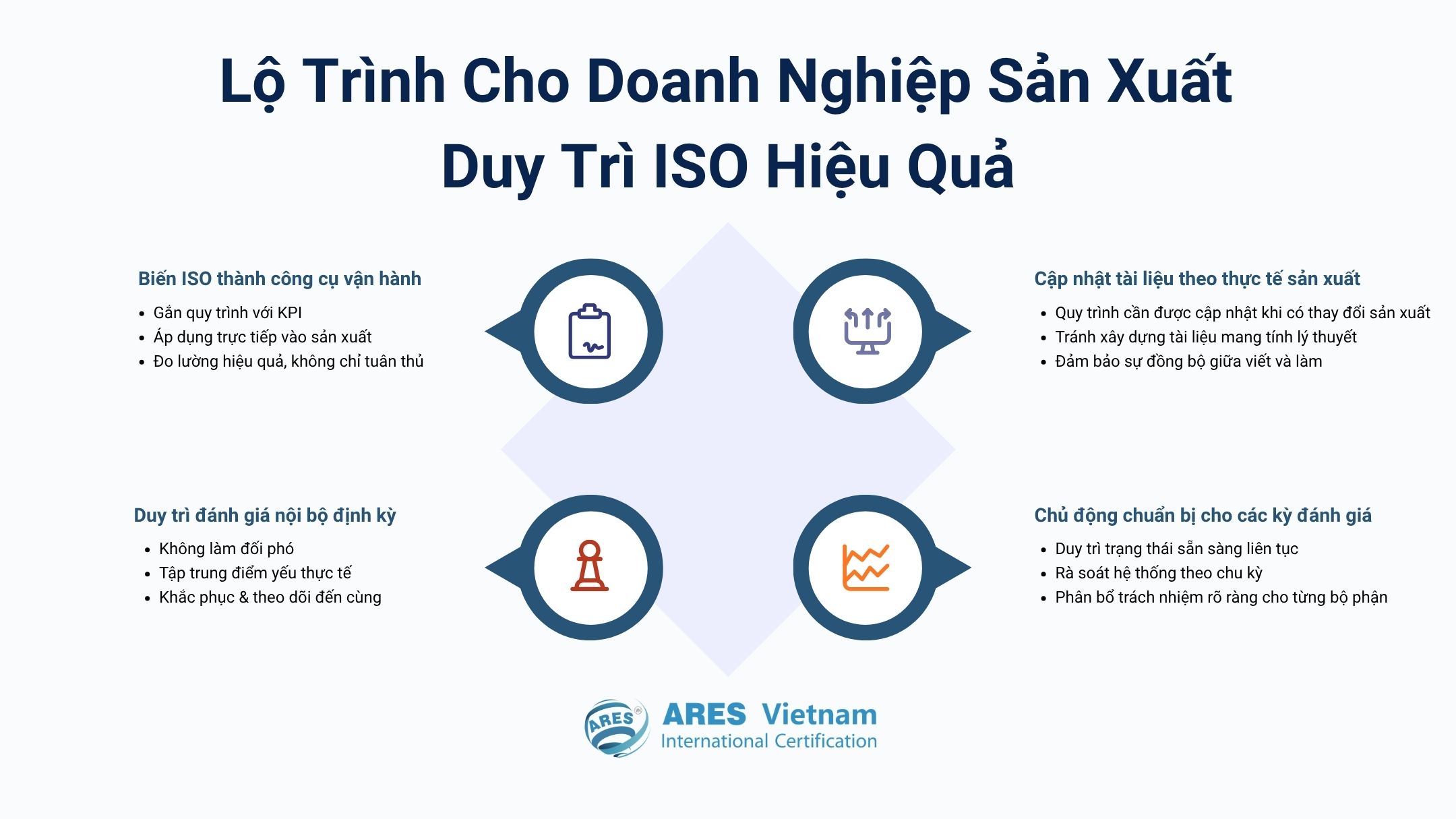
A roadmap for manufacturing companies to maintain ISO certification effectively
When Should Businesses Improve Or Upgrade the ISO System?
ISO is not a fixed system. As the business evolves, the system must also be adjusted accordingly.
Key moments to consider include:
- Expansion in scale or production output
- Increasing internal defect rates
- Higher requirements from customers
- A shift toward sustainable development models
Timely improvement ensures the system continues to create value, rather than becoming a constraint.
Maintaining ISO Certification To Protect Performance And Competitiveness
Maintaining ISO certification is not simply about keeping a certificate. More importantly, it helps manufacturing businesses protect performance, control risks, and strengthen long-term competitiveness.
When properly implemented, ISO becomes an investment in the system. It creates real value in daily production. In contrast, if it only exists in form, it will not deliver the expected results.
If your business is:
- Preparing for a surveillance audit, or
- Unsure whether the current system is operating effectively
Then a comprehensive internal assessment can help:
- Identify nonconformities accurately
- Evaluate risk levels before the audit
- Recommend improvements aligned with actual operations
Contact ARES Vietnam for consultation and to build an effective ISO maintenance roadmap.
Related news

Circular 49/2026/TT-BCT Takes Effect Soon: Which Environmental Records Should Factories Review?
Read more


ARES Vietnam Conducts the Second ISO 9001:2015 Surveillance Audit at KAISER 1 & KAISER 2 (Vietnam)
Read more

National Single Window and ASEAN Single Window: What Documents Should Import–Export Businesses Prepare?
Read more

ARES Vietnam Awards ISO 9001:2015 Certification to Simona Leather Company Limited
Read more

ARES Vietnam Conducts ISO 9001:2015 Surveillance Audit at Simona Leather Company Limited
Read more