Environmental Inspection 2026: What Documents Do Businesses Need To Prepare?
The year 2026 marks a clear shift in how environmental inspections are carried out. Inspections no longer stop at reviewing documents for formality purposes. Instead, they now focus on comprehensively assessing the actual level of compliance in daily operations.
In this context, preparing documents is no longer just about fulfilling administrative requirements. Businesses need to correctly identify key document groups while establishing a systematic method for organizing and maintaining records. This helps meet increasingly strict inspection requirements with a strong emphasis on cross-checking.
Environmental Inspection 2026: What Will Businesses Be Inspected On?
Current environmental inspections are implemented based on the 2020 Law on Environmental Protection, Decree No. 08/2022/ND-CP, and amended provisions under Decree No. 48/2025/ND-CP (effective from January 29, 2026). These regulations not only govern licensing conditions but also tighten supervision mechanisms and the withdrawal of environmental permits.
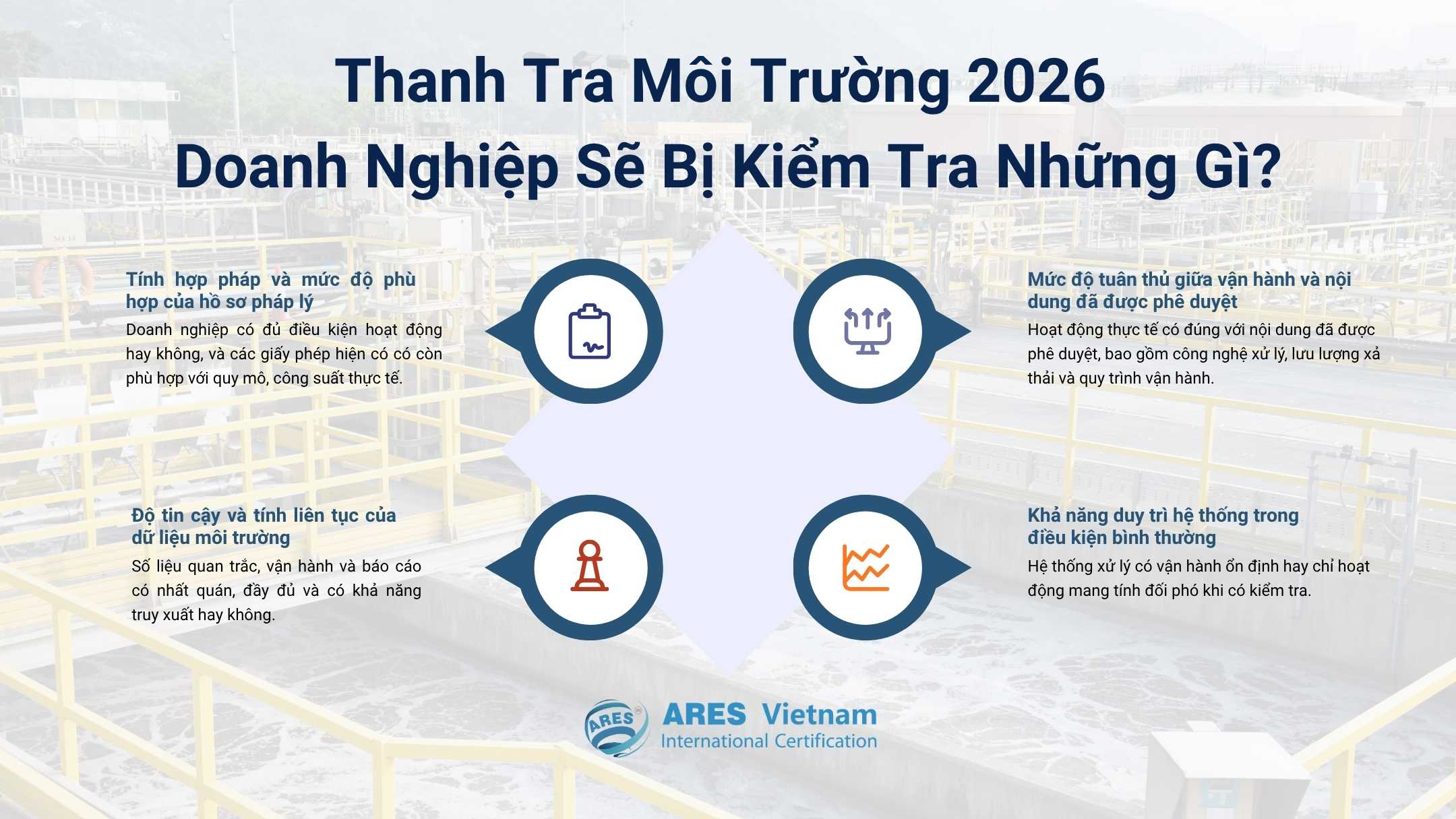
In practice, inspections usually focus on four main assessment areas:
▶️ Legality and suitability of legal documents: Whether the business meets operating conditions, and whether current permits remain suitable for its actual scale and production capacity.
▶️ Level of operational compliance: Whether actual operations match approved contents, including treatment technology, discharge volume, and operating procedures.
▶️ Reliability and continuity of environmental data: Whether monitoring, operational, and reporting data are consistent, complete, and traceable.
▶️ Ability to maintain systems under normal conditions: Whether treatment systems operate stably or only run temporarily when inspections occur.
Therefore, environmental inspections in 2026 do not assess each factor separately. Instead, authorities cross-check legal status, operations, and data to determine the true compliance level of a business.
4 Key assessment areas in the 2026 Environmental Inspection Process
Checklist of Documents Businesses Need To Prepare For Inspection
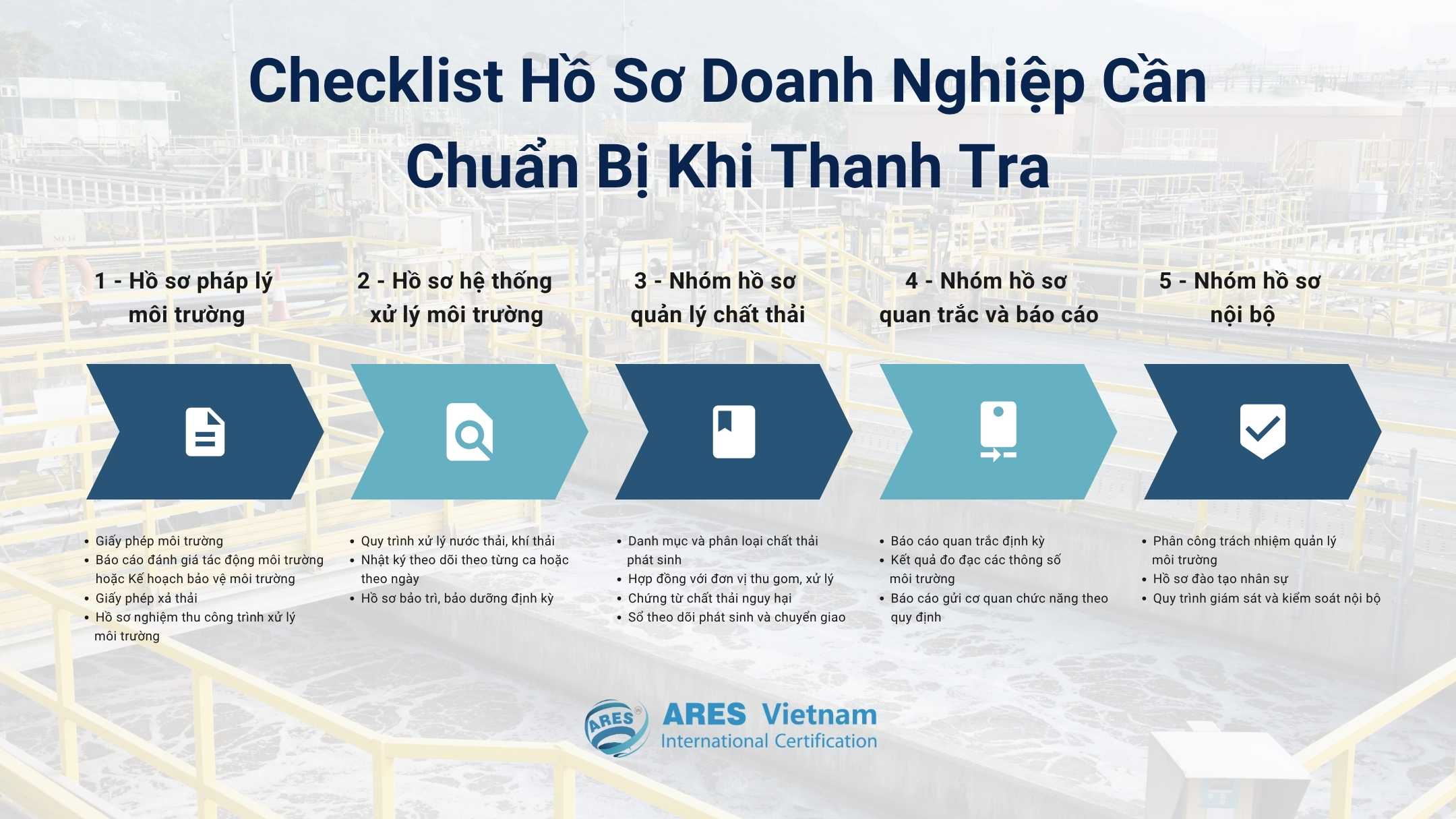
To meet inspection requirements, environmental records should be organized into functional groups corresponding to actual inspection contents.
1. Environmental legal documents (mandatory foundation)
- Environmental permit
- Environmental Impact Assessment (EIA) report or Environmental Protection Plan
- Discharge permit (if applicable)
- Acceptance records for environmental treatment facilities
▶️ These documents serve as the basis for determining operating eligibility and legal validity.
2. Treatment system operation records
- Wastewater and exhaust gas treatment procedures
- Shift/daily operation logs
- Periodic maintenance and servicing records
▶️ These records demonstrate actual operating conditions and system stability.
3. Waste management records
- Waste inventory and classification list
- Collection and treatment contracts
- Hazardous waste manifests
- Generation and transfer tracking logs
▶️ These records ensure waste streams are controlled from generation to final treatment.
4. Environmental monitoring and reporting records
- Periodic monitoring reports
- Environmental parameter measurement results
- Reports submitted to competent authorities as required
▶️ These serve as the basis for comparing actual operations with environmental technical standards.
5. Internal management records (often overlooked)
- Assignment of environmental management responsibilities
- Personnel training records
- Internal control and supervision procedures
▶️ These reflect organizational capability and the ability to maintain systems consistently.
Environmental records are not only for compliance purposes. They are also tools to prove the entire compliance process. Any missing documents or weak links between document groups may become risk points during inspections.
Checklist of documents businesses need to prepare for an inspection
Common Violations Businesses Are Penalized For During Environmental Inspections
According to Decree No. 45/2022/ND-CP, environmental violations are subject to penalties depending on their nature, severity, and scale.
1. Operating inconsistently with the environmental permit
- Changing capacity or technology without revising the permit
- Discharging beyond permitted limits or volume
▶️ Businesses may face significant penalties, along with additional measures such as suspension of operations or mandatory corrective actions.
2. Failure to conduct periodic environmental monitoring
- Missing required monitoring periods
- Using invalid monitoring results
▶️ Businesses may be administratively fined and required to conduct monitoring again.
3. Failure to prove operation of treatment systems
- No operation logs
- Missing maintenance records
- Systems installed but not actually operating
▶️ In many cases, this may be treated as untreated discharge, with serious penalties.
4. Violations in waste management (especially hazardous waste)
- No hazardous waste manifests
- Incomplete tracking of generation and transfer
- Transfer to unqualified service providers
▶️ Businesses may be fined and required to repeat handling procedures in accordance with regulations.
5. Inaccurate or inconsistent environmental data
- Reported figures do not match monitoring data
- No data available for inspection cross-checking
▶️ Businesses may be penalized and required to review and verify the entire environmental management system.
Under current regulations, administrative penalties in the environmental sector may range from tens of millions to billions of VND, depending on the violation, severity, discharge volume, and business scale. In serious cases, authorities may also suspend operations or reconsider permit validity.
In reality, most violations do not result from missing documents. Instead, they arise from inconsistencies between permits, operations, and data — the factor most strictly reviewed in inspections today.
What Should Businesses Do to Avoid Violations During Environmental Inspections?
Common violations show that risk does not lie in individual documents. Rather, it lies in how the business controls and operates its overall environmental system.
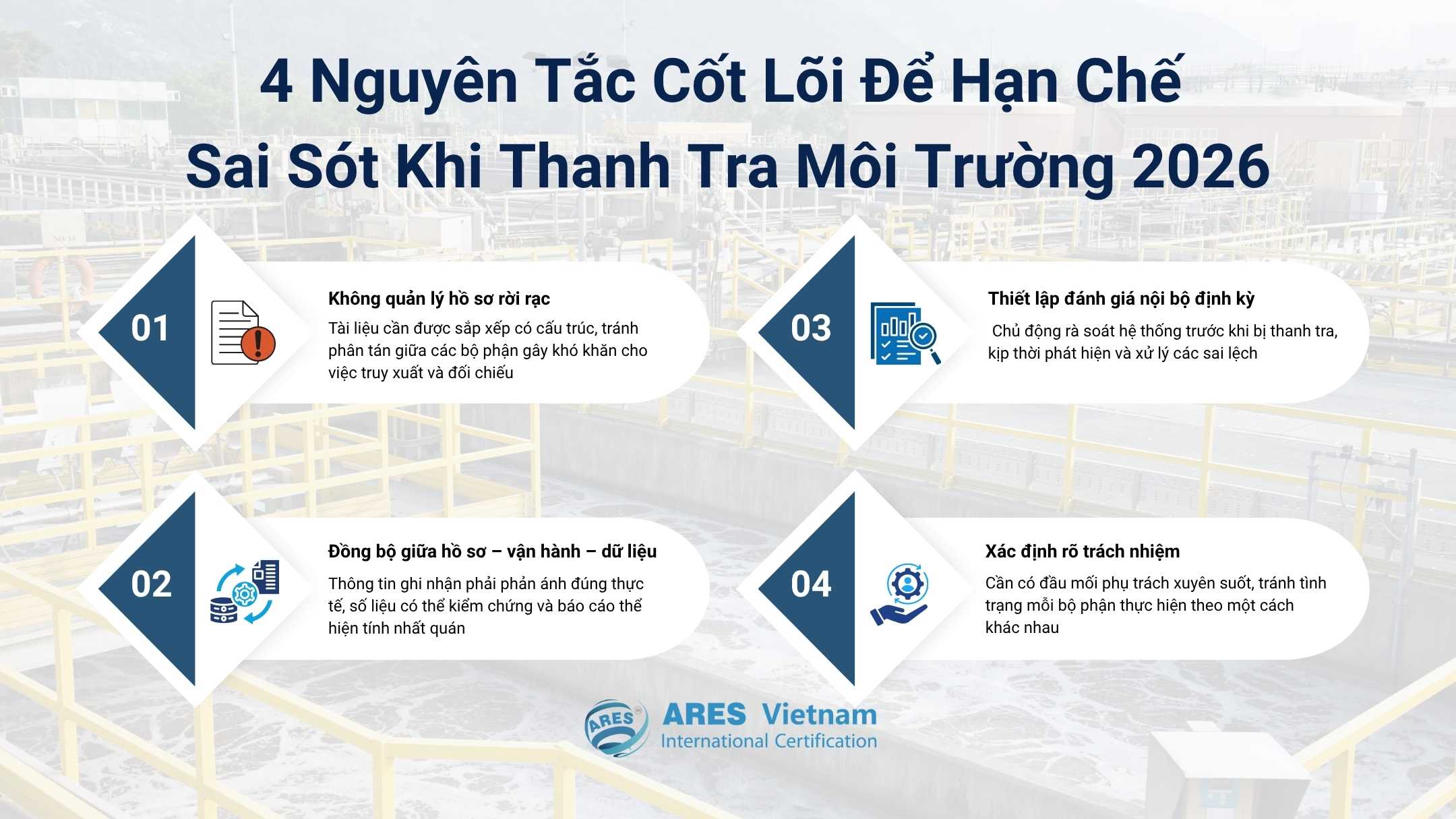
To reduce errors, businesses should ensure the following core principles:
▶️ Organize documents under a unified system: Avoid scattered records and ensure quick retrieval and cross-checking.
▶️ Align documents, operations, and data: All recorded information must reflect actual conditions and be verifiable.
▶️ Establish periodic internal control mechanisms: Proactively review and correct nonconformities before inspections occur.
▶️Clearly define management responsibilities: Ensure there is a responsible focal point throughout the process.
To implement these principles systematically, many businesses choose to apply an ISO 14001 environmental management system as an operational foundation.
This system helps:
- Standardize documents and procedures
- Link operations, data, and personnel
- Establish continuous internal controls
- Ensure consistency during cross-checking
As a result, businesses do not need to prepare separately for each inspection. Instead, they remain inspection-ready throughout normal operations.
4 core principles to minimize errors during the 2026 Environmental Inspection Process
Support Services For Preparing Environmental Documents
In practice, many businesses only begin reviewing documents once an inspection plan is announced. This often leads to rushed preparation and weak overall control.
Instead of reacting passively, proactively assessing readiness across legal, operational, and data requirements helps identify risks early and allows timely adjustments.
With extensive expertise in management systems, ARES Vietnam supports businesses by:
- Assessing readiness before environmental inspections
- Reviewing and standardizing records and data
- Building environmental management systems in line with ISO 14001
- Enhancing the capability to meet domestic and international assessment requirements
Proactively improving systems not only helps reduce legal risks, but also ensures stable and sustainable production and business operations.
Related news

How Does the EU CBAM Affect Manufacturing Companies in Vietnam?
Read more

Greenhouse Gas Inventory Process for Businesses Under ISO 14064-1
Read more

Classification of Import and Export Goods Under Circular 85/2026/TT-BTC: What Should FDI Enterprises Control?
Read more
Control of Measuring Equipment in Manufacturing Plants: What Should FDI Enterprises Consider Under ISO 9001?
Read more

ARES VIETNAM AT THE 2ND MEMBER CONGRESS OF TERM 19 & MID-AUTUMN FESTIVAL GALA
Read more