What’s New in ISO 14001:2026? Key Updates and Implementation Guidance
What’s new in ISO 14001:2026? Is it mandatory for businesses to transition? And if updates are delayed, will current certifications be affected?
The new version of ISO 14001, released in April 2026, marks a significant shift in how organizations are assessed in terms of environmental management capability.
As ESG requirements, emissions control, and supply chain accountability become increasingly stringent, slow adaptation is not only a compliance risk but can also directly impact order retention and competitive positioning.
This article provides a comprehensive view to help businesses understand the core changes in ISO 14001:2026, the practical implications, and an appropriate transition roadmap.
What Is ISO 14001:2026?
ISO 14001:2026 is the updated version of ISO 14001:2015 under the Environmental Management System (EMS), issued by the International Organization for Standardization.
The new version continues to follow the high-level structure (Annex SL), ensuring compatibility with other management systems such as ISO 9001 and ISO 45001. However, its content has been revised to reflect fundamental shifts in the global context, particularly those related to climate change, ESG, and international supply chain requirements.
This update is not merely technical; rather, it represents a shift in environmental management thinking.
Why Was ISO 14001:2026 Updated?
The update of ISO 14001 follows a regular review cycle. However, the 2026 version is strongly influenced by structural changes in the global market.
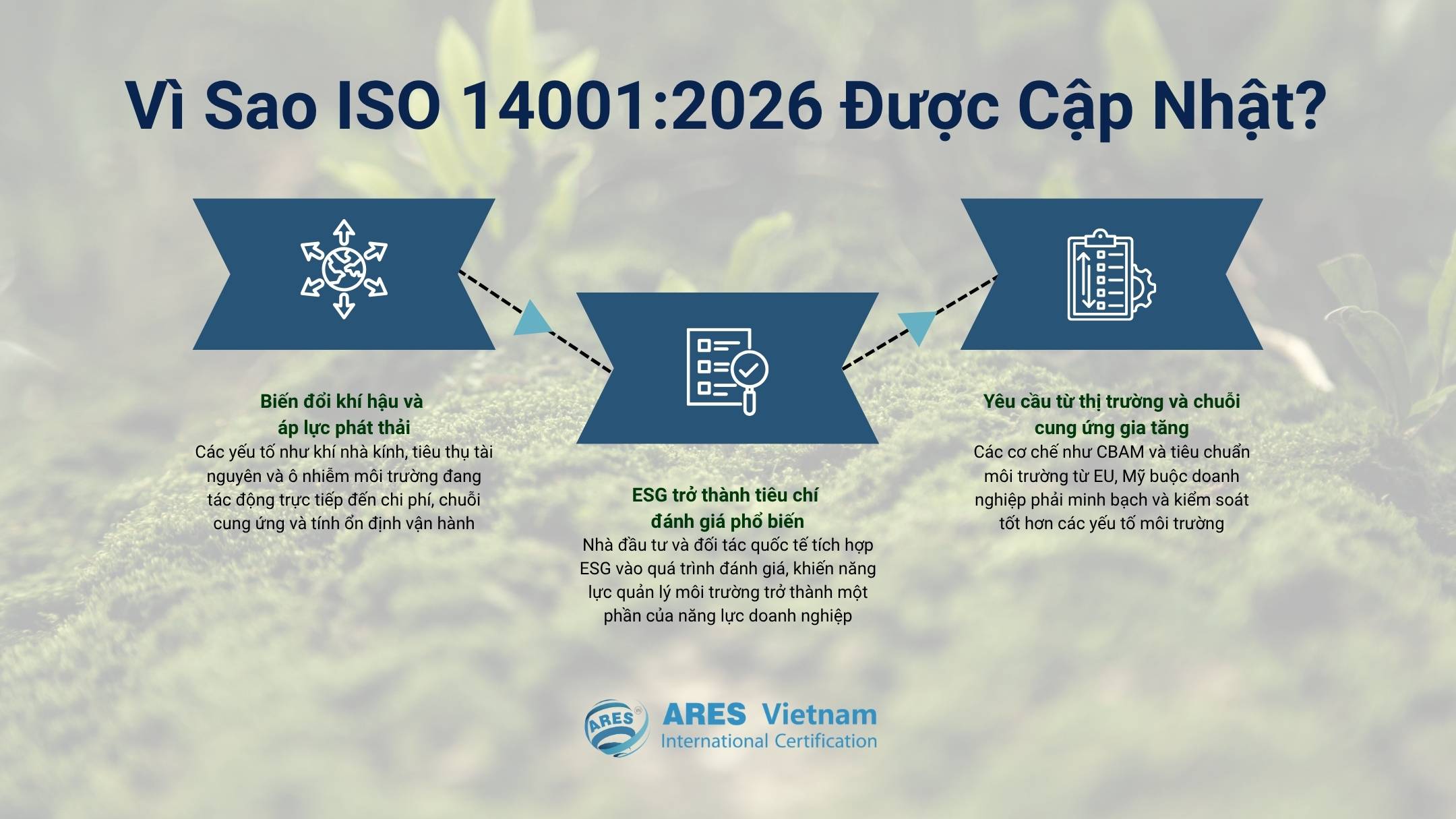
Three key drivers behind this update include:
▪️Climate change and emissions pressure: Factors such as greenhouse gas emissions, resource consumption, and environmental pollution are directly affecting operating costs, production stability, and supply capability.
▪️ESG as an evaluation criterion: Investors and international partners increasingly integrate ESG into their assessment processes, making environmental capability part of overall business capability.
▪️Rising market and supply chain requirements: Mechanisms such as the Carbon Border Adjustment Mechanism (CBAM), along with environmental standards from the EU and the US, require greater transparency and stricter control.
Therefore, ISO 14001 is no longer just an internal management tool; it has become a benchmark for a company’s ability to adapt to market demands.
Why was ISO 14001:2026 updated?
What’s New in ISO 14001:2026?
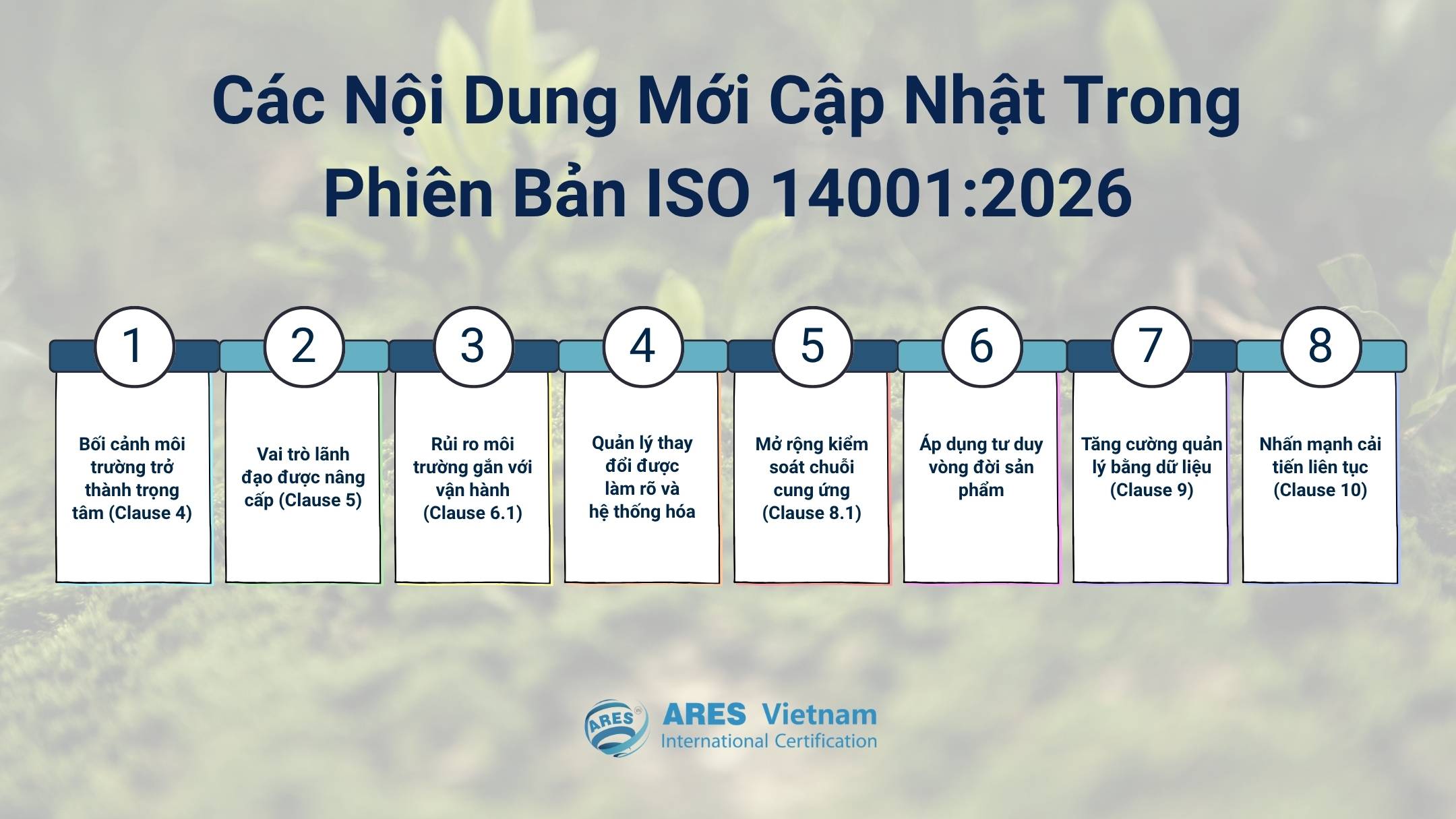
ISO 14001:2026 retains its core structure but strengthens requirements related to implementation, verifiability, and scope of assessment.
1. Environmental context becomes central (Clause 4)
Context analysis now extends to climate, natural resources, biodiversity, and pollution sources.
▶️Organizations need to fully assess external factors that may affect the system.
2. Stronger leadership role (Clause 5)
Leadership must directly align the environmental management system with business strategy and take responsibility for operational effectiveness.
▶️The environmental system becomes part of top-level management.
3. Environmental risks integrated into operations (Clause 6.1)
Risks must be embedded into actual processes, with the ability to be monitored and verified.
▶️If not implemented in practice, requirements are not met.
4. Systematic change management
All changes must be evaluated for environmental impact before and after implementation.
▶️The approach shifts from reactive to proactive control.
5. Expanded supply chain control (Clause 8.1)
The scope of assessment now includes suppliers and partners.
▶️Organizations are evaluated across the entire value chain.
6. Lifecycle thinking applied
Environmental impacts are considered throughout the lifecycle—from input to post-use.
▶️This helps identify all sources of impact.
7. Data-driven management strengthened (Clause 9)
Organizations must establish indicators, monitor performance, and use data for decision-making.
▶️Data becomes the foundation of management.
8. Emphasis on continuous improvement (Clause 10)
Improvement must be linked to actual results and changing context.
▶️The focus shifts toward optimizing operational performance.
Newly updated content in ISO 14001:2026 version
Comparison: ISO 14001:2015 vs ISO 14001:2026
Below are the key updates in ISO 14001:2026 compared to ISO 14001:2015, reflecting a clear shift toward higher requirements in both implementation and evaluation of environmental management systems.
| Change Area | ISO 14001:2015 | ISO 14001:2026 | Implications |
| Clause 4 – Context of the organization | Focus on internal factors | Expanded to include climate, resources, ecosystems | Organizations must broaden context analysis to include external environmental factors affecting the system |
| Clause 5 – Leadership | Emphasizes leadership commitment | Clarifies leadership accountability for system effectiveness and integration | Leadership must be directly involved and ensure consistent implementation |
| Clause 6 – Planning | Identify risks/opportunities and set objectives | Clarifies risk-based approach and integration into operations | Risks and opportunities must be embedded in planning and execution |
| Change management | Not clearly defined | Strengthened requirements within planning and implementation | Environmental impacts must be assessed before and after changes |
| Clause 7 – Support | Covers resources, competence, awareness, documented information | Clarifies control and maintenance of documented information as evidence | Documentation must accurately reflect implementation and be properly maintained |
| Clause 8 – Operation | Controls operational activities including outsourced processes | Clarifies scope and level of control over external providers and stakeholders | Organizations must define and apply appropriate control or influence over external parties |
| Clause 9 – Performance evaluation | Monitoring, measurement, analysis, evaluation, internal audit | Stronger emphasis on data-driven monitoring and evaluation | Organizations must establish KPIs and use data for evaluation and decision-making |
| Clause 10 – Improvement | Nonconformity, corrective action, continual improvement | Clarifies continual improvement based on performance and context | Improvement must be linked to actual results and system effectiveness |
Overall, the 2026 version focuses more on real-world implementation and accurate reflection of operations, rather than just meeting documentation requirements.
How Does ISO 14001:2026 Impact Businesses?
The level of impact varies depending on the current system maturity. However, the common point is clear: failure to adapt in time may affect not only audit results but also the ability to maintain orders and market access.
1. Organizations Already Certified to ISO 14001
For organizations with an existing system, transition is necessary to maintain certification validity. The focus is not rebuilding from scratch, but reviewing and adjusting how the system is implemented:
- Update the system based on new requirements
- Review and revise relevant documentation
- Conduct internal training for consistent implementation
▶️This means: systems that only meet documentation requirements will no longer be sufficient—they must reflect actual operations.
2. Organizations Without ISO 14001
For those not yet certified, the impact comes indirectly from market and supply chain requirements:
- Standard requirements in tender documents
- Conditions imposed by international customers
- Increased audits and assessments in supply chains
This is especially evident in industries closely tied to global supply chains:
- Textiles: environmental transparency required by global brands
- Food: environmental standards linked to safety and traceability
- Export manufacturing: stricter conditions for order participation and retention
▶️In this context, ISO 14001 is no longer a “value-added” option—it is increasingly becoming a market entry requirement, especially for exporters.
When Should Businesses Transition To ISO 14001:2026?
Currently, there is no official transition deadline announced by ISO or IAF.
However, based on common practice:
- Transition period: 2–3 years
- Estimated deadline: around 2029
▶️Businesses should prepare early to avoid pressure and risks in the final stage.
How To Transition To ISO 14001:2026
The transition does not require rebuilding the system from scratch. Instead, it focuses on reviewing, adjusting, and upgrading the existing system.
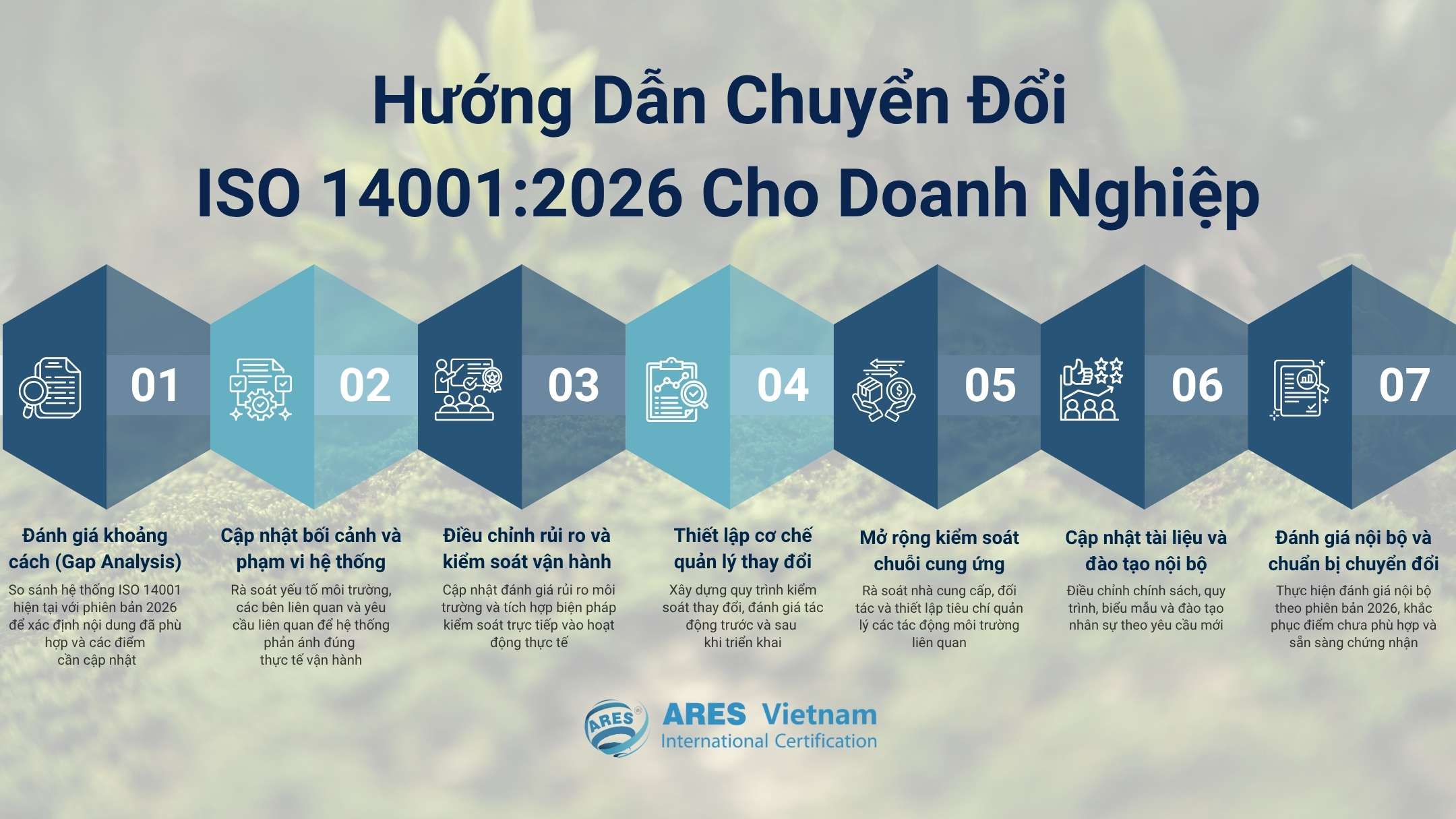
Step 1: Gap Analysis
Compare the current ISO 14001 system with the 2026 version to identify:
- What is already compliant
- What needs updating or improvement
This is the most critical step, determining the scope of transition.
Step 2: Update Context and Scope
Review:
- External environmental factors (climate, resources, supply chain)
- Interested parties and their requirements
Ensure the system reflects the current operating context.
Step 3: Align Risk and Operational Control
- Update environmental risk assessments
- Link risks to actual operational activities
- Add controls at relevant stages
Key point: risks must be embedded in operations, not just documented.
Step 4: Establish Change Management
- Develop a process to control changes:
- Assess environmental impacts before implementation
- Monitor and review after changes
This is a critical new requirement in the 2026 version.
Step 5: Expand Supply Chain Control
- Review suppliers and partners
- Assess their environmental impact
- Define appropriate control criteria
The system scope now extends beyond internal operations.
Step 6: Update Documentation and Training
- Revise policies, procedures, and forms
- Retrain employees on new requirements
Ensure consistent understanding and implementation.
Step 7: Internal Audit and Transition Preparation
- Conduct internal audits based on the new version
- Identify nonconformities
- Prepare for certification audit
This can be integrated into surveillance or recertification audits.
This approach enables businesses to transition in a controlled manner, avoiding operational disruption and minimizing risks during official adoption.
Guidance for transitioning to ISO 14001:2026 for businesses
Common Mistakes When Transitioning To ISO 14001:2026
Most challenges during the transition do not come from the standard itself, but from how organizations approach and implement it using outdated management models.
Common gaps include:
- Updating documentation without adjusting actual operations
- Limiting the scope of assessment to internal activities, while ignoring the product life cycle
- Managing changes reactively, without a predefined control mechanism
- Separating environmental management from production and business activities
- Delaying the transition until close to the official deadline
These approaches make it difficult for the system to meet audit requirements and reduce the effectiveness of control in real operations.
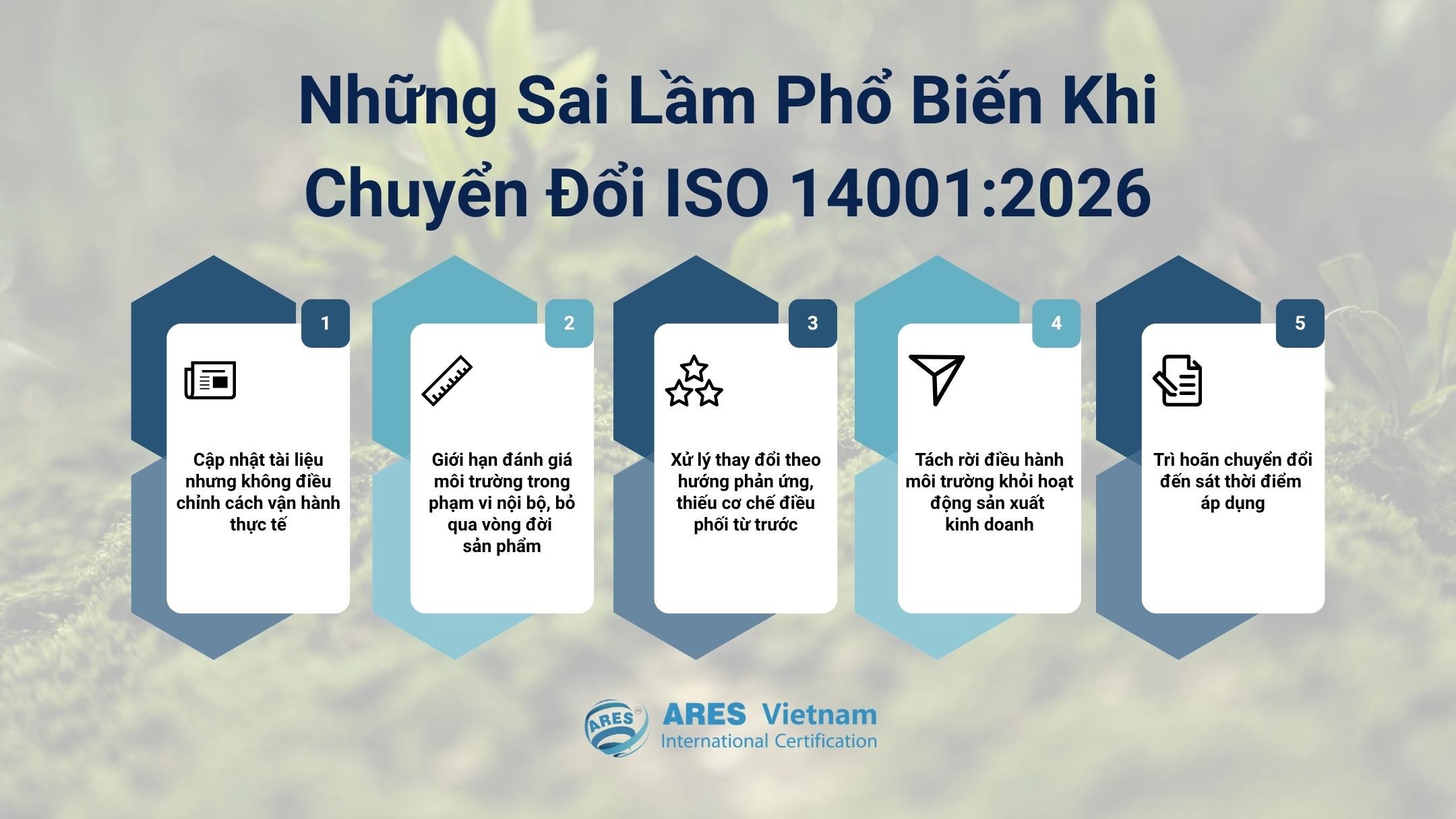
Common mistakes when transitioning to ISO 14001:2026
Effective Transition Starts With The Right Assessment
As environmental requirements become increasingly tied to market conditions, transitioning to ISO 14001:2026 should not be viewed as a simple standards update. Instead, it is a process of aligning the management system with actual operational practices.
The earlier an organization identifies the level of alignment of its current system, the greater its advantage in proactively building a transition roadmap and controlling risks during the transition period.
With over 20 years of experience in ISO, ARES Vietnam is supporting businesses in:
- Conducting gap analysis between ISO 14001:2015 and the direction of ISO 14001:2026
- Developing transition roadmaps aligned with operational models
- Integrating ESG requirements into environmental management systems
If an organization has not clearly identified its starting point, a structured assessment of the current system will provide the foundation for selecting an appropriate implementation approach and minimizing potential risks.
Contact us for consultation on a transition roadmap tailored to your industry and operational system.
FAQ – Frequently Asked Questions About ISO 14001:2026
| Common Questions | Answers to Inquiries |
| Is ISO 14001:2026 mandatory? | ISO 14001 is not a legally mandatory standard. However, once the updated version (ISO 14001:2026) is issued, it will be followed by a transition period defined by ISO and IAF. During this time, organizations using the previous version will need to transition to maintain certification validity. |
| Is it necessary to rebuild the entire system? | No. The transition typically focuses on reviewing, updating, and adjusting necessary elements within the existing system to meet new requirements, rather than rebuilding from scratch. |
| Can the transition be integrated into periodic audits? | Yes. Organizations can carry out the transition during surveillance or recertification audits, provided the system fully meets the new version’s requirements at the time of assessment. |
| Do small businesses need to adopt ISO 14001:2026? | ISO 14001 does not differentiate by company size. However, in practice, adoption depends on requirements from customers, partners, or the market—especially for businesses involved in supply chains or export activities. |
| Will delayed transition affect current certification? | Yes. After the transition period ends, certifications based on the old version will no longer be valid. Failure to transition in time may impact certification continuity and the ability to meet customer or partner requirements. |
Related news

ARES Vietnam Conducts the Second ISO 9001:2015 Surveillance Audit at KAISER 1 & KAISER 2 (Vietnam)
Read more


National Single Window and ASEAN Single Window: What Documents Should Import–Export Businesses Prepare?
Read more

ARES Vietnam Awards ISO 9001:2015 Certification to Simona Leather Company Limited
Read more

ARES Vietnam Conducts ISO 9001:2015 Surveillance Audit at Simona Leather Company Limited
Read more

Emissions Data & CBAM: 5 Practical Questions from Factory Operations
Read more