Vietnam Legal Regulations 2026: Key Compliance Priorities for Taiwanese Enterprises
Over the past two decades, Vietnam has become one of the most strategic investment destinations for Taiwanese enterprises in the Asia–Pacific region. This trend is particularly visible in sectors such as electronics, industrial components, textiles, and precision engineering.
At the same time, Vietnam has continued to refine its legal framework. As a result, the country aims to improve investment quality, strengthen governance transparency, and promote sustainable development.
As Vietnam enters the 2025–2026 period, several new regulations are beginning to influence foreign-invested enterprises. These regulations relate to land management, greenhouse gas emission reduction, personal data protection, and the employment of foreign workers.
Therefore, proactively updating and adapting to these legal changes becomes increasingly important. In practice, timely compliance helps enterprises maintain operational stability while strengthening competitiveness in a business environment that is becoming more standardized.
The following article summarizes several legal priorities that Taiwanese enterprises operating in Vietnam should carefully consider in 2026.
Legal Framework Governing FDI Enterprises In Vietnam
Investment activities of foreign-invested enterprises (FDI) in Vietnam operate within a comprehensive legal framework. This framework includes multiple laws and specialized decrees that regulate different aspects of investment and business activities.
At the foundational level, the operations of FDI enterprises in Vietnam are mainly established under several key laws:
- Amended Law on Investment 2025 (Law No. 143/2025/QH15) – effective from March 1, 2026. This law regulates investment and business activities in Vietnam. In addition, it defines market access conditions for foreign investors and outlines investment incentive policies.
- Law on Enterprises 2020 (Law No. 59/2020/QH14) – regulates the establishment, governance structure, and operational management of enterprises in Vietnam.
- Land Law 2024 (Law No. 31/2024/QH15) – establishes the framework for land allocation, land leasing, land use rights, and financial obligations related to investment projects.
- Law on Environmental Protection 2020 (Law No. 72/2020/QH14) – introduces requirements related to environmental impact assessments, emission control, and corporate environmental responsibilities.
- Amended Corporate Income Tax Law 2025 – provides regulations on tax obligations and defines tax incentive mechanisms applicable to investment and production activities.
- Amended Law on Tax Administration 2025 – regulates tax administration mechanisms, including tax declaration procedures and compliance obligations for enterprises.
In addition to these foundational laws, several decrees and subordinate regulations also play an important role in governing specific areas of FDI enterprise operations, including:
- Decree 31/2021/ND-CP – provides guidance for the implementation of the Law on Investment and details market access conditions for foreign investors.
- Decree 06/2022/ND-CP (amended and supplemented by Decree 119/2025/ND-CP) – regulates greenhouse gas emission reduction and outlines the roadmap for developing Vietnam’s carbon market.
- Decree 13/2023/ND-CP – introduces regulations on personal data protection and establishes new obligations for enterprises in collecting, processing, and safeguarding personal data.
- Decree 152/2020/ND-CP (amended by Decree 70/2023/ND-CP) – regulates the management of foreign workers employed in Vietnam.
Overall, these legal documents form a multi-layered regulatory structure. Together, they govern all major legal aspects of foreign-invested enterprise operations in Vietnam.
Therefore, a clear understanding of this legal framework helps enterprises strengthen regulatory compliance. Moreover, it supports long-term investment planning and enhances legal risk management throughout business operations.
Summary of legal regulations in Vietnam in 2026 that foreign-invested enterprises need to be aware of
Key Legal Changes FDI Enterprises Should Pay Attention To
1. Market access regulations for foreign investors
Market access for foreign investors in Vietnam is mainly governed by the Amended Law on Investment 2025 and its implementing regulations. In particular, Decree 31/2021/ND-CP provides detailed guidance for market access conditions. Under this framework, Vietnam applies a Negative List approach for market access. Accordingly, this list clearly defines investment scope and conditions for foreign-invested enterprises.
Under current regulations, business sectors for FDI enterprises fall into three main categories.
• Sectors with equal access as domestic investors
In these sectors, foreign investors may participate under the same conditions as domestic enterprises. Therefore, no additional market access restrictions apply.
• Conditional market access sectors
For these sectors, FDI enterprises must meet specific legal requirements. These may include limits on foreign ownership. They may also include rules on investment forms. In addition, some sectors define limits on business scope. Certain sectors may require financial and technological capacity.
• Sectors not yet open to foreign investors
These sectors are currently restricted under Vietnamese law. Typically, they relate to national security, defense, or areas under special state management.
The restricted sector list reflects an internationally recognized investment management approach. Accordingly, foreign investors may enter most sectors unless restrictions are clearly defined.
Therefore, before establishing a company, FDI enterprises should carefully review the market access list. In addition, they should assess all related investment conditions. This preparation supports compliance with Vietnamese legal regulations. At the same time, it helps enterprises manage legal risks during business operations.
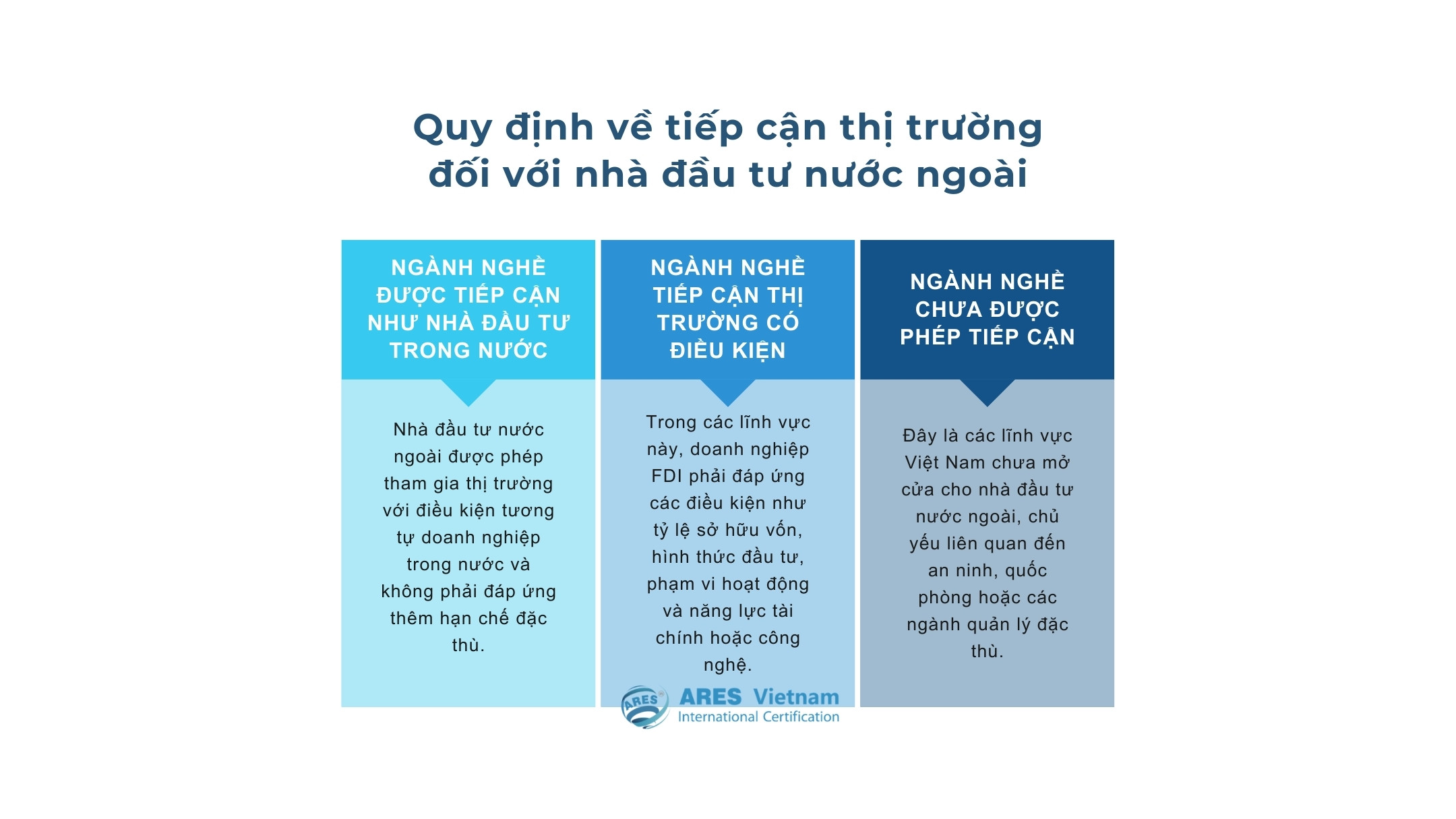
Regulations on market access for foreign investors
2. Land regulations and industrial zone project development
The legal framework governing land use for investment activities is primarily regulated by the Land Law 2024. This law represents a significant legal reform in Vietnam’s land management system.
Under current regulations, FDI enterprises do not obtain land ownership rights. Instead, they lease land directly from the State or sublease land in industrial zones, export processing zones, or economic zones. Therefore, regulations on land leasing and land use directly influence project implementation and operational planning.
Several key legal issues require careful attention:
- Procedures for leasing or subleasing land in industrial zones from infrastructure developers (Article 202).
- The land use term of a project, typically aligned with the duration of the investment project (Articles 172 and 175).
- The obligation to use land for the approved purpose in accordance with planning and the investment license.
- Regulations governing the transfer of investment projects or land use rights associated with the project.
The Land Law 2024 introduces several adjustments to strengthen transparency in land management. In addition, it improves land use efficiency for investment projects. For example, the law standardizes land use planning mechanisms. It also enhances land use right auction and bidding procedures based on market principles.
In practice, manufacturing projects in industrial zones involve several legal procedures. These typically include an Investment Registration Certificate, a construction permit, and environmental approvals. Therefore, preparing complete legal documentation during the project preparation stage is essential. As a result, enterprises can reduce risks and support smoother project implementation.
3. Tax regulations and trends in Investment incentives
Tax policy plays an important role in the operational costs of FDI enterprises in Vietnam. In addition, it directly influences overall investment efficiency. Currently, the legal framework for tax obligations is mainly defined by the Value-Added Tax Law and the Corporate Income Tax Law. These laws are supported by several implementing regulations and guidance documents.
A notable policy during the 2025–2026 period is the continuation of a 2% VAT reduction. This policy follows Resolution 204/2025/QH15 issued by the National Assembly. Under this resolution, the VAT rate for many goods and services decreases from 10% to 8%. The policy applies from July 1, 2025 to December 31, 2026. Implementation details are provided in Decree 174/2025/ND-CP.
This tax reduction helps enterprises lower operational costs. Moreover, it supports domestic consumption and business recovery. These measures are particularly relevant during periods of global economic uncertainty.
For FDI enterprises, especially in manufacturing and trade, the VAT reduction can improve cash flow and operational flexibility. It also helps enhance product competitiveness in the market. Vietnam also continues to implement several fiscal support measures for businesses, including tax payment extensions and reductions in administrative fees. In addition, reductions in land rental payments support investment activities. Overall, these policies contribute to a more supportive environment for foreign-invested enterprises in Vietnam.

Tax regulations and trends in adjusting investment incentives for foreign-invested enterprises
4. Regulations on greenhouse gas emission reduction and the carbon market
Vietnam is gradually strengthening its legal framework to control greenhouse gas emissions and develop a domestic carbon market. The legal foundation for this area is mainly established under the Law on Environmental Protection 2020 and its implementing regulations.
Under current regulations, production facilities with significant emissions must conduct periodic greenhouse gas inventories and reporting according to the government roadmap. In addition, the list of sectors required to perform greenhouse gas inventories is specified in Decision 01/2022/QD-TTg.
In addition, Decree 06/2022/ND-CP establishes a management framework for emission reduction activities and the development of the carbon market. The framework includes several key mechanisms:
- Requirements for greenhouse gas inventory and emission reporting for large emitting facilities.
- Allocation of greenhouse gas emission quotas for sectors with high emission levels.
- Development of mechanisms for carbon credit trading and offsetting.
According to the current roadmap, Vietnam plans to pilot the carbon market before 2028. Subsequently, the country aims to establish a fully operational carbon credit trading mechanism in the following years. This step also supports Vietnam’s commitment to achieving Net Zero emissions by 2050, as announced at COP26.
5. Regulations on personal data protection
In the context of rapid digital transformation and e-commerce growth, personal data protection has become an important legal requirement for businesses operating in Vietnam. The legal framework for this area is mainly governed by Decree 13/2023/ND-CP on Personal Data Protection.
Under current regulations, organizations and enterprises that collect, store, or process personal data must follow several core principles. For example, they must obtain the data subject’s consent, use information for the declared purpose, and apply appropriate security measures.
In addition, enterprises should pay attention to several important obligations:
- Develop internal personal data protection policies within the enterprise.
- Conduct personal data processing impact assessments in certain cases as required by law.
- Ensure information security and control cross-border data transfers.
If a personal data breach or incident occurs, enterprises must notify the competent authority within 72 hours after detecting the incident.
For FDI enterprises operating in sectors such as technology, e-commerce, financial services, or logistics, establishing a proper data governance system is increasingly important. Such systems help reduce legal risks and strengthen trust among customers and business partners.
6. Regulations on foreign employees in Vietnam
FDI enterprises in Vietnam often employ foreign experts for management or highly technical positions. Therefore, regulations related to work permits and foreign labor management require careful attention.
The legal framework for this area is mainly governed by the Labor Code 2019, Decree 152/2020/ND-CP, and Decree 70/2023/ND-CP. Common requirements for enterprises employing foreign workers include:
- Obtaining work permits for foreign experts or managers.
- Demonstrating professional qualifications and relevant work experience for the position.
- Registering the demand for foreign workers with authorities before recruitment.
In addition, enterprises must comply with regulations on labor contracts, insurance obligations, and personal income tax under Vietnamese law. Non-compliance may result in administrative penalties and could affect business operations.

Foreign-invested enterprises should take note of regulations on foreign labour in Vietnam
ESG Trends And Sustainability Compliance Requirements
In addition to specific legal regulations, the investment environment in Vietnam is increasingly linked to sustainability and ESG (Environmental, Social, and Governance) standards.
This trend is reflected in the growing requirements related to greenhouse gas emission management, corporate environmental responsibility, and transparency in business operations.
For many FDI enterprises, especially in manufacturing and export sectors, meeting ESG standards has become increasingly important. In particular, multinational corporations and global supply chain partners often require these standards. As a result, many companies in Vietnam have started implementing international management systems to address these expectations.
Several widely adopted standards include:
- ISO 14001 – Environmental Management Systems
- ISO 45001 – Occupational Health and Safety Management Systems
- ISO 14064 – Standards for greenhouse gas inventory and emission reporting
Adopting these standards helps enterprises strengthen internal management capabilities. At the same time, it supports compliance with rising expectations related to environmental management and social responsibility.
Legal Compliance Risks For FDI Enterprises
Although the legal framework for foreign investment in Vietnam continues to improve, many FDI enterprises still face compliance risks during operations. These risks arise not only from regulatory violations but also from rapid policy changes and increasing governance expectations.
In practice, three common categories of risk affect many FDI enterprises:
• Policy change risks, especially in areas such as environmental regulation, personal data protection, taxation, and labor management.
• Internal compliance system risks, including incomplete management systems for emissions, personal data, work permits, or investment reporting obligations.
• Global supply chain compliance risks, when enterprises must meet both domestic regulations and international partner standards.
These risks may lead to administrative penalties. In addition, they can affect corporate reputation and long-term cooperation with international partners.
Checklist Of Legal Issues for Enterprise Review
In practice, many legal risks can be reduced when enterprises maintain regular compliance checks and internal assessments. Therefore, to ensure operations align with Vietnamese regulations, enterprises should review several key areas:
- Review the Investment Registration Certificate and the scope of registered business activities.
- Verify periodic investment reporting obligations under applicable regulations.
- Assess environmental compliance, including greenhouse gas inventory and emission management obligations.
- Check work permits and the legal status of foreign employees.
- Review personal data protection policies and information security measures.
- Evaluate tax structures, tax obligations, and applicable investment incentives.
A structured compliance management system helps enterprises prevent legal risks. At the same time, it strengthens governance capacity and supports sustainable development in Vietnam’s business environment.
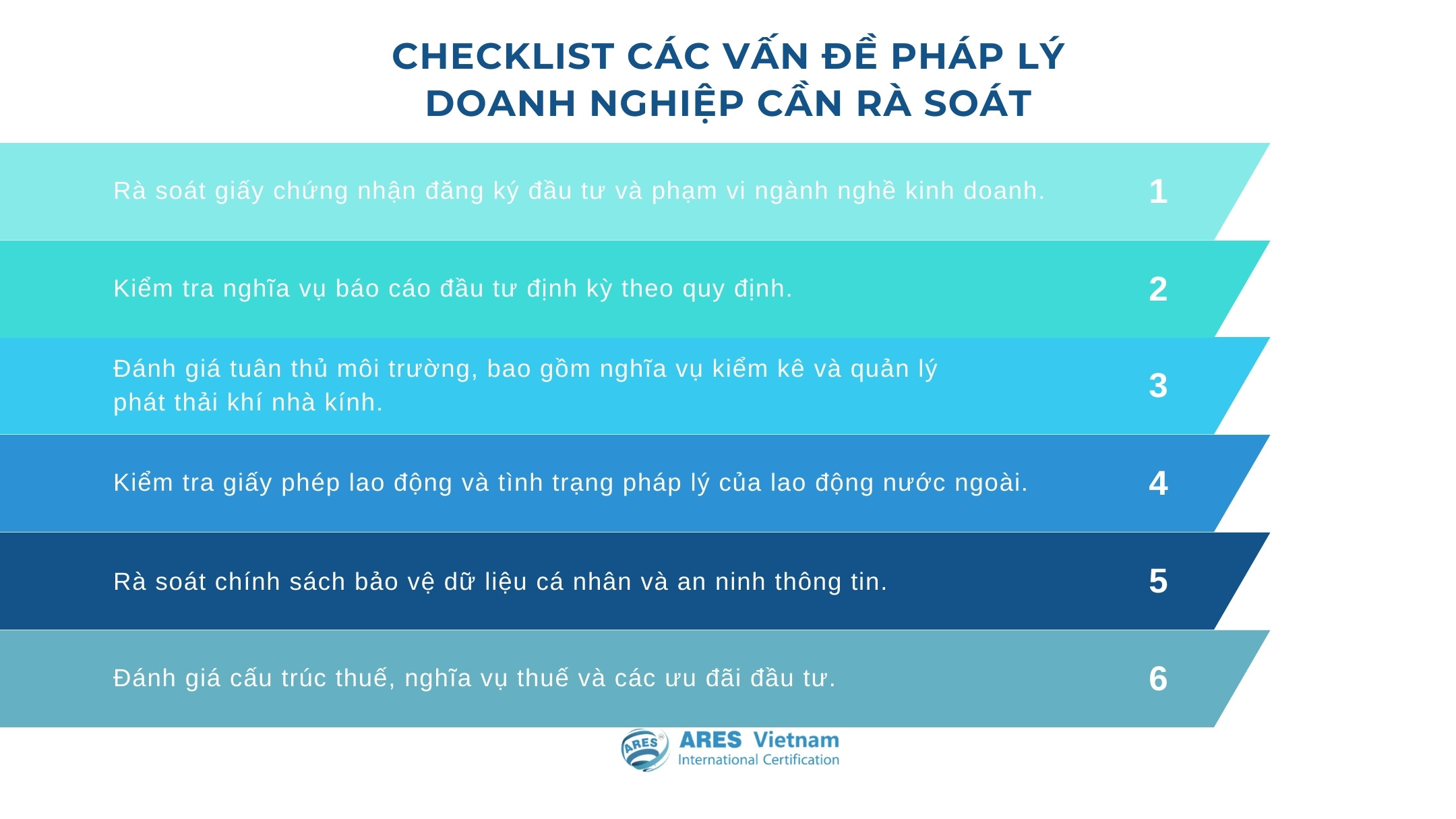
Checklist of legal issues that foreign-invested enterprises need to review
Legal Compliance As A Foundation For Sustainable Development
The period from 2025 to 2026 marks significant changes in the legal framework governing investment and business activities in Vietnam. These reforms aim to create a more transparent, competitive, and sustainable business environment.
For enterprises from Taiwan operating in Vietnam, timely updates on new legal regulations are essential. In addition, establishing an effective compliance management system supports stable operations and long-term development strategies.
With experience in certification and management system assessment, ARES Vietnam supports enterprises in implementing international standards such as ISO 14001, ISO 45001, and ISO 14064. These standards help strengthen governance capacity and meet the increasing requirements of the modern business environment.
Related news

Emissions Data & CBAM: 5 Practical Questions from Factory Operations
Read more


Greenhouse Gas Inventory Challenges: What Data Should Businesses Prepare?
Read more
ARES Vietnam Conducts ISO 45001:2018 Surveillance Audit at A&J (VIETNAM) CO., LTD.
Read more

Rice Export and Import Business Under Decree 365/2026/ND-CP: What Should Enterprises Control?
Read more

ARES Vietnam Verifies Greenhouse Gas Report under ISO 14064-1:2018 at GE LAN Vietnam
Read more