Which Industries Need To Implement he ISO 14001 Environmental Management System?
Since 2024, many industrial parks, export processing zones, and large-scale manufacturing facilities have entered a period of unprecedented environmental supervision. Inspection frequency has increased significantly, with a strong focus on operations involving high emissions, chemical usage, complex treatment processes, or intensive industrial activities.
In this context, businesses that fail to provide clear evidence of environmental impact control in accordance with the Law on Environmental Protection 2020 are facing substantial penalties. In more serious cases, they may also encounter prolonged suspension of operations.
As a result, ISO 14001 is no longer viewed merely as an internal improvement tool. Instead, it has effectively become a default benchmark for environmentally sensitive industries—both from a legal compliance perspective and under growing market pressure.
How Should The Term “Mandatory” Be Understood In This Article?
Under the Law on Environmental Protection 2020, there is no explicit provision requiring all businesses to obtain ISO 14001 certification. However, many industries are required to establish an environmental management framework equivalent to ISO 14001 in order to maintain compliance, meet legal documentation requirements, and ensure safe operations.
Therefore, in this article, the term “mandatory” does not imply a compulsory certification requirement. Rather, it is used in its professional sense:
◾Industries are required to establish a comprehensive environmental management system, including hazard identification, emission control, and incident response capabilities.
◾Moreover, this system must demonstrate effective operational performance when subjected to inspections, customer audits, or investor assessments.
In other words, the obligation lies in management capability, not in the certificate itself. ISO 14001 represents the most effective and widely recognized framework for meeting this requirement.

ISO 14001 – The International Standard for Environmental Management Systems (EMS)
Three Industry Groups Under Mandatory Pressure To Establish ISO 14001-Aligned Systems
Based on the Law on Environmental Protection 2020, Decree No. 08/2022/NĐ-CP, inspection mechanisms of the Ministry of Natural Resources and Environment, and international supply chain requirements, ARES Vietnam identifies three industry groups currently under substantial compliance pressure in practice.
1. Industries with high pollution risks under legal regulations
This group is listed in Appendix II of Decree No. 40/2019/NĐ-CP, which has been incorporated into Decree No. 08/2022/NĐ-CP. Facilities in this category are required to implement strict emission management, conduct periodic reporting, and maintain continuous environmental control capabilities.
| Industry | Key Environmental Challenges |
| Chemicals – Solvents – Paints | Risk of chemical incidents, VOC emissions |
| Pulp and Paper Manufacturing | High COD/BOD wastewater, odor, sludge |
| Cement – Construction Materials | Fine dust, thermal emissions, kilns |
| Plastics – Rubber – Recycling | VOC emissions, microplastics |
| Metallurgy – Mechanical Engineering – Metal Casting | Slag, heavy metals |
| Wood Processing – MDF – Veneer | Wood dust, formaldehyde emissions |
| Textiles – Dyeing – Leather Tanning | Dye chemicals, complex wastewater |
| Seafood – Food Processing – Livestock | Organic wastewater, strong odors |
⇒ Why is this group required to establish an ISO 14001-equivalent system?
Due to large-scale emissions, multiple sensitive operational points, and high technical requirements, businesses in this group must be able to demonstrate structured, stable, and measurable environmental management methods. In this regard, ISO 14001 provides the most suitable framework to fulfill these obligations effectively.
2. Industries under pressure from international supply chains
During 2024–2025, global corporations such as Nike, Adidas, H&M, Samsung, LG, Toyota, and Unilever have tightened supplier selection criteria. At the same time, the EU has strengthened controls over various export product groups through mechanisms such as CBAM and EPR.
Typical sectors include:
◾Textiles – Garments – Footwear – Backpacks – Handbags (requirements such as ZDHC, Higg FEM)
◾Electronic components – Precision engineering
◾Wood processing – Furniture – Packaging
◾Products exported to the EU, U.S., and Asia-Pacific markets
◾Food, seafood, and beverages (pressure related to carbon footprint and traceability)
⇒ Why is this group required to establish an ISO 14001-equivalent system?
Beyond compliance with domestic regulations, manufacturing facilities must demonstrate operational models that meet global customer expectations. Without ISO 14001 or an equivalent system, suppliers may be eliminated at the initial screening stage of the supply chain selection process.
Industries under pressure from international supply chains
3. Industries involved in tendering, projects, epc, and energy
Investors, PPP projects, and EPC contractors often impose strict requirements. Environmental risk assessments and internationally aligned procedures are mandatory criteria in technical bid evaluations.
Key cases include:
◾EPC projects, energy, power, and water infrastructure
◾Factories in industrial parks when signing infrastructure contracts
◾Tier-1 suppliers of Samsung, LG, Toyota, Unilever, and similar corporations
⇒ Why is this group required to establish an ISO 14001-equivalent system?
In these cases, environmental management capability is a decisive exclusion criterion in technical evaluations. ISO 14001 plays a critical role in infrastructure contract execution, business license renewal, and periodic inspections by regulatory authorities.

Industries involved in tendering, projects, EPC, and the energy sector
These industries share common features: significant environmental impact and increasingly complex management requirements. Failure to follow a recognized management framework exposes businesses to serious legal and commercial risks. These risks are analyzed in detail below.
Legal And Commercial Risks Of Lacking An Environmental Management System
The absence of a structured environmental management foundation places businesses in a reactive position. Typical issues include emissions exceeding regulatory limits, inconsistent monitoring data, and fragmented or discontinuous documentation. Such deficiencies can directly result in penalties under Decree No. 45/2022/NĐ-CP, placement under enhanced regulatory supervision, or even temporary suspension of operations.
More importantly, these impacts quickly extend into the commercial domain. As green compliance becomes a benchmark of credibility, non-compliant companies are often downgraded in evaluations, face restricted partnership opportunities, and encounter barriers to accessing preferential financing.
Collectively, these pressures strain internal operations. Fragmented data increases handling costs, erodes efficiency, delays delivery schedules, and ultimately weakens overall competitiveness.

Legal and commercial risks of lacking an environmental management system
Practical Benefits Of Implementing ISO 14001 For High-Risk Businesses
Far beyond certification value, ISO 14001 translates advanced environmental governance principles into practical outcomes. Its value can be seen across multiple layers:
◾ Enhanced data quality and ESG transparency
ISO 14001 standardizes methods for measuring and reporting environmental aspects and impacts. As a result, it establishes a reliable foundation for sustainability disclosures, which are increasingly required in major global markets.
◾ Driving technological innovation and green transformation
A comprehensive management framework enables clear identification of environmental hotspots. Consequently, businesses can prioritize investments in clean technologies, circular models, and automation, creating long-term advantages in their green transition roadmap.
◾ Improved forecasting and environmental risk prevention
The standard supports early detection of changes related to climate, raw materials, incidents, or evolving international standards. Therefore, response scenarios can be developed proactively and aligned with real operational conditions.
◾ Strengthened brand reputation in green markets
A clear and consistent strategy helps businesses build a credible sustainability image. This increases attractiveness to investors, partners, and high-quality talent, while reducing the risk of greenwashing disputes—where environmental claims are not supported by actual operations.
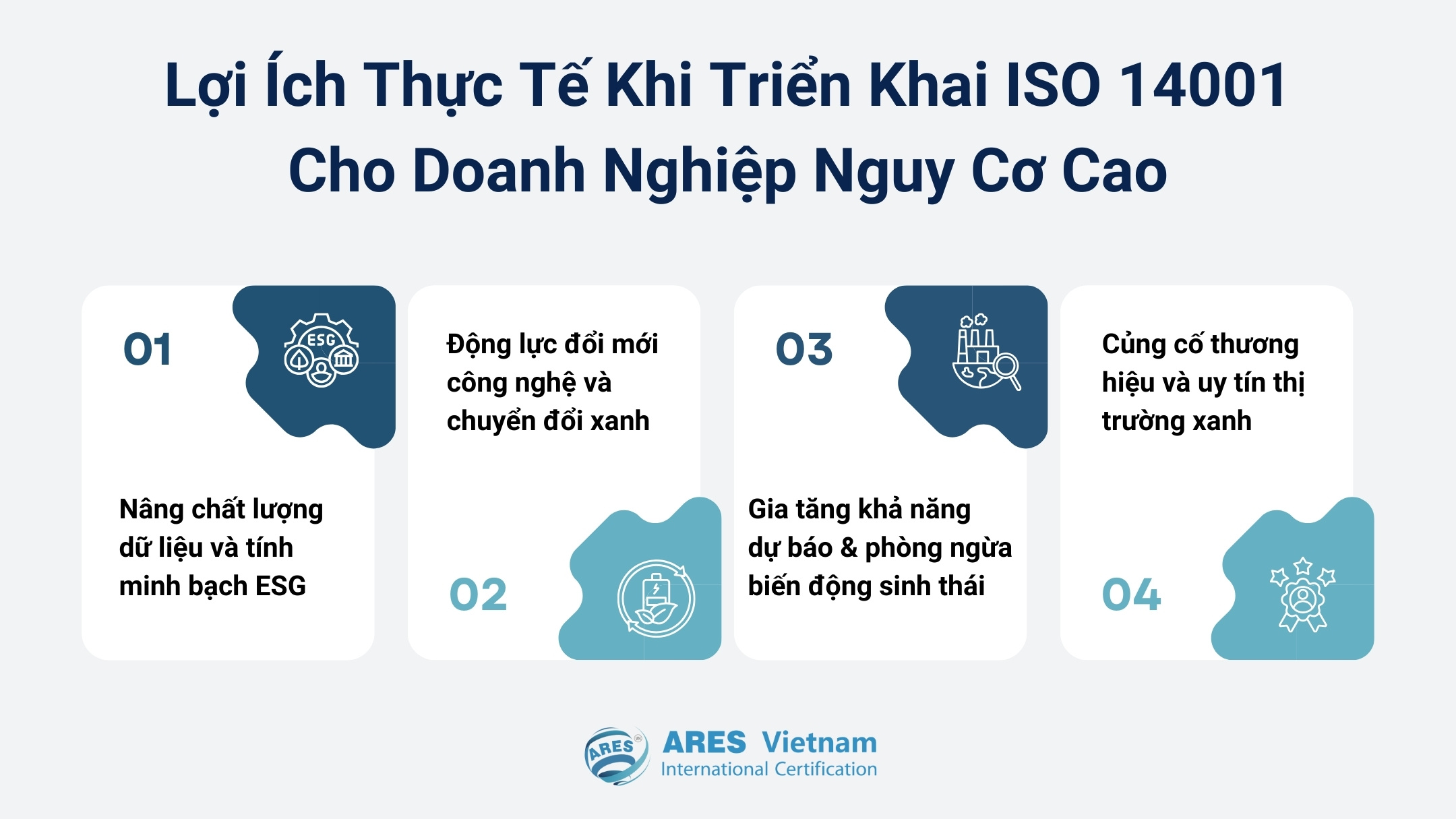
Practical benefits of implementing ISO 14001 for high risk businesses
Roadmap For Establishing An Environmental Management System In Line With ISO 14001
To implement ISO 14001 effectively and sustainably, businesses require a structured roadmap. This process starts with environmental risk reviews tailored to industry characteristics, followed by operational standardization, personnel training, and certification completion.
Such an approach strengthens environmental governance foundations comprehensively. Moreover, it ensures the system is resilient to market fluctuations and regulatory changes.
From the perspective of a consulting organization specialized in industrial and export-oriented sectors, ARES Vietnam proposes the following key implementation steps:
- Assess the current management system and level of environmental compliance
- Identify significant environmental aspects and impacts throughout operations
- Establish environmental objectives and management programs aligned with development strategy
- Control implementation through procedures, role assignments, and documentation
- Measure and monitor operational performance and emission control effectiveness
- Conduct internal audits to identify nonconformities and improvement opportunities
- Register for certification with an independent, competent, and accredited certification body
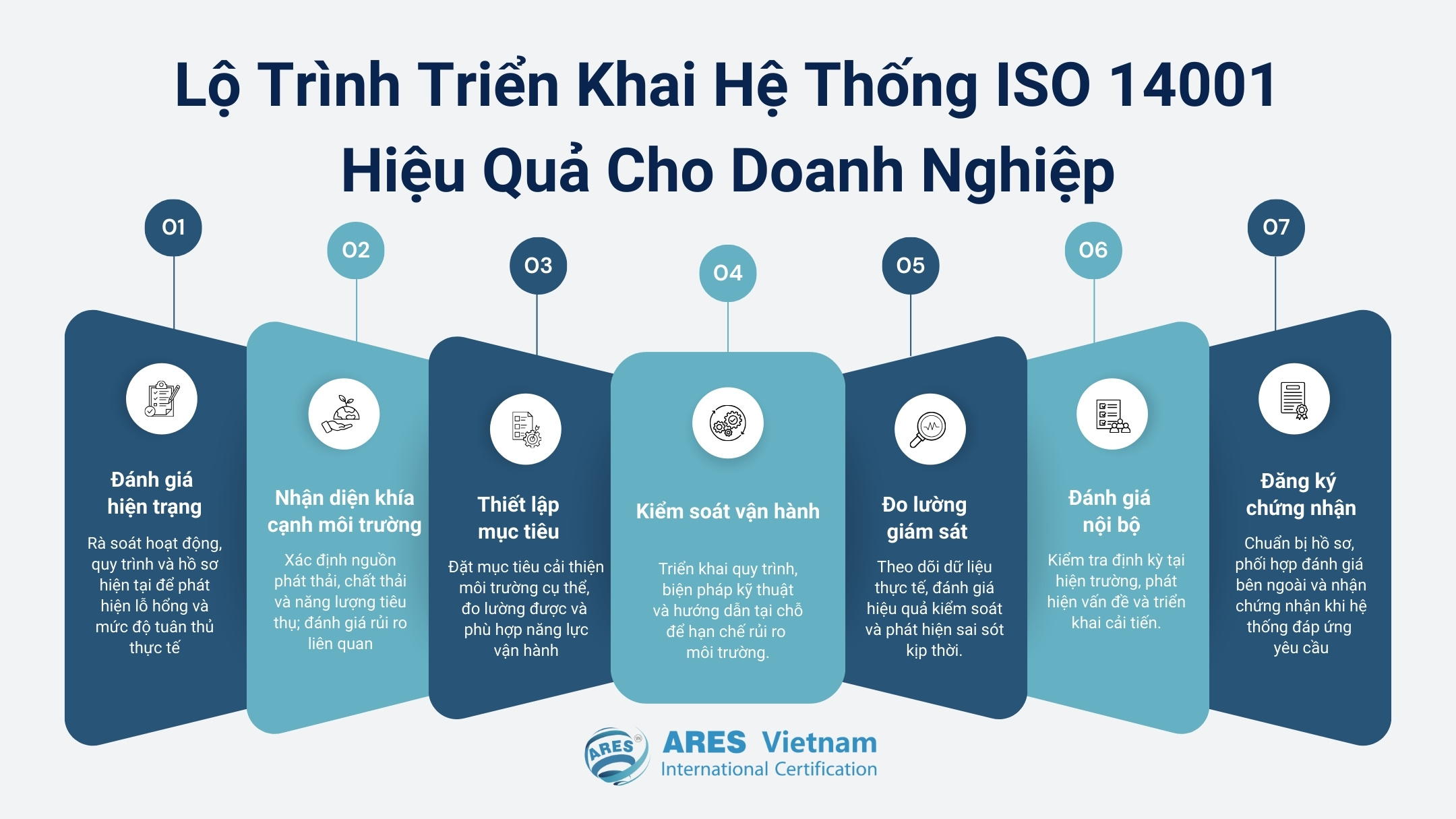
Roadmap for establishing an environmental management system in line with ISO 14001
From 2025 to 2030, environmental transparency will increasingly become a prerequisite in both public and private procurement, as well as across global supply chains. In this context, ISO 14001 functions as a “green passport,” enabling businesses to maintain market access, meet tightening sustainability requirements, and expand exports on a long-term basis.
If your organization operates in a high-risk sector or is preparing for inspections, customer audits, or investor assessments, ARES Vietnam is ready to support the development of an environmental management system tailored to your operational characteristics and available resources—ensuring effective compliance and sustainable long-term value.
REFERENCES
Related news
Greenhouse Gas Inventory Process for Businesses Under ISO 14064-1
Read more

Control of Measuring Equipment in Manufacturing Plants: What Should FDI Enterprises Consider Under ISO 9001?
Read more
ARES VIETNAM AT THE 2ND MEMBER CONGRESS OF TERM 19 & MID-AUTUMN FESTIVAL GALA
Read more
Liquid Milk Has Passed Testing: What Else Should Businesses Control?
Read more
ARES Vietnam Conducts ISO 50001:2018 Surveillance Audit at Gemtek Vietnam Corporation Limited
Read more