2025 Business Regulations Update: Why Has ISO Become an Important Management Tool?
The end of 2025 marks the most stringent regulatory tightening in nearly a decade. A wide range of regulations related to environmental protection, occupational safety, quality management, and risk governance are now being enforced at a significantly higher level. At the same time, Decision No. 1322/QĐ-TTg has clearly defined a core requirement. Enterprises are expected to operate under evidence-based management models aligned with international standards in order to maintain their competitive capacity.
Against this backdrop, organizations that have not yet implemented ISO management systems are facing an increasingly wide compliance gap. This gap affects legal compliance, the ability to pass regulatory inspections, and participation in global supply chains. Consequently, ISO has become a critical line of defense. It enables enterprises to enter 2026 with a transparent management foundation, stable operations, and a higher level of risk control.
Why Are Vietnamese Enterprises Facing Stronger Pressure To Change?
1. A shift toward stricter, quantitative enforcement mechanisms
From late 2024 through 2025, regulations such as Decree No. 45/2022/NĐ-CP and inspection plans issued by the Ministry of Natural Resources and Environment and the Ministry of Industry and Trade have significantly increased penalties and expanded inspection scopes.
In the environmental sector, depending on the violation, penalties may reach up to VND 2 billion. In addition, production suspension for three to six months may be imposed if emissions exceed permitted thresholds.
Industries such as food, textiles, electronics, and chemicals continue to be subject to heightened supervision. Notably, enforcement authorities now verify compliance based on monitoring data, equipment logs, and periodic reports. Verbal explanations or post-inspection document supplementation are no longer accepted.
2. National productivity enhancement strategy
Decision No. 1322/QĐ-TTg clearly defines the mission of the industrial sector. Enterprises are required to transition from fragmented operating models to interconnected production networks. The core of this strategy lies in restructuring the entire production cycle. Raw materials, machinery, processes, and distribution activities must all be recorded within a unified management architecture.
The greatest pressure does not stem from compliance requirements themselves. Rather, it arises from the speed of adaptation. Organizations that continue to rely on disconnected practices, inconsistent delegation, or weak digital foundations will struggle to meet the inter-industry connectivity requirements being rolled out at the national level.
3. Tighter international technical barriers during 2025–2026
Major markets are simultaneously raising their standards. In many cases, standards are no longer recommendations but mandatory market entry conditions.
◾CBAM, effective from 2026, will impose carbon taxes on steel, cement, aluminum, fertilizers, electricity, and hydrogen. Facilities lacking EU-compliant emissions reports may face retroactive taxation and potential export bans to Europe.
◾DPA/GDPR frameworks are tightening supplier requirements in electronics, pharmaceuticals, and F&B. A single failure in data storage or transmission may result in immediate contract termination.
◾ISO 9001:2026 (expected to be issued in September 2026) will introduce stricter requirements on governance architecture and responsibility allocation across supply chains.
Overall, pressure from these three directions not only increases the risk of legal violations but also restricts market expansion opportunities. This convergence makes late 2025 the most critical period. Organizations are therefore required to adapt rapidly and restructure their systems sooner than originally anticipated.
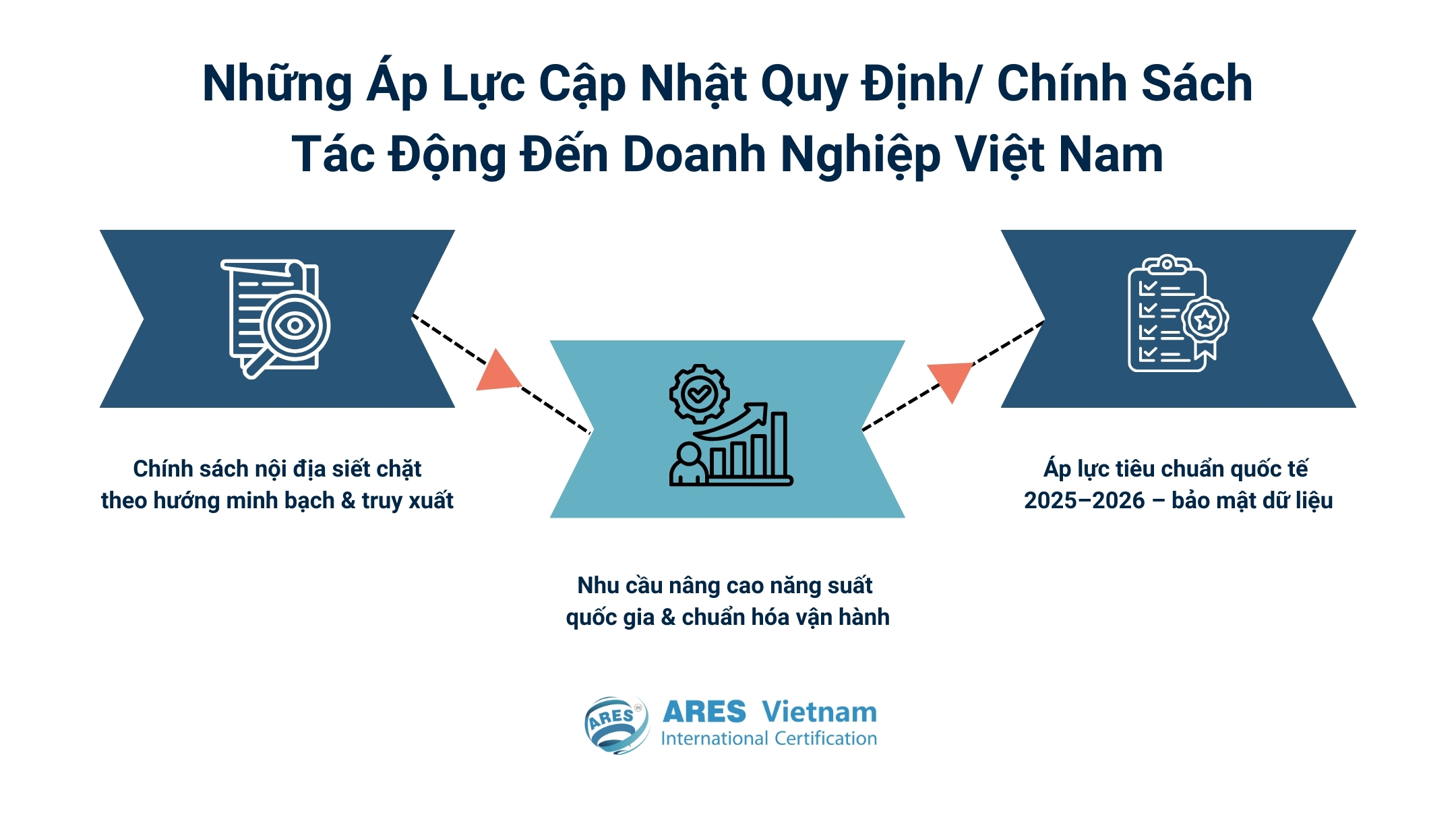
Regulatory and policy update pressures impacting vietnamese businesses
Overview of Key Regulations And Policies Impacting Enterprises (Late 2025 – Early 2026)
The following list summarizes regulations that are already in effect, as well as implementation roadmaps confirmed at ministerial levels. These requirements directly govern the 2025–2026 management period.
1. Data security and digital transformation (Related to ISO/IEC 27001)
◾Decree No. 13/2023/NĐ-CP has increased assessment requirements. Organizations must complete DPIAs and standardize all personal data processing activities.
◾The 2023 Law on Electronic Transactions introduces technical criteria for data storage, identification, and security across all online transactions.
◾Draft Decrees at Level 2 further tighten cross-border data transfer governance and introduce additional periodic reporting obligations.

Data security and digital transformation regulations (Related to ISO/IEC 27001)
2. Product and service quality (Related to ISO 9001)
◾The Ministry of Science and Technology is finalizing amendments to the Law on Product and Goods Quality. These amendments raise defect-based assessments, mandatory inspections, and export technical standards.
◾Decree No. 111/2021/NĐ-CP tightens supplier requirements and strengthens cooperation with FDI organizations in electronics, food, and logistics sectors.

Product and service quality regulations (Related to ISO 9001)
3. Environment and occupational health and safety (Related to ISO 14001 and ISO 45001)
◾The 2020 Law on Environmental Protection introduces emissions audits, periodic reporting, and expanded EPR requirements under Decree No. 05/2025/NĐ-CP for waste, packaging, and post-consumer products.
◾Decree No. 119/2025/NĐ-CP completes the carbon credit market framework. It regulates quotas, greenhouse gas inventories, and mandatory carbon credit trading for production and import activities.
◾Occupational Safety Acts and OSHA standards in the United States have also increased oversight and working condition requirements at manufacturing facilities.
Environmental and occupational health & safety regulations (Related to ISO 14001 & ISO 45001)
4. Supply chains and supplier standards
◾The General Department of Customs applies mechanisms under Decision No. 1952/QĐ-TCHQ, increasing scrutiny of non-compliant documentation.
◾The Ministry of Industry and Trade has strengthened agricultural and food traceability requirements under Circular No. 17/2021/TT-BNNPTNT and inter-ministerial guidance.
◾Supplier standards are increasingly aligned with ESG principles. These are reflected in Supplier Codes of Conduct issued by Walmart, Nike, Samsung, and in labor ethics compliance indices.

Supply chain regulations and supplier standards
Together, these policies form a visible “compliance wall.” Enterprises that adapt slowly risk losing credibility with international buyers and investment funds. ISO therefore becomes a critical tool to demonstrate capability and build transparent governance models toward 2026.
ISO As A Governance Framework For Risk Reduction And Regulatory Resilience
ISO is not merely a certification. It is a governance framework that transforms core activities into measurable, controllable, and continuously improvable processes. As a result, errors are identified early, risks are narrowed, and workforce capacity is utilized more effectively.
Strengthening operational and legal safeguards: ISO systems standardize every process step. All critical activities are controlled and traceable. Enterprises avoid violations, penalties, and exclusion from preferred supplier lists.
Accelerating ESG readiness: Documentation, reports, and internal data are systematically linked. This creates a strong foundation for rapid ESG compliance and sustainable development strategies.
Enhancing efficiency and cost optimization: Standardized processes reduce repeated errors, shorten processing time, and optimize human resources. Indirect costs are therefore significantly reduced.
Building global competitive advantage: ISO is a prerequisite for bidding, exporting, and partnering with multinational corporations. It provides quantitative evidence of governance capability and operational consistency.
Preparing for new standards in 2026: Early ISO adopters can adapt more easily to updated versions, particularly ISO 9001:2026, and avoid passive responses to policy changes.
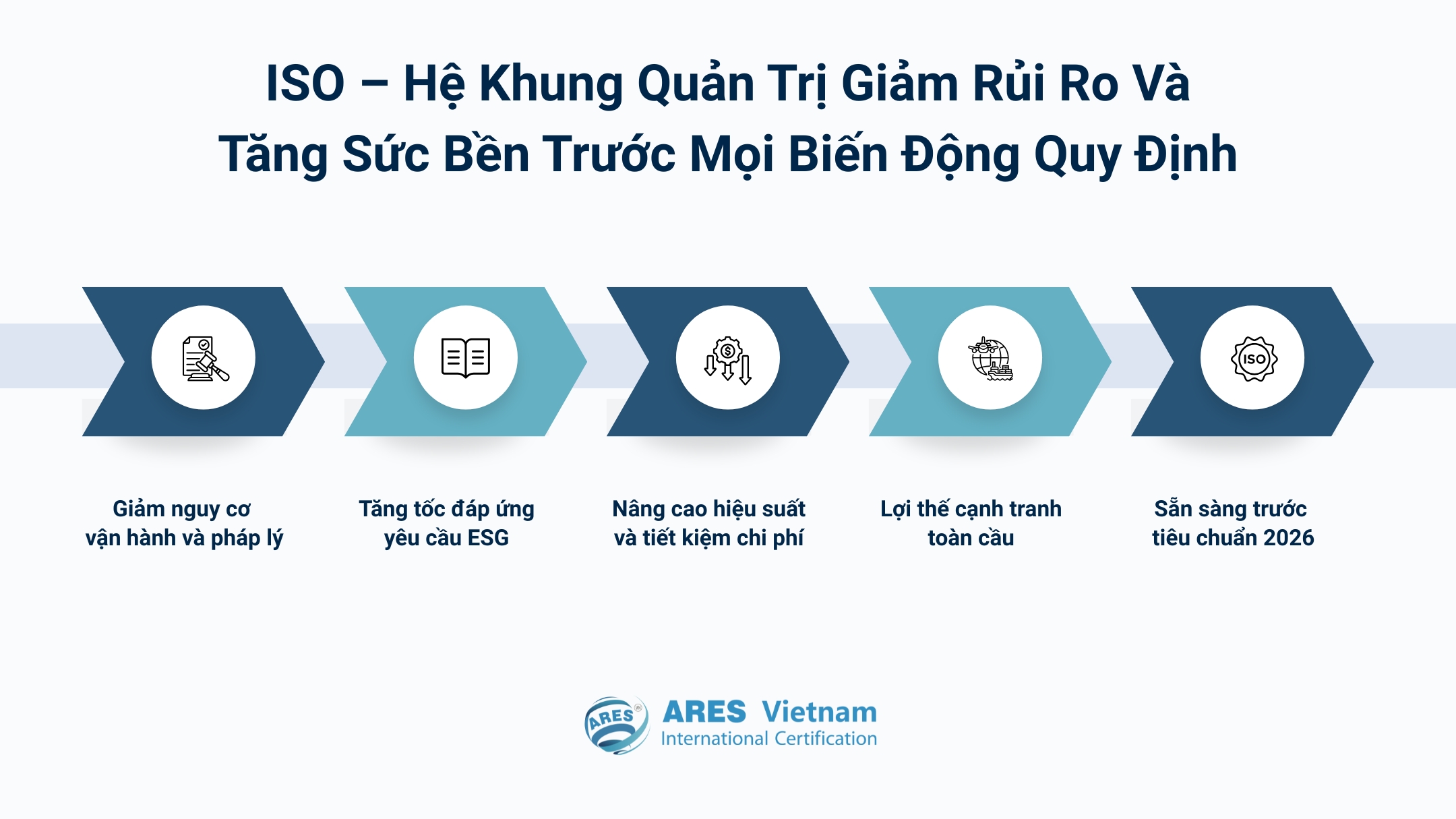
ISO – A governance framework for risk reduction and regulatory resilience
Where Should Enterprises Begin? An Effective ISO Implementation Roadmap For 2025–2026
Based on extensive consulting experience across industries in Vietnam, ARES Vietnam recommends a four-step roadmap aligned with real-world pressures and requirements.
Step 1 – Gap analysis and scope definition
- Review all internal processes against legal requirements and industry standards. Identify priority gaps that require immediate action.
Step 2 – Selection of relevant ISO standards
- ISO 9001 for quality management
- ISO 14001 / ISO 45001 for construction contractors or high environmental impact operations
- ISO/IEC 27001 for data security, which is especially critical in 2025
Step 3 – Process consolidation and capability development
- Re-evaluate operational steps and clearly assign responsibilities. Train personnel to ensure standardized processes are effectively implemented in practice.
Step 4 – Corrective actions and certification
- Conduct internal audits and prepare thoroughly for official certification audits. This ensures system validity is maintained through future surveillance and recertification cycles.

An effective ISO implementation roadmap for the 2025–2026 period
Recommendations For Vietnamese Enterprises (2025–2026): Proactive Adaptation To Regulatory Change
Organizations should not wait for new regulations to be issued. Instead, they should reassess all workflows and governance models currently in place. Any non-conformity may become a bottleneck. This can directly affect legal compliance and participation in the global business ecosystem.
This is the appropriate time to prioritize ISO implementation. At the same time, existing operations should be refined to align with upcoming standards such as ISO 9001:2026 and ISO 14001:2026.
If your organization is preparing its 2026 plan and needs to establish ISO-compliant systems, we can provide support from gap assessment and training to certification, with streamlined roadmaps tailored for SMEs.
REFERENCES
Related news

Circular 49/2026/TT-BCT Takes Effect Soon: Which Environmental Records Should Factories Review?
Read more


ARES Vietnam Conducts the Second ISO 9001:2015 Surveillance Audit at KAISER 1 & KAISER 2 (Vietnam)
Read more

National Single Window and ASEAN Single Window: What Documents Should Import–Export Businesses Prepare?
Read more

ARES Vietnam Awards ISO 9001:2015 Certification to Simona Leather Company Limited
Read more

ARES Vietnam Conducts ISO 9001:2015 Surveillance Audit at Simona Leather Company Limited
Read more