Scope 1, Scope 2, and Scope 3: Understanding GHG Emissions
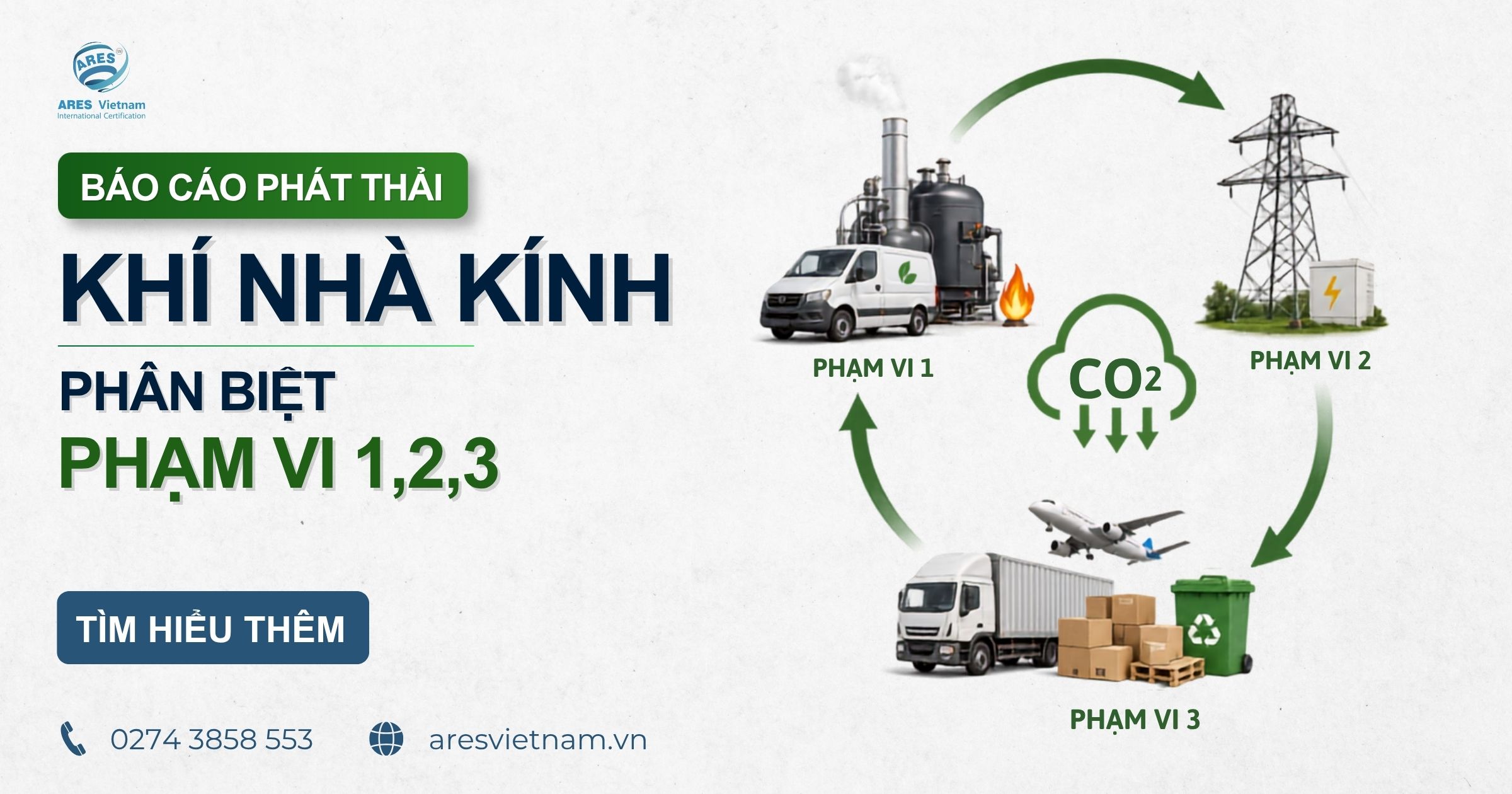
Scope 1, Scope 2, and Scope 3 provide the foundation for classifying greenhouse gas (GHG) emissions at the organizational level. As greenhouse gas reporting requirements continue to expand, organizations must understand these emissions scopes to prepare accurate GHG inventories and reports.
In practice, many businesses generate emissions from sources with similar characteristics, yet those sources are not always identified or classified consistently. As a result, inaccurate classification can complicate data collection, emissions quantification, and the preparation of reliable GHG inventories and reports.
So, what exactly are Scope 1, Scope 2, and Scope 3 emissions? How do these categories differ, and what should organizations consider when applying them to greenhouse gas inventories? In this article, ARES Vietnam explains the key concepts and practical considerations.
What Are Scope 1, Scope 2, and Scope 3 Emissions?
To establish a consistent approach for identifying and reporting organizational greenhouse gas emissions, the GHG Protocol categorizes emission sources into three distinct scopes: Scope 1, Scope 2, and Scope 3.
This classification has become the most widely adopted framework for corporate GHG accounting and serves as the foundation for determining which emission sources should be included in an organization’s inventory.
Each scope represents a different category of emission sources with unique characteristics. Consequently, this framework enables organizations to classify emissions consistently across all business activities, ensuring that emissions are identified and reported using the same principles throughout the inventory and reporting process.
Scope 1: Direct Greenhouse Gas Emissions
1. What Is Scope 1?
Scope 1 emissions are direct greenhouse gas emissions generated from sources that are owned or controlled by an organization. Because these sources are operated or managed directly by the organization, Scope 1 emissions are generally the category over which it has the greatest level of operational control.
These emissions may occur at manufacturing facilities, offices, construction sites, or during the operation of company-owned vehicles. In all cases, they result directly from the organization’s own activities, equipment, or industrial processes.
2. Common Scope 1 Emission Sources
In general, Scope 1 emissions can be grouped into the following four categories.
Table 1. Common Scope 1 Emission Sources
| Source Category | How Emissions Occur | Examples |
| Stationary combustion | Fuel combustion in stationary equipment | Boilers, furnaces, generators, heating systems |
| Mobile combustion | Fuel combustion in vehicles owned or controlled by the organization | Trucks, forklifts, passenger vehicles, ships |
| Industrial processes | Chemical reactions or production processes that release greenhouse gases | Cement, lime, steel, and chemical manufacturing |
| Fugitive emissions | Unintentional greenhouse gas releases from equipment or systems | Refrigerants from HVAC systems and cold storage, fire suppression gases, SF₆ used in certain electrical equipment |
Depending on the nature of its operations, an organization may have one or several of these emission source categories. The actual Scope 1 boundary varies according to industry, production processes, equipment, and transportation assets.
For example, a trading company may primarily generate Scope 1 emissions from company vehicles and air conditioning systems. By contrast, a manufacturing company may also generate emissions from boilers, industrial furnaces, or production processes.
3. Data Required to Quantify Scope 1 Emissions
After identifying Scope 1 emission sources, organizations should collect the operational data needed to calculate greenhouse gas emissions. Depending on the emission source, relevant records may include:
- Fuel type and fuel consumption data.
- Operating records for emission-generating equipment or vehicles.
- Production output, raw material inputs, or process parameters for industrial process emissions.
- Information on greenhouse gas types, refrigerant charging, recovery, or leakage for fugitive emission sources.
In addition to activity data, organizations should establish consistent practices for defining reporting periods, measurement units, data sources, and departmental responsibilities. Standardizing these elements from the outset helps minimize inconsistencies during emissions calculation and reporting.
Note: Energy generated and operated directly by an organization may be classified differently from energy purchased or received from external suppliers. This distinction is explained in the Scope 2 section below.
Scope 2: Indirect Emissions from Purchased Energy
1. What Is Scope 2?
Scope 2 emissions are indirect greenhouse gas emissions associated with the generation of purchased or acquired electricity, steam, heating, or cooling consumed by an organization.
Although the emissions occur at the energy generation facility rather than at the organization’s site, the organization reports them under Scope 2 because it is the end user of that purchased energy.
2. Common Scope 2 Emission Sources
According to the GHG Protocol, Scope 2 includes purchased or acquired energy used to support an organization’s operations.
Table 2. Common Scope 2 Emission Sources
| Purchased Energy | Examples |
| Grid electricity | Electricity used in offices, factories, warehouses, and production lines |
| Purchased steam | Steam supplied for manufacturing processes or heating |
| Purchased heating | District heating systems |
| Purchased cooling | Centralized cooling systems in industrial parks or commercial buildings |
It is important to note that not all electricity consumption falls under Scope 2. The determining factor is whether the electricity is purchased or acquired from an external source.
For instance, if an organization generates its own electricity using a diesel-powered generator, the emissions from burning diesel fuel are classified as Scope 1, not Scope 2.
3. Data Required to Quantify Scope 2 Emissions
To calculate Scope 2 emissions, organizations should collect data on the amount of purchased or acquired energy consumed during the reporting period. Typical supporting documentation includes:
- Electricity, steam, heating, or cooling consumption records.
- Utility bills, energy supply contracts, or payment records.
- Meter readings or energy monitoring system data, where available.
- Supplier documentation supporting the determination of energy consumption.
For organizations operating multiple facilities, energy data should first be compiled separately for each site before being consolidated into the corporate GHG report. Furthermore, supporting records should be retained to facilitate future calculations, internal reviews, or external verification.
Note: Under the GHG Protocol Scope 2 Guidance, Scope 2 emissions may be calculated using either the location-based or the market-based method. When applying the market-based approach, organizations should also consider supplier-specific information and contractual instruments related to electricity procurement.
Scope 3: Indirect Emissions Across the Value Chain
1. What Is Scope 3?
Scope 3 emissions are all indirect greenhouse gas emissions that are not included in Scope 1 or Scope 2 but occur as a consequence of an organization’s activities. These emissions typically arise from suppliers, transportation providers, customers, or other entities throughout the organization’s value chain.
Compared with Scope 1 and Scope 2, Scope 3 covers a much broader range of activities and often requires data from multiple external parties. As a result, it is generally considered the most complex category to identify, quantify, and report during a greenhouse gas inventory.
2. Upstream Scope 3 Emissions
Upstream Scope 3 emissions refer to indirect emissions associated with the goods, services, and resources that an organization purchases or acquires to support its operations. These emissions commonly include purchased goods and services, capital goods, inbound transportation, operational waste, business travel, and employee commuting.
For example, an organization may hire a third-party logistics provider to transport raw materials to its manufacturing facility. Because the transportation vehicles are owned and operated by the logistics company rather than the organization itself, the resulting emissions are generally classified as Scope 3.
3. Downstream Scope 3 Emissions
Downstream Scope 3 emissions are indirect emissions associated with products and services after they have been sold or transferred by the organization. They also include certain downstream activities within the value chain, such as leased assets, franchises, and investments.
For instance, the electricity consumed by customers while using an electrical product, or the emissions generated during a product’s end-of-life treatment and disposal, may both fall under Scope 3.
Table 3. The 15 Scope 3 Categories Defined by the GHG Protocol
| Upstream Activities | Downstream Activities |
| 1. Purchased goods and services | 9. Downstream transportation and distribution |
| 2. Capital goods | 10. Processing of sold products |
| 3. Fuel- and energy-related activities (not included in Scope 1 or Scope 2) | 11. Use of sold products |
| 4. Upstream transportation and distribution | 12. End-of-life treatment of sold products |
| 5. Waste generated in operations | 13. Downstream leased assets |
| 6. Business travel | 14. Franchises |
| 7. Employee commuting | 15. Investments |
| 8. Upstream leased assets |
According to the GHG Protocol, organizations should review all 15 Scope 3 categories to determine which ones are relevant to their operations. However, not every category applies to every business. The categories ultimately quantified and reported depend on the organization’s activities and the reporting framework being used.
Comparing Scope 1, Scope 2, and Scope 3
To help organizations identify and classify emission sources more efficiently, the table below summarizes the key characteristics of each emissions scope.
Table 4. Comparison of Scope 1, Scope 2, and Scope 3
| Criteria | Scope 1 | Scope 2 | Scope 3 |
| Nature of emissions | Direct emissions | Indirect emissions from purchased energy | Other indirect emissions |
| Emission sources | Equipment, vehicles, or processes owned or controlled by the organization | Purchased electricity, steam, heating, or cooling | Activities occurring throughout the organization’s value chain |
| Where emissions occur | At sources operated or controlled by the organization | At energy generation facilities | At suppliers, customers, or other external parties |
| Primary data sources | Mainly internal operational records | Utility bills, meter readings, supplier records | A combination of internal data and external information |
| Relationship to the emission source | Source is owned or operationally controlled | Organization purchases or acquires the energy | Source exists within the value chain but outside Scope 1 and Scope 2 |
| Examples | Boilers, trucks, generators, refrigerant leakage | Purchased grid electricity, purchased steam | Purchased raw materials, outsourced logistics, business travel, use of sold products |
This comparison provides a practical starting point for identifying emission sources. However, when evaluating a specific activity, organizations should follow a structured decision-making process to determine the appropriate emissions scope.
How to Determine Whether an Emission Source Belongs to Scope 1, Scope 2, or Scope 3?
Organizations can classify greenhouse gas emissions by answering the following three key questions.
Question 1:
Yes → Scope 1
Question 2: Does the emission result from the generation of electricity, steam, heating, or cooling that the organization purchases or acquires for its own use?
Yes → Scope 2
Question 3: Is it another indirect emission occurring somewhere within the organization’s value chain?
Yes → Scope 3
Ultimately, emission classification should be based on the nature of the emission source and the organization’s reporting boundary, rather than simply the name of the activity.
Table 5. Common Scenarios That Are Frequently Misclassified
| Scenario | Scope | Reason for Classification |
| A company-owned diesel truck | Scope 1 | The organization directly controls the combustion source. |
| Purchased electricity used to operate a manufacturing facility | Scope 2 | The emissions occur at the electricity generation facility. |
| Purchased electricity used to charge company-owned electric vehicles | Scope 2 | The electricity is purchased from an external supplier. |
| Hiring a third-party logistics company to transport raw materials | Scope 3 | The vehicles are owned and controlled by the logistics provider. |
| Employees commuting to work using their own transportation | Scope 3 | Classified under the employee commuting category. |
| A waste management contractor treating the organization’s waste | Scope 3 | The emissions occur at the contractor’s waste treatment facility. |
Do Organizations Need to Report Scope 1, Scope 2, and Scope 3 Emissions?
Organizations are not automatically required to report all three emissions scopes. The reporting boundary depends on the reporting objective, the framework being applied, and the requirements established by regulators, customers, parent companies, or reporting programs. Common scenarios include the following:
- Reporting under the GHG Protocol Corporate Standard requires organizations to account for and report Scope 1 and Scope 2 emissions. Under the Corporate Standard, Scope 3 reporting is voluntary. However, if an organization prepares a Scope 3 inventory in accordance with the GHG Protocol Corporate Value Chain (Scope 3) Standard, it should follow that standard’s requirements regarding organizational boundaries, emission categories, and disclosure.
- Reporting to customers or parent companies: The reporting scope is determined by the specific requirements of the requesting organization.
- Reporting to comply with regulatory requirements: Organizations should prepare their greenhouse gas reports in accordance with the applicable regulations, reporting templates, and official guidance issued by the relevant authorities.
- Reporting for internal management purposes: Organizations may define reporting boundaries that best support internal decision-making, sustainability management, and performance tracking.
Establishing the reporting objective at the outset enables organizations to determine the appropriate emissions scopes and prepare the data needed for an efficient and consistent reporting process.
Are Scope 1, Scope 2, and Scope 3 the Same as the Classification Used in ISO 14064-1?
Scope 1, Scope 2, and Scope 3 are emission categories established by the GHG Protocol. In contrast, ISO 14064-1:2018 specifies the principles and requirements for quantifying and reporting greenhouse gas emissions at the organizational level. Although both frameworks address organizational GHG inventories, they adopt different approaches to classifying emissions
Table 7. Key Differences Between the GHG Protocol and ISO 14064-1:2018
| Criteria | GHG Protocol | ISO 14064-1:2018 |
| Purpose | Organizational greenhouse gas inventories | Organizational greenhouse gas inventories |
| Emissions classification | Scope 1, Scope 2, and Scope 3 | Direct emissions and indirect emissions grouped into six categories |
| Organizational boundary | Equity share, financial control, or operational control | Equity share or control approach |
| Primary role | Corporate greenhouse gas accounting and reporting standard/guidance | Principles and requirements for organizational GHG quantification, reporting, and removals |
Although the two frameworks share many common principles and their data can often be aligned, Scope 1, Scope 2, and Scope 3 should not be considered direct equivalents of the emission categories defined in ISO 14064-1.
Both the GHG Protocol and ISO 14064-1 are widely used for organizational greenhouse gas inventories, but each has its own classification methodology and reporting requirements. Organizations may map Scope 1, Scope 2, and Scope 3 emissions to the corresponding emission categories in ISO 14064-1 for data management purposes; however, the two classification systems should not be treated as interchangeable.
In addition to ISO 14064-1:2018, organizations may also refer to ISO/TS 14064-4:2025, which provides guidance for establishing organizational boundaries and identifying and quantifying greenhouse gas emission sources during the inventory process.
Key Considerations for Greenhouse Gas Inventories and Reporting in Vietnam
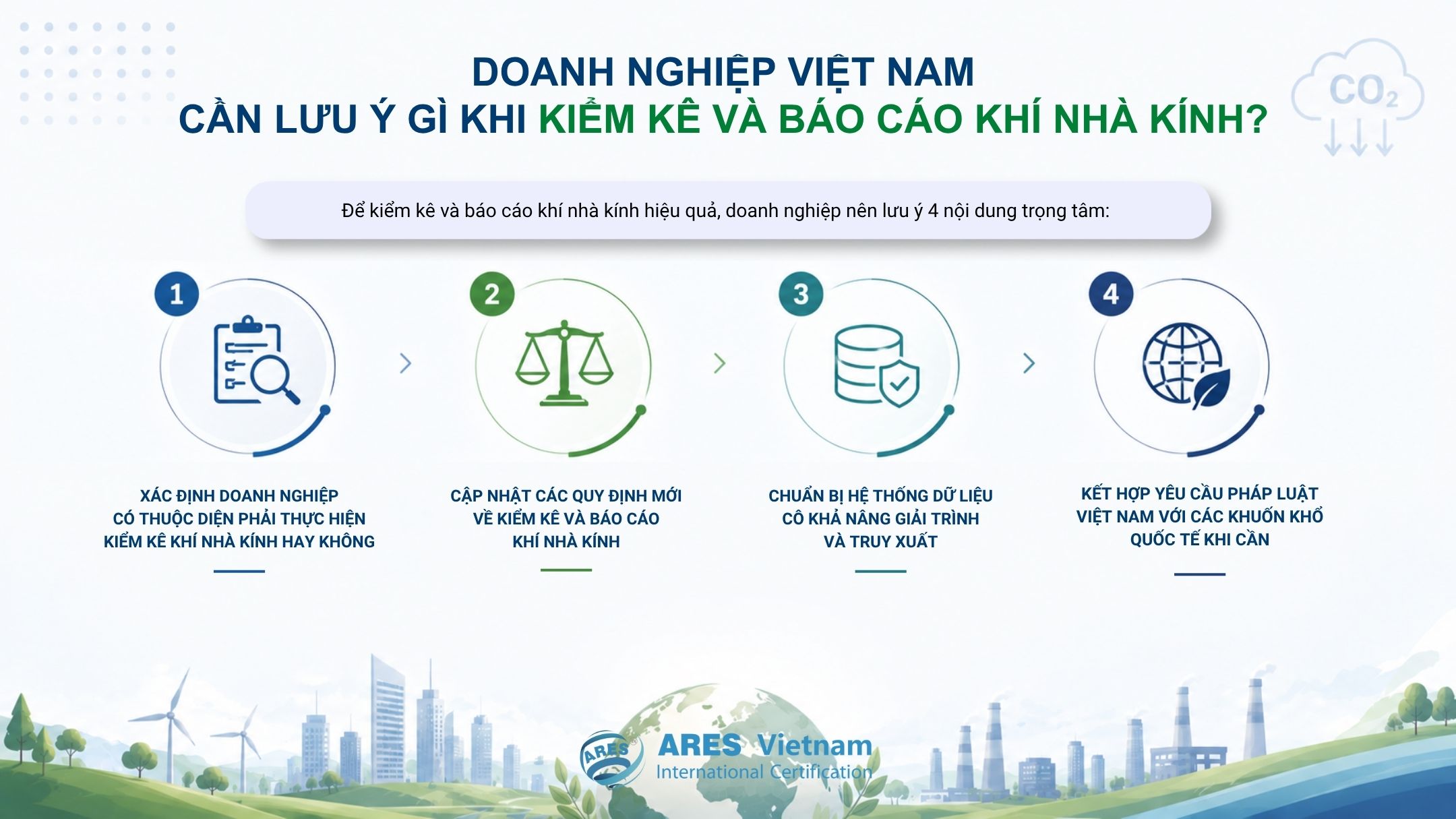
In addition to correctly classifying emissions as Scope 1, Scope 2, or Scope 3, organizations operating in Vietnam should also comply with applicable legal requirements and establish a data management system that supports their reporting objectives. When preparing a greenhouse gas inventory, organizations should pay particular attention to the following considerations.
1. Determine Whether Your Organization Is Required to Conduct a Greenhouse Gas Inventory
Not all businesses are required to conduct greenhouse gas inventories. Enterprises should refer to the 2026 updated List of greenhouse gas-emitting sectors and facilities required to conduct greenhouse gas inventories, issued together with Decision No. 42/2026/QD-TTg, to determine their obligations. This Decision was issued by the Prime Minister on 10 August 2026, takes effect from 25 September 2026, and replaces Decision No. 13/2024/QD-TTg.
Note: Where a facility is no longer included in the updated list issued under the replacement Decision, it is not required to conduct a facility-level greenhouse gas inventory or submit an inventory report in the following year for that reporting year.
2. Stay Up to Date with Vietnam’s Latest Greenhouse Gas Regulations
Vietnam’s legal framework for greenhouse gas mitigation continues to evolve through Decree No. 06/2022/NĐ-CP and its subsequent amendments, including Decree No. 119/2025/NĐ-CP and Decree No. 83/2026/NĐ-CP.
These regulations introduce and revise numerous provisions relating to greenhouse gas inventories, emissions reporting, inventory verification, and the responsibilities of government agencies and regulated organizations. Therefore, organizations should regularly monitor regulatory updates to ensure ongoing compliance with current legal requirements.
3. Establish a Traceable and Auditable Data Management System
Whether an organization prepares a greenhouse gas inventory to satisfy regulatory obligations, customer requests, or parent company requirements, maintaining a complete and consistent data management system is essential.
Records relating to emission-generating activities, activity data, emission factors, calculation methodologies, and supporting documentation should be organized systematically to facilitate future reviews, validations, or independent verification. This approach is also emphasized in Vietnam’s technical guidance for greenhouse gas inventories.
4. Align Vietnamese Regulatory Requirements with International Frameworks When Necessary
Many foreign-invested enterprises (FDIs) and export-oriented companies must comply not only with Vietnamese regulations but also with reporting requirements established by customers or multinational parent companies.
Accordingly, organizations should define the applicable reporting framework at the beginning of the process. Doing so allows them to develop an appropriate inventory methodology, establish suitable reporting boundaries, and build a consistent data management system, thereby minimizing duplicate work and reducing the need for significant adjustments in future reporting cycles.
Where Should Organizations Begin Their Greenhouse Gas Emissions Reporting Journey?
For organizations conducting a greenhouse gas inventory for the first time, following a clear, step-by-step process can help minimize errors and save time during data collection.
Table 8. Recommended Steps for Getting Started with a Greenhouse Gas Inventory
| Step | Key Activities | Objective |
| 1 | Define the reporting objective and applicable framework | Understand the reporting requirements and intended purpose of the inventory. |
| 2 | Establish organizational and reporting boundaries | Determine which entities, facilities, and emission sources should be included. |
| 3 | Identify emission sources | Compile a comprehensive list of relevant Scope 1, Scope 2, and Scope 3 emission sources. |
| 4 | Collect and validate activity data | Gather reliable operational data required for emissions quantification |
| 5 | Calculate emissions and prepare the report | Quantify emissions and present the results in accordance with the selected reporting framework. |
| 6 | Review and continuously improve | Verify completeness and consistency while strengthening the inventory process for future reporting cycles. |
These steps are intended as general guidance and may be adapted to reflect an organization’s size, industry, operational complexity, and reporting objectives.
Nevertheless, implementing the process in a logical sequence helps organizations build a robust greenhouse gas inventory system and establish a reliable foundation for future reporting.
If your organization would like to learn more about ISO 14064-1, greenhouse gas inventory system development, or greenhouse gas validation and verification services, ARES Vietnam is ready to provide professional guidance tailored to your organization’s specific needs.

Frequently Asked Questions (FAQ)
| Question | Answer |
| Can the same emission source appear in the greenhouse gas reports of multiple organizations? | Yes. The same greenhouse gas emissions may be reported differently by different organizations. For example, an emission source may be classified as Scope 1 by the organization that owns or controls it, while the very same emissions may be reported as Scope 3 by another organization within the same value chain.
However, within an individual organization’s greenhouse gas inventory, emission sources should always be classified consistently to avoid double counting. |
| How often should an organization review its inventory of emission sources? | Organizations should review their emission source inventory regularly and whenever significant operational changes occur. Examples include opening new facilities, modifying production processes, introducing new fuels, acquiring or disposing of assets, or changing transportation arrangements.
Periodic reviews help ensure that the inventory continues to accurately reflect the organization’s operations |
| What should an organization do if its suppliers cannot provide Scope 3 data? | As an initial step, organizations may identify the most significant Scope 3 emission sources, establish standardized data collection templates, and use appropriate proxy or secondary data where permitted by the applicable reporting framework. Over the longer term, organizations should collaborate with suppliers to improve the completeness, consistency, and traceability of Scope 3 data. |
| Do Scope 1, Scope 2, and Scope 3 reports require independent verification? | Independent verification depends on the applicable legal requirements, customer specifications, parent company policies, reporting programs, or the intended use of the reported information. Even when third-party verification is not mandatory, organizations are encouraged to maintain documentation and supporting data that can be reviewed, explained, and independently verified when needed. |
| Should previously reported data be adjusted if an organization’s operations change? | Whether historical data should be recalculated depends on the reporting framework, the organization’s internal policies, and the significance of the change. Events such as mergers, acquisitions, divestitures, changes in calculation methodologies, or the discovery of material errors may require historical emissions data to be reviewed or recalculated to preserve consistency and comparability across reporting periods |
| Should organizations establish significance thresholds for Scope 3 emission sources? | Yes, where appropriate. Because Scope 3 often includes numerous emission categories and relies on data from multiple external sources, organizations may establish screening criteria based on factors such as: – Estimated emissions magnitude – Relevance to business activities – Data availability and reliability – Degree of influence over the data – Reporting requirements established by customers or other stakeholders Whatever criteria are adopted, they should be clearly documented and applied consistently over time. |
| How long should Scope 1, Scope 2, and Scope 3 data be retained? | The appropriate retention period depends on applicable legal requirements, the reporting framework being used, verification cycles, and the organization’s internal document retention policies. As a best practice, organizations should establish consistent retention periods for utility bills, operational records, activity data, emission factors, calculation methodologies, and all supporting documentation. Maintaining these records facilitates future audits, data reconciliation, and comparisons across reporting periods. |
Related news

Emissions Data & CBAM: 5 Practical Questions from Factory Operations
Read more


Greenhouse Gas Inventory Challenges: What Data Should Businesses Prepare?
Read more

ARES Vietnam Conducts ISO 45001:2018 Surveillance Audit at A&J (VIETNAM) CO., LTD.
Read more

Rice Export and Import Business Under Decree 365/2026/ND-CP: What Should Enterprises Control?
Read more

ARES Vietnam Verifies Greenhouse Gas Report under ISO 14064-1:2018 at GE LAN Vietnam
Read more