ISO And Compliance Trends In 2026 That Vietnamese Businesses Should Not Overlook
The year 2026 marks a structural shift in the global business environment. Requirements for emissions transparency, traceability, supply chain responsibility, and sustainability reporting are no longer merely recommendations. Instead, they are being formalized into law, quantified, and directly linked to financial obligations.
At the same time, the role of the International Organization for Standardization is being redefined. ISO is no longer viewed simply as a quality certification system. Rather, it is increasingly recognized as a governance framework based on data and risk control.
These two trends—compliance and ISO—are converging at a common point: the capability to manage operations through measurable performance and independently verifiable data.
Compliance Trends In 2026: From Legal Obligation To Commercial Pressure
1. Carbon becomes a component of export costs
Starting January 1, 2026, the Carbon Border Adjustment Mechanism (CBAM) enters its financial phase. This mechanism is established under Regulation (EU) 2023/956. As a result, sectors such as steel, cement, aluminum, fertilizers, electricity, and hydrogen must declare emissions. They must also fulfill corresponding financial obligations when exporting to the European Union.
Consequently, companies must establish measurement systems based on EU-recognized methodologies.
Transparent data and audit readiness therefore become essential. Once emissions are translated into carbon costs, export shipments include an additional price component. This component directly influences profit margins.
2. Greenhouse gas inventories and the domestic carbon market
At the national level, legal obligations are defined in the 2020 Law on Environmental Protection.
These requirements are further detailed in Decree No. 06/2022/NĐ-CP. Facilities listed as major emitters must conduct periodic greenhouse gas inventories. They must also develop emission reduction plans and prepare for carbon market participation.
The roadmap includes a pilot phase from 2025 to 2027. Full market operation is expected after 2028. Importantly, these obligations apply regardless of export activities. Therefore, emission management systems should be established proactively. Delayed preparation may increase inspection and compliance risks.
Administrative penalties are regulated under Decree No. 45/2022/NĐ-CP.
3. Energy, traceability, and supply chain responsibility
Carbon emissions are closely linked to energy efficiency. This connection is defined in the 2010 Law on Energy Efficiency and Conservation. Key energy-consuming facilities must report annual energy consumption. They must also develop annual energy-saving plans. These measures create a foundation for controlling emission intensity.
Meanwhile, international regulations are expanding supply chain responsibilities. Examples include Regulation (EU) 2023/1115 on deforestation-free products. In addition, Directive (EU) 2022/2464 strengthens sustainability reporting obligations. Consequently, responsibility now extends across the entire value chain. Companies are accountable not only for final products. They must also ensure the accuracy of raw material data and ESG-related information.
Therefore, legal and commercial responsibilities are distributed across supply chains. Data inconsistencies at any stage may affect export contracts. They may also influence market reputation and international partnerships.
Overall, these developments show that compliance is becoming more structured. It is increasingly built on data-driven monitoring systems. Emissions, energy use, and supply chain information must be measured and independently verified.
At this intersection, the role of ISO becomes increasingly important.
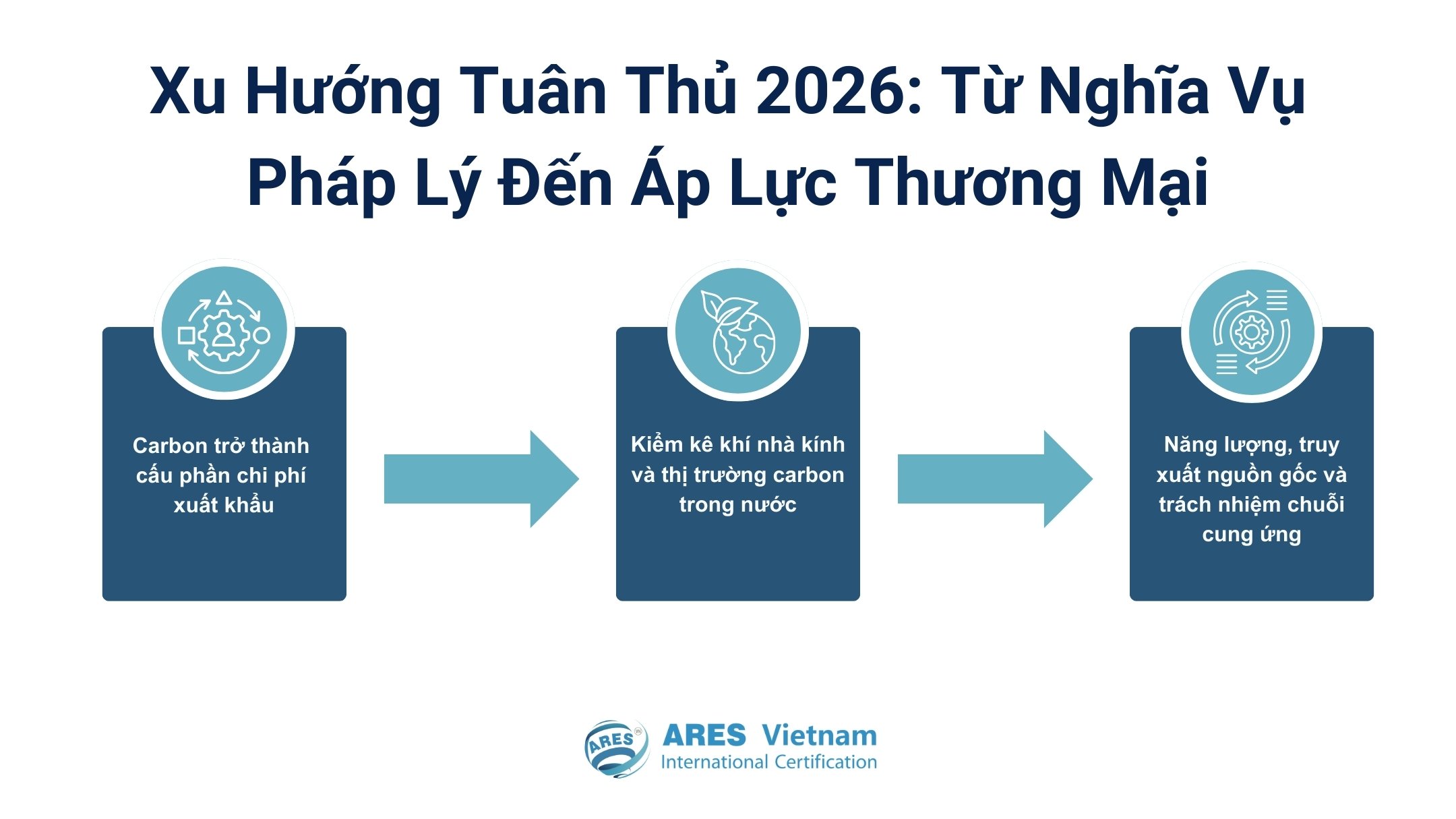
Compliance Trends in 2026: From Legal Obligation to Commercial Pressure
ISO Trends In 2026: Governance Systems In A High-Risk Environment
Following the post-COVID period and supply chain disruptions, global business risks have increased. At the same time, economies are transitioning toward low-carbon models. In this context, ISO standards are evolving beyond certification frameworks. They are increasingly recognized as governance structures. These structures help organizations manage risk and standardize operational data.
The ISO Strategy toward 2030 emphasizes four key priorities. These priorities include climate action, digital transformation, market trust, and supply chain resilience. Together, they shape the legal and commercial pressures emerging from 2026 onward.
1. Trend 1 – ISO evolves from certification to data governance
ISO performance is increasingly evaluated through data-driven management capability. The presence of documentation alone is no longer the primary indicator. Key risks must be clearly identified. Performance indicators should be measurable and structured.
Management decisions therefore rely on quantitative evidence. This approach transforms standards into practical control tools. Critical processes are monitored through operational data. Results are measured periodically. Improvements are also driven by verified information.
2. Trend 2 – Integrated management systems instead of fragmented implementation
Implementing standards separately has shown practical limitations. Examples include ISO 9001, ISO 14001, and ISO 45001. Compliance requirements are increasingly interconnected. Quality, environmental, and occupational safety risks often share common structures.
Therefore, integrated management systems are becoming strategic choices. They reduce fragmentation across organizational processes. They also eliminate duplication and improve governance efficiency.
3. Trend 3 – ISO as a structural foundation for ESG data
International regulations are strengthening sustainability disclosure obligations. A prominent example is the Corporate Sustainability Reporting Directive (CSRD) of the European Union.
In this environment, ISO standards provide structured data management frameworks. For example, ISO 14001 and ISO 50001 support systematic management of emissions and energy data. ISO does not replace ESG reporting frameworks. However, it provides an operational structure. This structure helps standardize, control, and verify data before public disclosure.
4. Trend 4 – ISO as a pre-qualification requirement in supply chains
Many multinational corporations now include ISO certification in supplier screening criteria. This requirement often appears at the early stages of supplier evaluation. Standards such as ISO 9001, ISO 14001, and ISO/IEC 27001 therefore become market entry thresholds.
As a result, compliance responsibilities extend across the entire value chain. Management systems are increasingly established as entry conditions. They are no longer considered a post-cooperation addition.
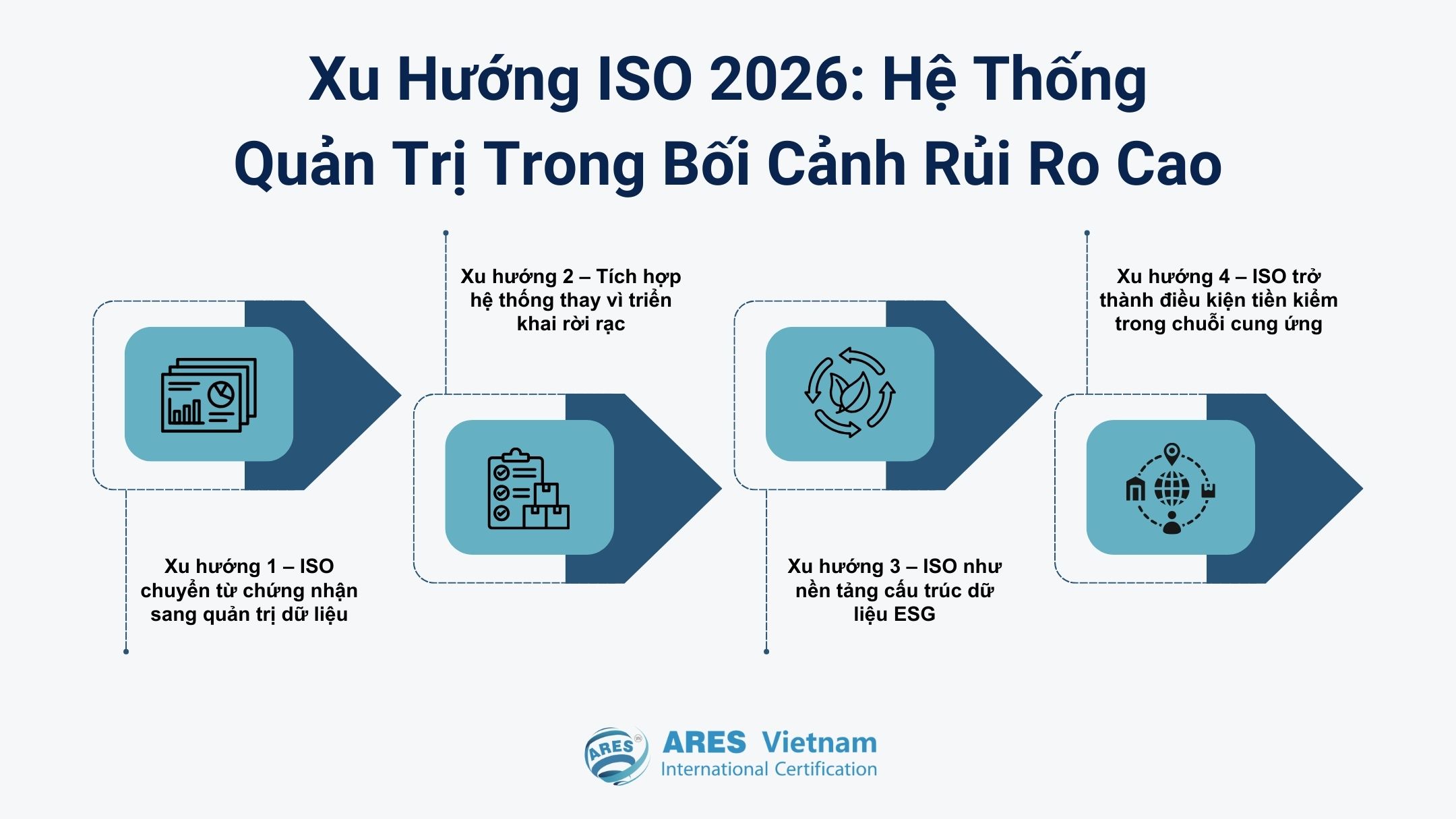
ISO Trends in 2026: Governance Systems in a High-Risk Environment
Convergence Point: Quantifiable Governance Capability
ISO trends reflect changes in how organizations design management systems. Compliance trends reflect transformations in global legal and trade structures. These two developments converge at one critical point. That point is data-based governance capability that can be independently verified.
Organizations that establish measurement and risk management foundations early gain strategic advantages. Otherwise, compliance costs after 2026 may extend beyond legal expenses. They may also influence market access, competitiveness, and investor confidence.
Importantly, 2026 is not the beginning of change. Rather, it marks the moment when existing requirements reach operational maturity. These requirements will increasingly influence profitability and global supply chain positioning.
With extensive experience in international management systems, ARES Vietnam supports organizations in building data-driven governance structures. Through this approach, companies can strengthen measurement capability, monitoring systems, and adaptive compliance readiness.
Related news

Circular 49/2026/TT-BCT Takes Effect Soon: Which Environmental Records Should Factories Review?
Read more


ARES Vietnam Conducts the Second ISO 9001:2015 Surveillance Audit at KAISER 1 & KAISER 2 (Vietnam)
Read more

National Single Window and ASEAN Single Window: What Documents Should Import–Export Businesses Prepare?
Read more

ARES Vietnam Awards ISO 9001:2015 Certification to Simona Leather Company Limited
Read more

ARES Vietnam Conducts ISO 9001:2015 Surveillance Audit at Simona Leather Company Limited
Read more