Vietnam Carbon Exchange Begins Pilot Operations: Which Businesses Are Affected?

On June 29, 2026, the Vietnam Carbon Exchange officially launched and began operating on the country’s stock market infrastructure. This milestone marks the transition from the preparation phase to the establishment of a centralized trading mechanism for emissions allowances and carbon credits.
However, the launch of the exchange does not mean that every business must immediately start trading emissions allowances or carbon credits. The level of impact depends on each company’s legal obligations, greenhouse gas emissions profile, and customer requirements.
Which organizations are directly affected, which should monitor future developments, and how should businesses prepare? ARES Vietnam explores these questions in the article below.
What Stage Is the Vietnam Carbon Exchange Currently In?
The Vietnam Carbon Exchange officially commenced operations on June 29, 2026. Under Decree No. 29/2026/ND-CP, the market is currently operating under a pilot phase through December 31, 2028, with full-scale implementation expected to begin in 2029.
The exchange operates on the country’s securities market infrastructure, with the following authorities and organizations participating in its operation:
| Organization | Primary Responsibility |
| Ministry of Agriculture and Environment | Manages the National Registry for emissions allowances and carbon credits. |
| Hanoi Stock Exchange (HNX) | Operates the carbon trading platform. |
| Vietnam Exchange (VNX) | Oversees and supervises market operations within its assigned authority. |
| Vietnam Securities Depository and Clearing Corporation (VSDC) | Provides depository, clearing, and settlement services for carbon market transactions. |
| BIDV | Serves as the settlement bank during the current pilot phase. |
Under this framework, trading, registration, depository, and settlement activities are conducted through a centralized infrastructure. However, the market remains in its pilot phase, and participation is currently limited to eligible entities rather than all businesses operating in Vietnam.
How Does the Carbon Exchange Work?
The carbon exchange provides a marketplace where eligible participants can trade and fulfill compliance obligations related to emissions allowances and carbon credits. To understand how the market operates, it is essential to distinguish between these two tradable assets.
Two Types of Tradable Carbon Assets
Although both are traded within the carbon market, emissions allowances and carbon credits are created through different mechanisms and serve distinct functions within the market.
| Criterion | Emissions Allowance | Carbon Credit |
| Nature | A permitted quantity of greenhouse gas emissions allocated to a regulated facility | A verified amount of greenhouse gas emissions reduced or removed |
| Source | Allocated by the competent authority | Generated through eligible projects, programs, or activities |
| Owner | A facility receiving an emissions allowance allocation | An organization that legally owns eligible carbon credits |
| Primary Purpose | Controls the total emissions of regulated facilities | Used for eligible offsetting purposes or traded in accordance with applicable regulations |
Understanding the distinction between these two assets is essential when determining a company’s rights, obligations, and eligibility to participate in the carbon market. Emissions allowances represent allocated emission limits, whereas carbon credits are created only after verified emission reductions or removals have been recognized under an approved mechanism.
From Allowance Allocation to Compliance Submission
For facilities that receive emissions allowances, trading is not a standalone activity. Instead, it forms part of the broader compliance process, which includes emissions monitoring, allowance reconciliation, and regulatory reporting. The overall process can be summarized as follows.
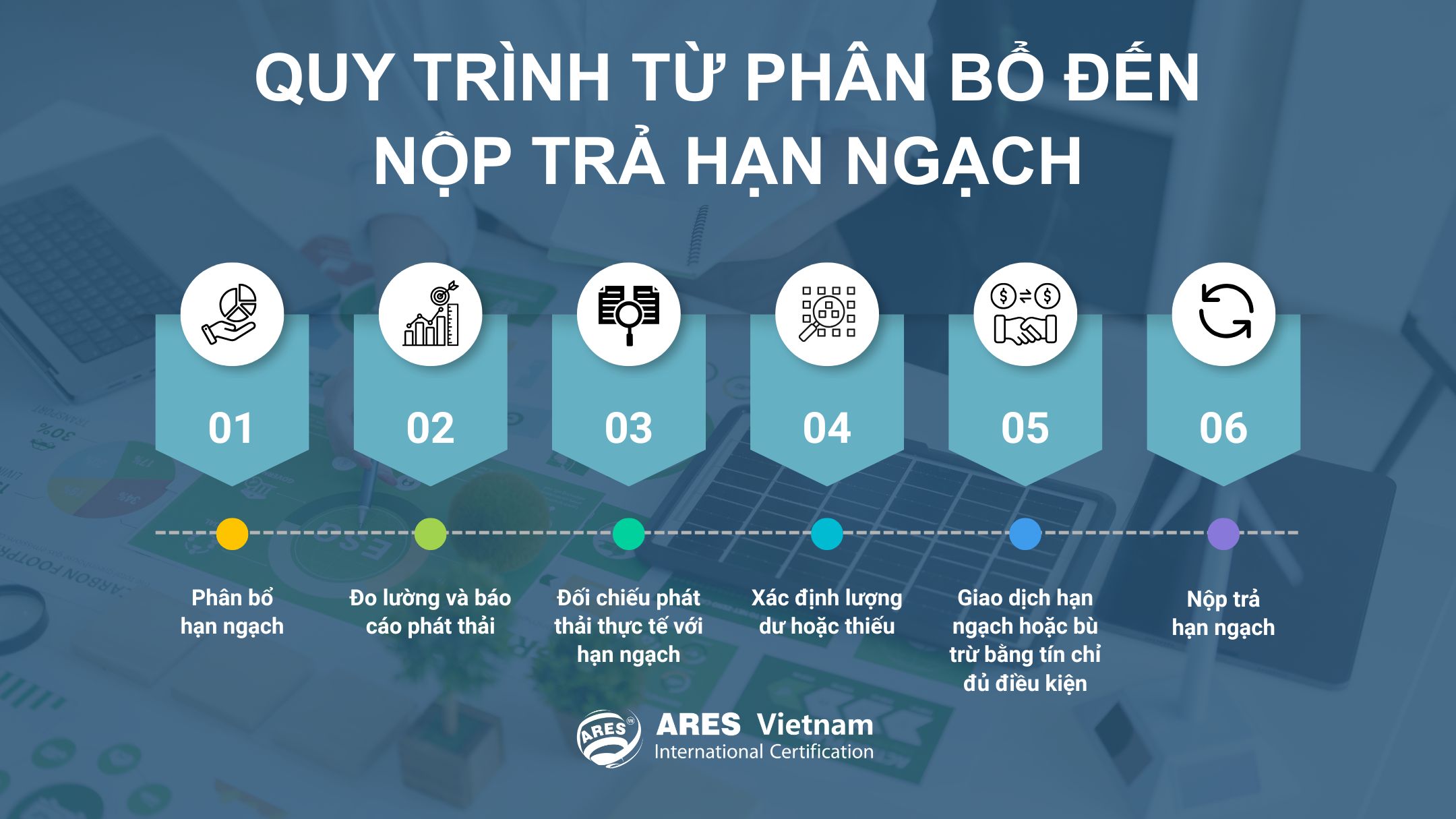
Under Decree No. 06/2022/ND-CP, as amended by Decree No. 119/2025/ND-CP, eligible carbon credits may be used for compliance offsetting. However, the total amount of credits used may not exceed 30% of the emissions allowances allocated to a facility.
If a facility fails to surrender the required amount of emissions allowances, the shortfall will be handled in accordance with applicable regulations and deducted from the allowances allocated for the subsequent compliance period.
Which Entities Are Directly Participating in the Carbon Market?
During the pilot phase, the most direct impact falls on entities that have already been allocated emissions allowances or own carbon credits that meet the regulatory requirements for trading.
92 Companies with 110 Facilities Allocated Emissions Allowances
The entities most directly affected are the facilities that have already received emissions allowances. Their actual greenhouse gas emissions will be compared with the allocated allowances to determine their compliance obligations.
In the first allocation period, emissions allowances were distributed to 92 companies operating 110 facilities, including 34 thermal power plants, 25 iron and steel production facilities, and 51 cement manufacturing plants.
For these facilities, conducting a greenhouse gas inventory is no longer simply a reporting requirement. It also provides the basis for forecasting carbon-related costs and planning allowance management strategies. Identifying potential allowance surpluses or shortages early enables businesses to allocate resources more effectively.
See also: 2026 Emissions Allowances: How Should Power, Steel, and Cement Companies Prepare?
Organizations Holding Carbon Credits
In addition to entities receiving emissions allowances, organizations holding carbon credits may also supply tradable assets to the market. However, simply reducing greenhouse gas emissions or increasing carbon removals does not automatically make those reductions eligible for trading.
To be traded on the exchange, carbon credits must originate from an approved mechanism, be properly registered, assigned unique identifiers, and satisfy all applicable regulatory requirements. As a result, not every emissions reduction activity generates carbon credits, and not every carbon credit qualifies for trading.
Do Facilities Required to Conduct a Greenhouse Gas Inventory Need to Participate in Carbon Trading Immediately?
No. Being included in the list of facilities required to conduct a greenhouse gas inventory does not automatically mean that a facility has been allocated emissions allowances or must trade on the Vietnam Carbon Exchange. Under Decision No. 13/2024/QD-TTg, 2,166 facilities are currently required to prepare greenhouse gas inventories.
Note:
This list is reviewed and updated periodically. At the time this article was last updated, the 2026 list was still undergoing the formal approval process. Businesses should refer to the latest official regulations to determine their applicable obligations.
However, during the first allowance allocation period, only 110 facilities received emissions allowances. This demonstrates that greenhouse gas inventory requirements and emissions allowance allocation are two distinct regulatory obligations. Inclusion in the GHG inventory list does not automatically qualify a facility for emissions allowance allocation.
For most of the remaining facilities, the immediate priority is not carbon trading but establishing reliable data to support greenhouse gas inventories and emissions management. This foundation will also help businesses meet future regulatory requirements if the scope of the carbon market expands.
Table: Number of Facilities Required to Conduct Greenhouse Gas Inventories Under Decision No. 13/2024/QD-TTg
| Sector | Number of Facilities |
| Industry and Trade | 1.805 |
| Transport | 75 |
| Construction | 229 |
| Natural Resources and Environment | 57 |
| Total | 2.166 |
Which Businesses Are Not Yet Direct Participants but Should Closely Monitor the Market?
Not every impact of the carbon market stems directly from emissions allowance regulations. For many businesses, the first source of pressure may come from customers, business partners, or export markets—well before any formal trading obligation arises under the Vietnam Carbon Exchange.
1. Businesses in the Supply Chain
Even if they have not been allocated emissions allowances, suppliers may still be asked by their customers to provide greenhouse gas emissions data. This information is commonly used to calculate value chain emissions or assess the environmental performance of the supply network.
Businesses may be requested to provide information such as:
- Electricity and fuel consumption data
- Raw material consumption data
- Product-related emissions information
- Emissions reduction plans or performance results
- Data used to calculate value chain emissions
These requests primarily arise from commercial relationships and supply chain management practices rather than from any direct trading obligation resulting from the launch of the Vietnam Carbon Exchange.
2. Export-Oriented Businesses
For exporters, carbon-related data requirements may arise earlier as a result of international customers’ procurement criteria and broader sustainability expectations.
During supplier assessments, businesses may be asked to provide information such as:
- Product carbon footprint (PCF)
- Carbon intensity of manufacturing operations
- Energy sources used in production
- Compliance with sustainable procurement requirements
- Emissions reduction plans or demonstrated emissions reduction performance
According to government authorities, international investors and business partners are placing increasing emphasis on green growth, clean energy, and environmental performance when selecting suppliers. As a result, even businesses that are not direct participants in the carbon market should proactively monitor these evolving expectations to meet customer requirements and remain competitive.
How Will the Carbon Exchange Change Corporate Management?
The launch of the Vietnam Carbon Exchange introduces more than a new trading mechanism. It also represents a gradual shift in how businesses manage greenhouse gas emissions across production, investment, and operational activities. For organizations directly affected—or preparing for future emissions requirements—carbon is becoming a management factor that must be measured, monitored, and incorporated into business decision-making rather than simply reported in environmental disclosures.
1. Emissions Become a Financial Variable
Once an emissions allowance system is in place, greenhouse gas emissions are no longer merely environmental indicators. They become financial factors that can directly influence a company’s operating costs.
When emissions exceed the allocated allowance, businesses must secure sufficient allowances to meet their compliance obligations through permitted mechanisms, such as purchasing additional allowances, borrowing within regulatory limits, or using eligible carbon credits for offsetting within the allowable threshold.
Conversely, effective emissions management can reduce the need to acquire additional allowances. In some cases, surplus allowances or eligible carbon credits may also generate economic value through market transactions.
2. Investment Decisions Must Take Carbon Costs into Account
Investment decisions can no longer be based solely on capital expenditures and operating costs. When evaluating new technologies, businesses should also consider long-term emissions performance and potential carbon-related costs.
Key factors to consider include:
- The cost of maintaining existing technologies
- The cost of purchasing additional emissions allowances if emissions exceed allocated limits
- Investment costs for emissions reduction technologies
- The expected reduction in greenhouse gas emissions after implementation
- The payback period for each investment option
Evaluating these factors together enables businesses to select solutions that balance economic performance with long-term emissions management objectives.
3. Environmental Data Becomes Compliance Data
As emissions data is increasingly used for greenhouse gas inventories, emissions allowance compliance, and validation or verification activities, expectations regarding data quality become significantly more stringent.
As a result, data related to electricity consumption, fuel use, raw materials, and production output should be managed using a consistent methodology to ensure that it:
- Has a clear source and supporting evidence
- Is collected and controlled through appropriate procedures
- Can be traced and verified when required
- Remains consistent across reporting periods
- Is suitable for validation or verification activities
4. Carbon Management Capability Influences Market Access and Business Credibility
Beyond regulatory compliance, carbon management capability is becoming an important criterion that customers and business partners consider when evaluating suppliers and manufacturers.
An organization’s ability to collect, control, trace, and substantiate emissions data not only enables it to respond more effectively to environmental requirements but also strengthens the credibility of its disclosures and enhances its ability to participate in carbon-related markets.
What Should Businesses Do Based On Their Level of Impact?
The launch of the Vietnam Carbon Exchange does not require every business to take the same course of action. Priorities will depend on each organization’s current regulatory obligations, potential participation in the carbon market, and customer or partner requirements.
Before developing an action plan, businesses can begin by asking the following three questions:
- Has the company been allocated emissions allowances as one of the 110 regulated facilities?
- Is the company included in the list of 2,166 facilities required to conduct greenhouse gas inventories?
- Does the company own eligible carbon credits or receive requests from customers to provide carbon-related data?
Once their current situation has been identified, businesses can prioritize the most appropriate actions using the following guidance.
| Business Status | Current Level of Impact | Priority Actions |
| Allocated emissions allowances (110 regulated facilities) | Direct and significant | Monitor actual emissions, reconcile emissions against allocated allowances, forecast potential allowance surpluses or deficits, and prepare strategies for trading and allowance surrender. |
| Required to conduct GHG inventories but not allocated emissions allowances | Direct compliance obligation | Improve activity data, calculation methodologies, GHG inventory reports, and supporting documentation for regulatory compliance and emissions management |
| Owns carbon projects or carbon credits with trading potential | Market participation opportunity | Verify the applicable carbon credit mechanism, credit eligibility, registration requirements, issuance procedures, and trading regulations. |
| Supplier or export-oriented business | Commercial impact | Prepare organization-level emissions data or product carbon footprint information to meet customer and business partner requirements |
| Not currently included in any of the above categories | Limited short-term impact | Monitor regulatory developments, improve energy data management, and identify key emissions sources to prepare for potential future requirements. |
Note:
Businesses that have not been allocated emissions allowances should not rush to purchase carbon credits simply because the exchange has become operational.
Before considering any trading activities, organizations should first determine their regulatory obligations, evaluate customer requirements, and identify the emissions data they need to manage. This provides a sound basis for selecting appropriate solutions while avoiding unnecessary costs or premature investments.
How Can ISO Standards Support Businesses?
ISO standards can help organizations establish structured management approaches and improve the reliability of greenhouse gas information. However, ISO standards do not replace legal requirements, carbon credit mechanisms, or the eligibility criteria for participating in the Vietnam Carbon Exchange.
Depending on their management objectives and operational needs, businesses may consider the following ISO standards to support greenhouse gas inventories, emissions data management, and emissions quantification.
| Business Need | upporting Standard | Primary Scope |
| Organization-level greenhouse gas inventory | ISO 14064-1 | Quantification and reporting of greenhouse gas emissions and removals at the organizational level. |
| Greenhouse gas reduction or removal projects | ISO 14064-2 | Establishing baselines, quantifying, monitoring, and reporting greenhouse gas reduction or removal projects. |
| Improving the credibility of greenhouse gas information | ISO 14064-3 | Validation and verification of greenhouse gas statements and related information. |
| Product-related greenhouse gas emissions | ISO 14067 | Quantification of a product’s carbon footprint throughout its life cycle. |
| Integrating environmental controls into business management | ISO 14001 | Establishing environmental objectives, assigning responsibilities, controlling operations, and continually improving the environmental management system. |
The appropriate standard should be selected based on the level of data being managed—organizational, project, or product—as well as the intended reporting objectives, verification requirements, and the expectations of relevant programs or customers.
If your organization is planning to implement ISO standards to strengthen carbon and environmental management, ARES Vietnam is ready to provide assessment and certification services tailored to your specific scope and business needs.

Frequently Asked Questions (FAQ)
| Question | Answer |
| Do all businesses in Vietnam have to participate in the Vietnam Carbon Exchange? |
No. Only entities that fall within the applicable regulatory scope and hold eligible emissions allowances or carbon credits are subject to trading activities under current regulations.
|
| Do all 2,166 facilities required to conduct greenhouse gas inventories have to purchase emissions allowances? |
No. A facility is only subject to emissions allowance obligations if it falls within the allowance allocation scheme established by the competent authority.
|
| Are emissions allowances the same as carbon credits? |
No. An emissions allowance represents a permitted quantity of greenhouse gas emissions allocated to a regulated facility, whereas a carbon credit represents a verified amount of greenhouse gas emissions reduced or removed under an approved mechanism.
|
| What should a business do if its emissions exceed its allocated allowances? |
The business should acquire additional emissions allowances or use eligible carbon credits for offsetting within the limits permitted by applicable regulations before completing its allowance surrender obligation.
|
| Does implementing ISO 14064-1 generate carbon credits? |
No. ISO 14064-1 provides requirements for quantifying and reporting greenhouse gas emissions and removals at the organizational level. Carbon credits can only be generated through eligible projects, approved methodologies, and recognized carbon crediting mechanisms.
|
Related news

Greenhouse Gas Inventory Process for Businesses Under ISO 14064-1
Read more

Control of Measuring Equipment in Manufacturing Plants: What Should FDI Enterprises Consider Under ISO 9001?
Read more

ARES VIETNAM AT THE 2ND MEMBER CONGRESS OF TERM 19 & MID-AUTUMN FESTIVAL GALA
Read more

Liquid Milk Has Passed Testing: What Else Should Businesses Control?
Read more

ARES Vietnam Conducts ISO 50001:2018 Surveillance Audit at Gemtek Vietnam Corporation Limited
Read more