ISO Standards For The Garment Industry
Today, the garment industry competes not only in production speed, cost, and manufacturing capacity but also in meeting increasingly demanding requirements from customers, business partners, and global supply chains. In addition to product quality, manufacturers must effectively manage environmental impacts, occupational health and safety, energy use, production data, and sustainability.
In this context, relying heavily on individual experience can lead to inconsistent processes, poor error control, and difficulties in demonstrating management capability when working with major buyers or export markets. Therefore, many garment manufacturers are adopting ISO standards as a foundation for standardizing management systems and improving operational performance.
So, which ISO standards should garment manufacturers implement? More importantly, where should they begin to match their production characteristics and business objectives? This article provides a practical overview of the most relevant ISO standards for the garment industry.
Why Should Garment Manufacturers Implement ISO Standards?
Garment manufacturers today must do more than produce quality products. They also need to manage production schedules, operational costs, environmental responsibilities, workplace safety, and customer requirements throughout the supply chain.
Problems such as incorrect measurements, color variations, defective stitching, or nonconforming finishing can increase rework costs, delay deliveries, and damage a company’s reputation. Furthermore, major international brands often evaluate not only product quality but also management systems, production processes, quality records, and factory compliance.
Implementing ISO standards helps garment manufacturers standardize processes, improve risk management, and maintain consistent operations. As a result, businesses are better positioned to meet customer expectations, strengthen partnerships, and participate more effectively in global supply chains.
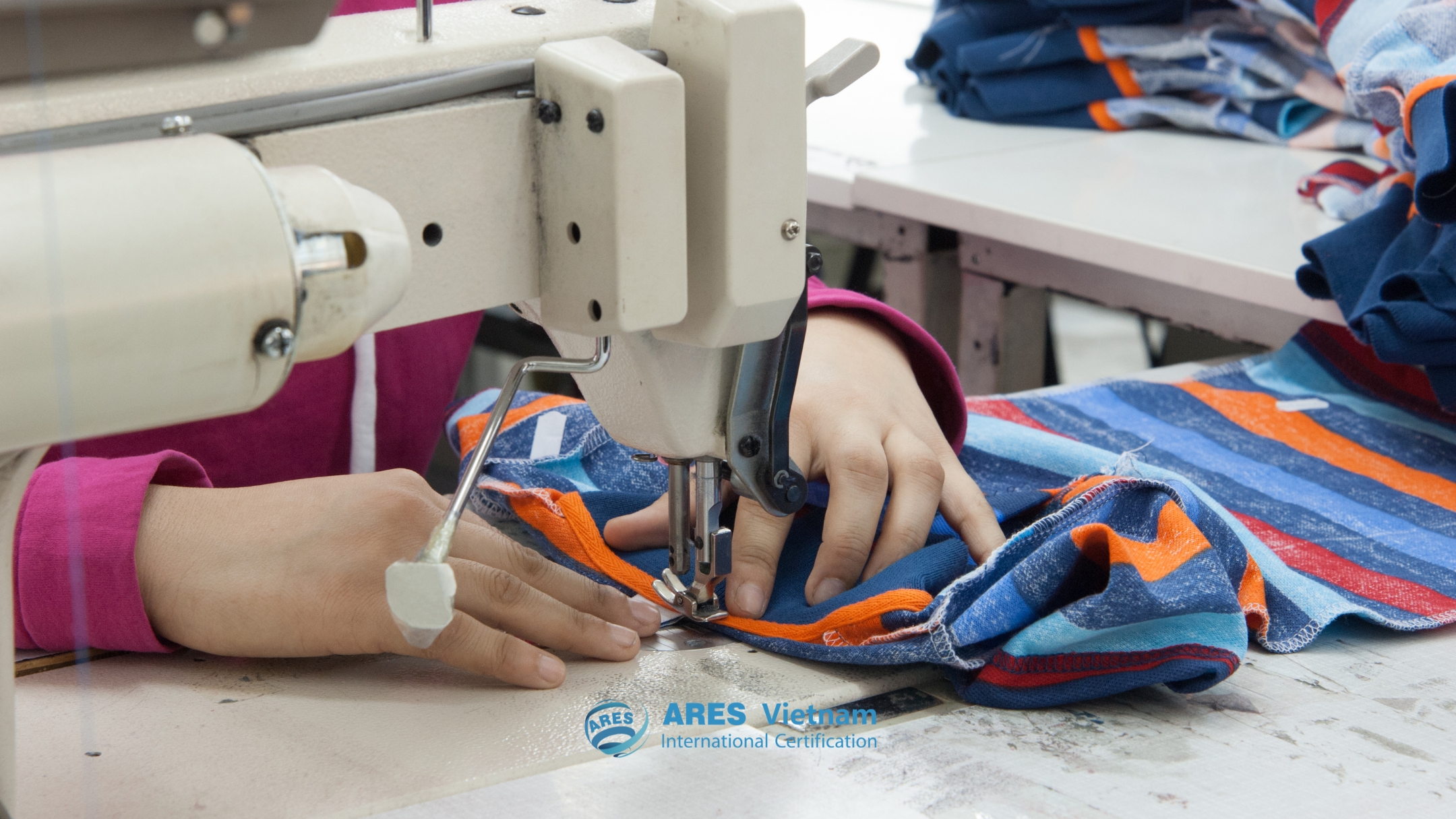
ISO standards apply in the garment industry
Overview Of ISO Standards For The Garment Industry
Depending on their production model, operational characteristics, and customer requirements, garment manufacturers may implement different ISO standards. Each standard focuses on a specific management objective and addresses different business needs.
| ISO Standard | Primary Purpose | Suitable for |
| ISO 9001:2015 | Quality Management | Garment workshops, apparel factories, CMT, FOB, and OEM manufacturers |
| ISO 14001:2026 | Environmental Management | Sewing, textile, dyeing, washing, printing, and finishing facilities |
| ISO 45001:2018 | Occupational Health and Safety Management | Factories with large workforces, machinery, and production lines |
| ISO 50001:2018 | Energy Management | Facilities with high electricity, steam, compressed air, or boiler consumption |
| ISO 14064-1:2018 | Organizational Greenhouse Gas Inventory | Export-oriented businesses or companies pursuing ESG initiatives |
| ISO 14067:2018 | Product Carbon Footprint | Organizations calculating carbon emissions for individual products |
| ISO/IEC 27001:2022 | Information Security Management | Businesses managing order data, product designs, and customer information |
| ISO 3758:2023 | Textile Care Labelling Symbols | Manufacturers responsible for product care labels and garment instructions |
Choosing the right ISO standard should be based on current operations, business objectives, and existing management requirements. Businesses do not need to implement every standard at the same time. Instead, they should prioritize the standards that deliver the greatest value at each stage of development.
ISO 9001:2015 – Quality Management System for the Garment Industry
In garment manufacturing, quality is not created by a single production stage. Instead, it is built throughout the entire manufacturing process. ISO 9001:2015 provides a management framework that helps businesses maintain process consistency from raw material inspection to finished products. When implemented effectively, every production stage follows the same standards, reducing variation between production batches and sewing lines.
ISO 14001:2026 – Environmental Management System for Garment Manufacturers
Environmental performance has become an increasingly important concern in the textile and garment industry, especially in dyeing, washing, printing, and finishing operations. ISO 14001:2026 helps organizations establish systematic controls and continually improve the environmental impacts of manufacturing activities, including wastewater, air emissions, chemicals, and industrial waste.
ISO 45001:2018 – Occupational Health and Safety Management System
Garment factories often operate with large workforces, continuous machinery, and production environments that may expose employees to various workplace hazards. ISO 45001:2018 focuses on identifying risks and reducing hazards related to machinery, noise, dust, heat, and prolonged working conditions. Consequently, businesses can prevent incidents proactively instead of responding only after accidents occur.
ISO 50001:2018 – Energy Management System for Garment Factories
Energy costs account for a significant portion of operating expenses in many garment factories, particularly as production capacity expands. Systems such as electricity, steam, compressed air, boilers, cooling equipment, ironing, drying, and finishing can consume substantial energy if they are not properly monitored. ISO 50001:2018 helps organizations identify major energy-consuming areas and develop improvement measures based on measurable performance data.
ISO 14064-1:2018 and ISO 14067:2018 – Carbon Emissions Management for the Garment Industry
Demand for transparent carbon reporting continues to increase throughout the global textile supply chain. ISO 14064-1:2018 focuses on quantifying and reporting organizational greenhouse gas emissions, providing a comprehensive picture of corporate emissions. Meanwhile, ISO 14067:2018 addresses the carbon footprint of individual products, enabling businesses to calculate emissions associated with specific products.
ISO/IEC 27001:2022 – Information Security Management System for the Garment Industry
As digital transformation accelerates, data has become one of the most valuable assets in the garment industry. Product designs, customer orders, technical specifications, quotations, and customer information all require effective protection against unauthorized access or data breaches. ISO/IEC 27001:2022 provides a structured framework for managing information security risks and safeguarding critical business data.
ISO 3758:2023 and Related Technical Standards for Textiles
Unlike management system standards, ISO 3758:2023 focuses specifically on textile care labelling and garment care instructions. The standard specifies internationally recognized symbols for washing, drying, ironing, bleaching, and professional textile care, ensuring consistent product care information on garment labels.
In addition to ISO 3758:2023, the textile industry also applies various technical standards to evaluate the characteristics and quality of raw materials, fabrics, and finished products. The applicable standards depend on customer requirements, export market regulations, and specific product categories.
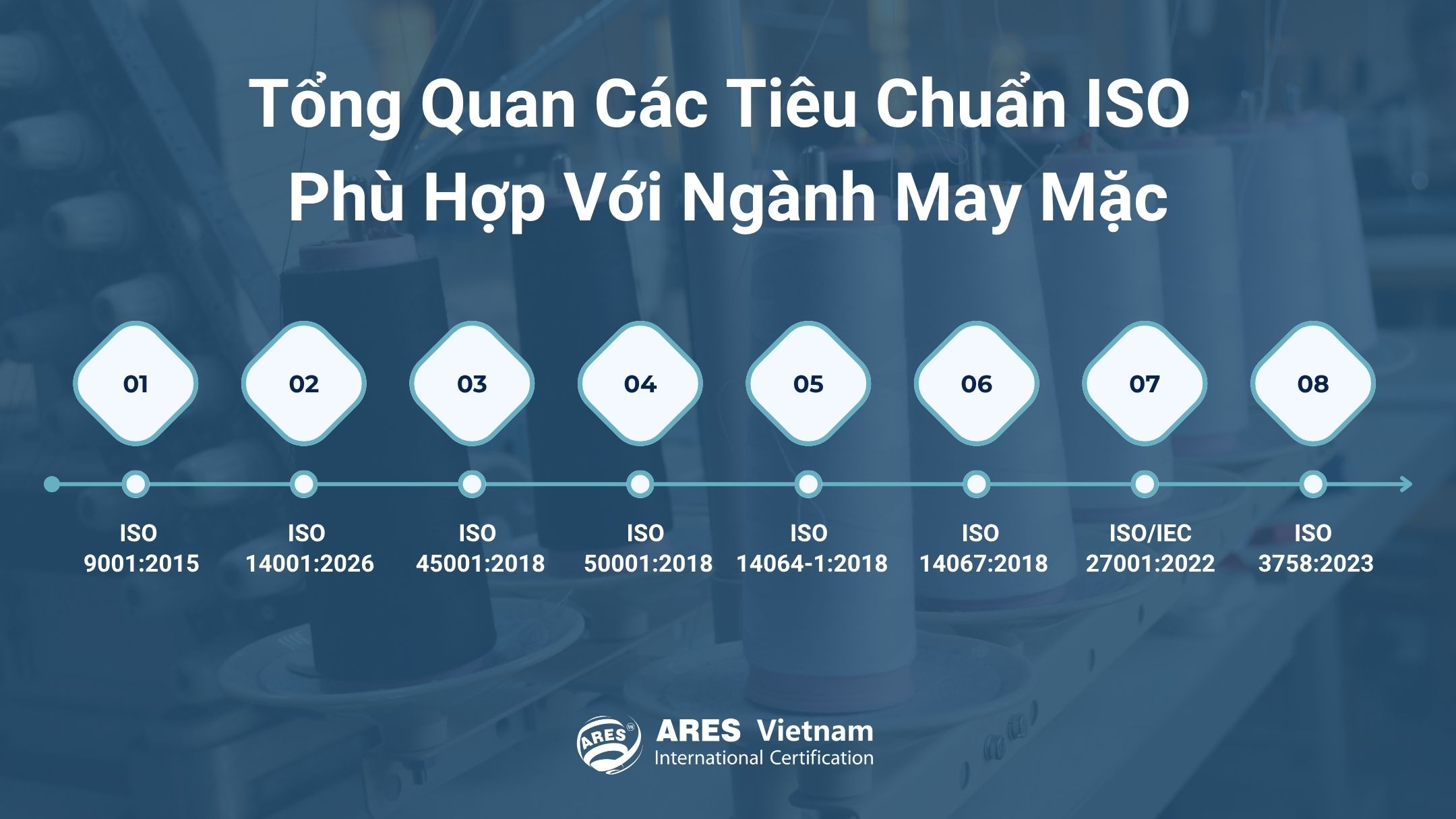
Overview of ISO standards suitable for the garment industry
Which ISO Standard Should Garment Manufacturers Implement First?
In practice, the choice of an ISO standard usually depends on the challenges a business is facing or the specific requirements of its customers. Therefore, companies do not need to implement every ISO standard at the same time.
Below are some common recommendations for garment manufacturers.
| Business Situation | Recommended ISO Standard |
| Production processes are unstable, and recurring defects occur frequently | ISO 9001:2015 |
| Product quality needs to be standardized to work with major customers | ISO 9001:2015 |
| The factory operates textile, dyeing, washing, printing, or finishing processes | ISO 14001:2026 |
| The factory has a large workforce, machinery, and multiple production lines | ISO 45001:2018 |
| Electricity, steam, compressed air, or fuel costs continue to increase | ISO 50001:2018 |
| Customers require greenhouse gas data or ESG reporting | ISO 14064-1:2018 |
| Customers require product carbon footprint information | ISO 14067:2018 |
| The company manages large volumes of order data and product designs | ISO/IEC 27001:2022 |
For businesses that have never implemented an ISO management system, ISO 9001 is often the best place to start. Afterwards, additional standards can be integrated based on operational needs, production characteristics, and customer requirements.
Benefits Of Implementing ISO For Garment Manufacturers
ISO provides a structured management framework that helps garment manufacturers improve operational performance while maintaining consistency across the entire organization.
▶️Standardize processes from raw materials to finished products: Establish consistent procedures across every production stage and reduce variations between production batches and sewing lines.
▶️Improve product quality: Increase the ability to identify and minimize technical defects, helping maintain consistent product quality.
▶️Optimize resource utilization: Reduce waste of raw materials, accessories, energy, and other operational resources throughout the factory.
▶️Enhance delivery performance: Minimize production disruptions and support on-time delivery to customers.
▶️Strengthen internal management: Clearly define departmental responsibilities and improve cross-functional collaboration while ensuring consistent information flow.
▶️Increase market competitiveness: Better meet the requirements of customers, business partners, and global supply chains.
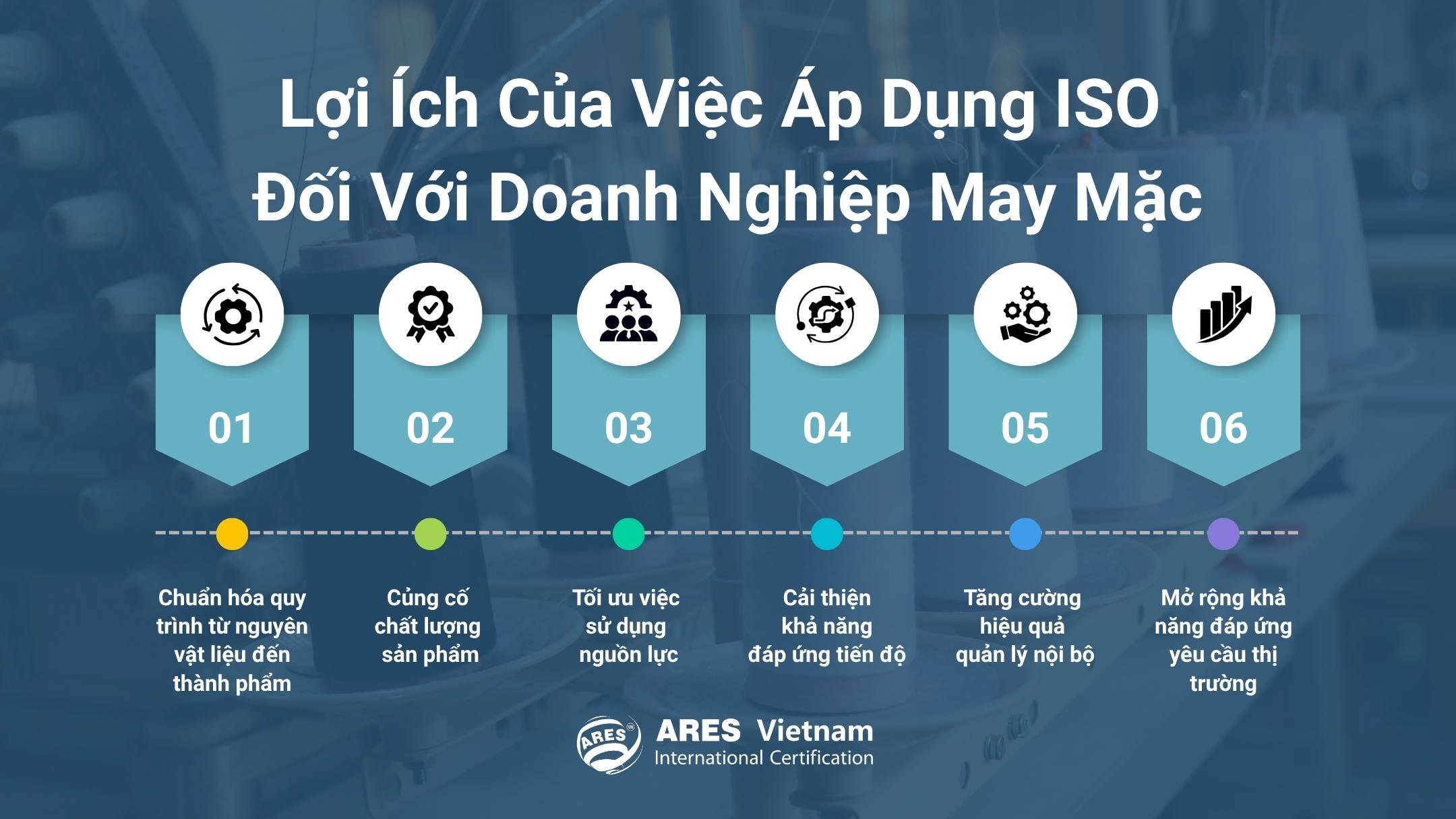
Benefits of applying ISO for garment businesses
Common Mistakes When Implementing ISO In The Garment Industry
Although ISO offers significant benefits, many garment manufacturers still encounter challenges during implementation.
1. Implementing ISO Only for Certification
Some organizations implement ISO solely to obtain certification or pass an audit. As a result, the management system is not integrated into daily operations, and its full value is never realized.
2. Developing ISO Documentation That Does Not Reflect Actual Operations
Many documented procedures are overly theoretical and do not accurately reflect how the factory operates. Consequently, employees often find them difficult to apply in practice.
3. Lack of Consistent Training and Cross-Department Collaboration
Employees may have different interpretations of ISO requirements, while communication and coordination between departments remain limited. This can reduce the overall effectiveness of the management system.
4. Failing to Maintain and Continually Improve the System After Certification
Without regular reviews and updates to reflect organizational changes, documented processes may gradually lose their effectiveness and no longer support business management efficiently.
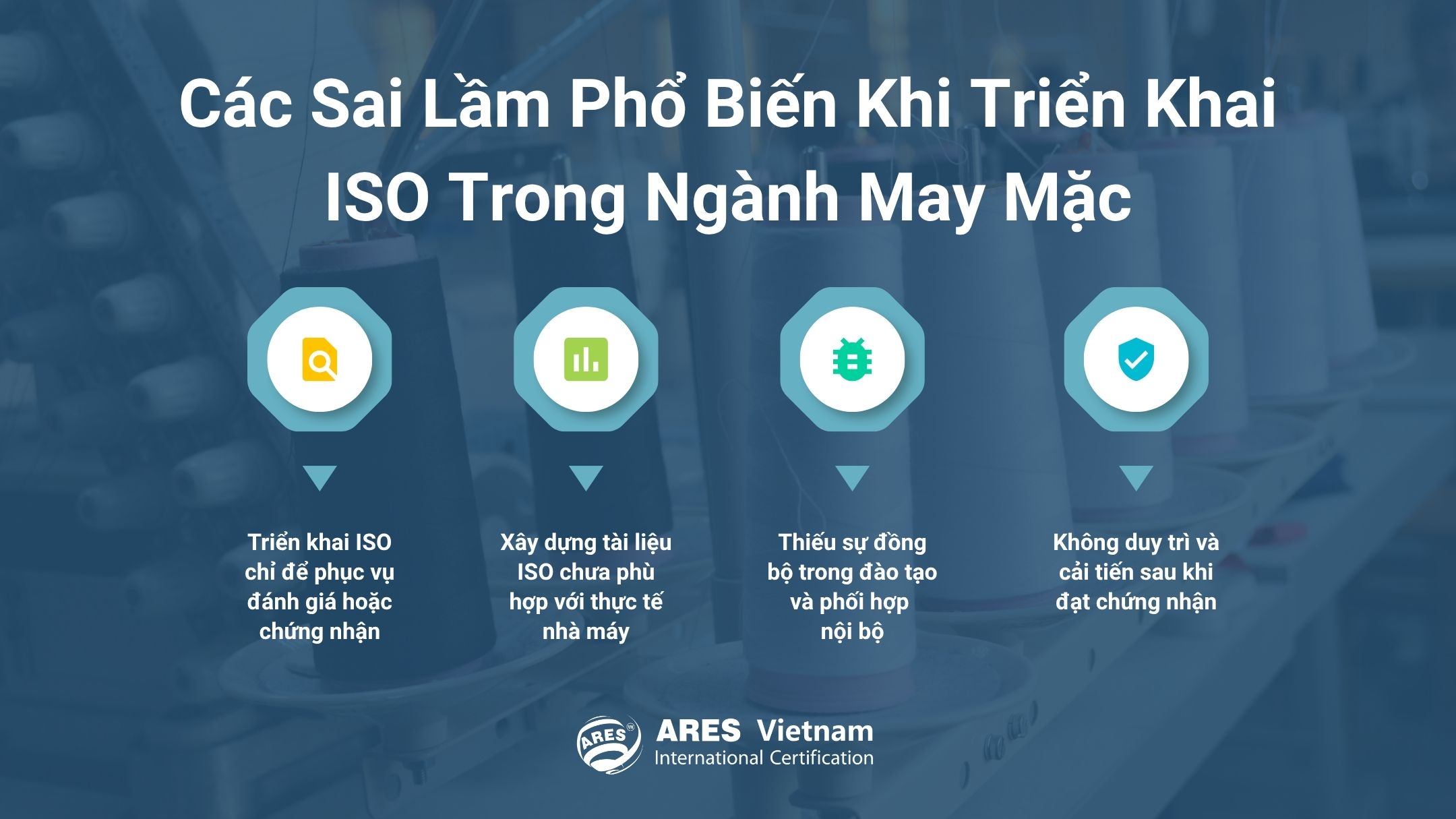
Common mistakes when implementing ISO in the garment industry
How Should Garment Manufacturers Prepare For ISO Certification?
To ensure a smooth certification process, businesses should begin preparing well before the certification audit.
- Define the scope of the ISO management system.
- Review existing production processes and records.
- Standardize documented information, forms, and record retention practices.
- Assign personnel responsible for implementing the management system.
- Provide ISO awareness training for relevant departments.
- Conduct internal audits.
- Correct identified nonconformities before the certification audit.
ISO implementation delivers lasting value only when businesses clearly understand their objectives and establish an implementation roadmap that aligns with their operational conditions.
For organizations seeking information about ISO standards for the garment industry or the ISO certification process, ARES Vietnam provides guidance on international standard requirements, certification scope, and certification procedures. In addition, all certification activities are conducted with independence, impartiality, and objectivity.
- Hotline: 085.3858.553
- Email: service@aresvietnam.vn
Frequently Asked Questions About ISO Standards For The Garment Industry
| Question | Answer |
| Should small garment manufacturers implement ISO? | Yes. ISO is not only suitable for large manufacturing facilities but also provides significant value for garment workshops and small businesses that want to standardize their processes and strengthen their management capabilities. |
| Can a company integrate multiple ISO standards into one management system? | Yes. Many organizations integrate standards such as ISO 9001, ISO 14001, and ISO 45001 into a single management system. This approach improves efficiency and reduces duplication across business operations. |
| Does a factory without textile or dyeing processes need ISO 14001? | Not necessarily. However, ISO 14001 may still be important if customers or business partners include environmental performance as part of their supplier evaluation criteria. |
| How long is an ISO certification valid? | Most ISO certifications are valid for three years. During this period, organizations must successfully complete periodic surveillance audits to maintain the validity of their certification. |
| Does a company need to be audited again after obtaining ISO certification? | Yes. After certification is granted, organizations must undergo regular surveillance audits and a recertification audit at the end of the certification cycle to maintain their certified status. |
Related news

Emissions Data & CBAM: 5 Practical Questions from Factory Operations
Read more


Greenhouse Gas Inventory Challenges: What Data Should Businesses Prepare?
Read more

ARES Vietnam Conducts ISO 45001:2018 Surveillance Audit at A&J (VIETNAM) CO., LTD.
Read more

Rice Export and Import Business Under Decree 365/2026/ND-CP: What Should Enterprises Control?
Read more

ARES Vietnam Verifies Greenhouse Gas Report under ISO 14064-1:2018 at GE LAN Vietnam
Read more