Liquid Milk Has Passed Testing: What Else Should Businesses Control?
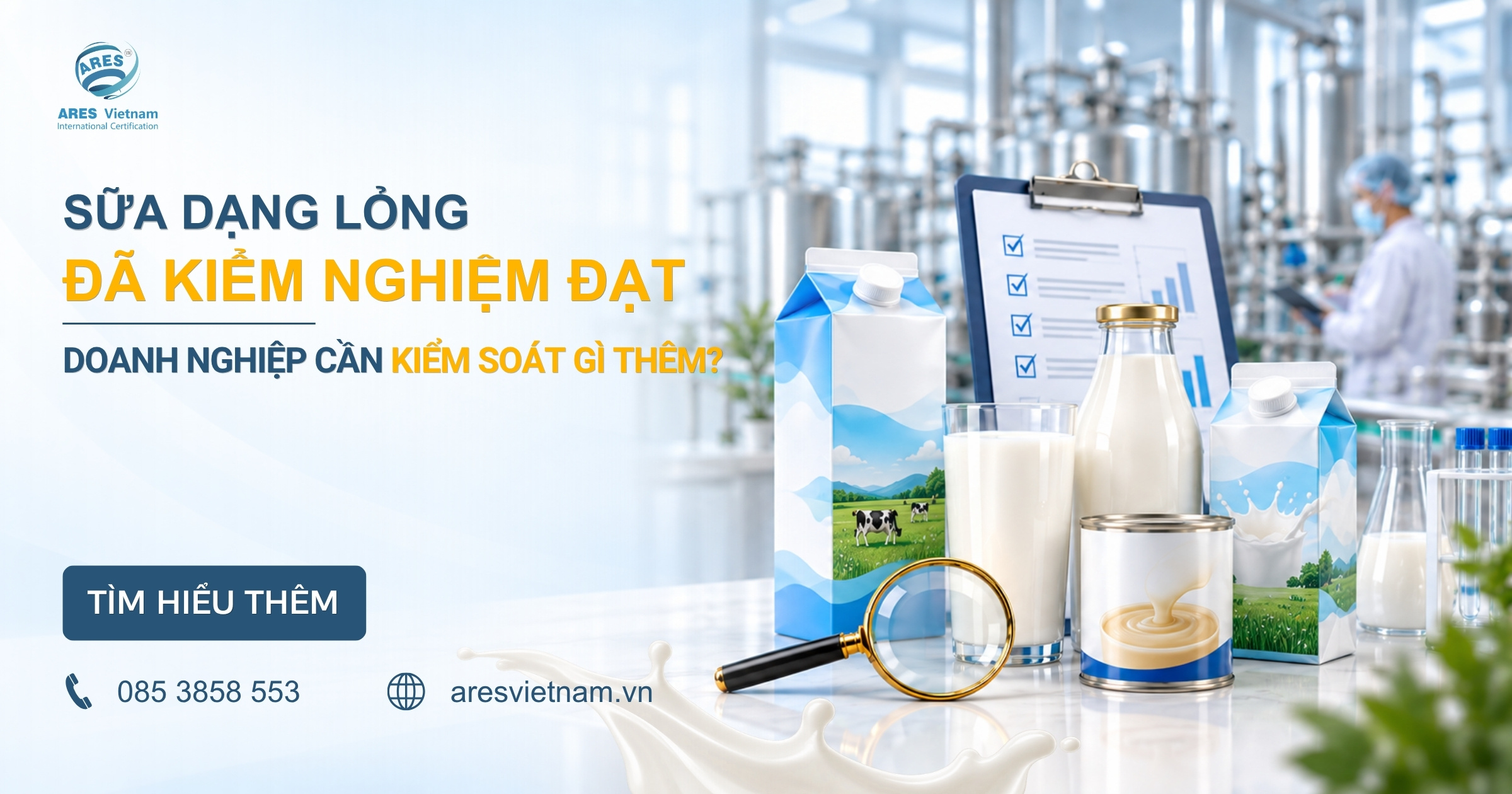
Test results provide an important basis for assessing a product against the parameters tested. However, the quality and safety of liquid milk also depend on many factors before and after sampling.
With the introduction of QCVN 28:2026/BCT for liquid milk products, businesses should review how they control products throughout the supply chain—from incoming materials and processing to distribution. So, beyond test results, which areas require control to maintain product consistency? Explore the details with ARES Vietnam below.
QCVN 28:2026/BCT: Key Information for Dairy Businesses
QCVN 28:2026/BCT was issued together with Circular No. 09/2026/TT-BCT by the Ministry of Industry and Trade on 26 February 2026. Its scope covers fresh milk; reconstituted milk, recombined milk and blended milk; concentrated milk; sweetened condensed milk; and concentr
Excluded products include infant formula for children up to 36 months of age, formula for special medical purposes for infants, and functional foods.
Businesses should pay attention to three main areas:
- Product classification: Identify the correct product group based on raw material source, composition and processing method.
- Technical requirements: Physical and chemical parameters; limits for contaminants and microorganisms; food additive use; sampling; and test methods.
- Management requirements: Labelling, declaration of conformity and traceability.
Implementation timeline: Under Decision No. 2130/QĐ-BCT dated 28 August 2026, the effectiveness of Circular No. 09/2026/TT-BCT was temporarily suspended, and the implementation date was extended to 1 December 2026. Businesses should monitor amending documents to update applicable requirements and implementation timelines.
Why Should Businesses Look Beyond Test Results?
Test results form an important part of product control. Still, the information they provide has a defined scope. Businesses should consider three broader aspects:
- The evidence has a specific scope: Test results relate to a particular sample, set of parameters and testing conditions. Their representativeness for an entire batch also depends on the sampling plan and sampling method.
- Operating conditions can change: Suppliers, formulations, sanitation practices, heat treatment and storage conditions can affect subsequent batches.
- Testing alone does not fully demonstrate control during deviations: When an issue occurs in a batch, the business still needs to identify the affected scope, related quantity, distribution locations and appropriate response.
Therefore, testing should work alongside the following control activities.
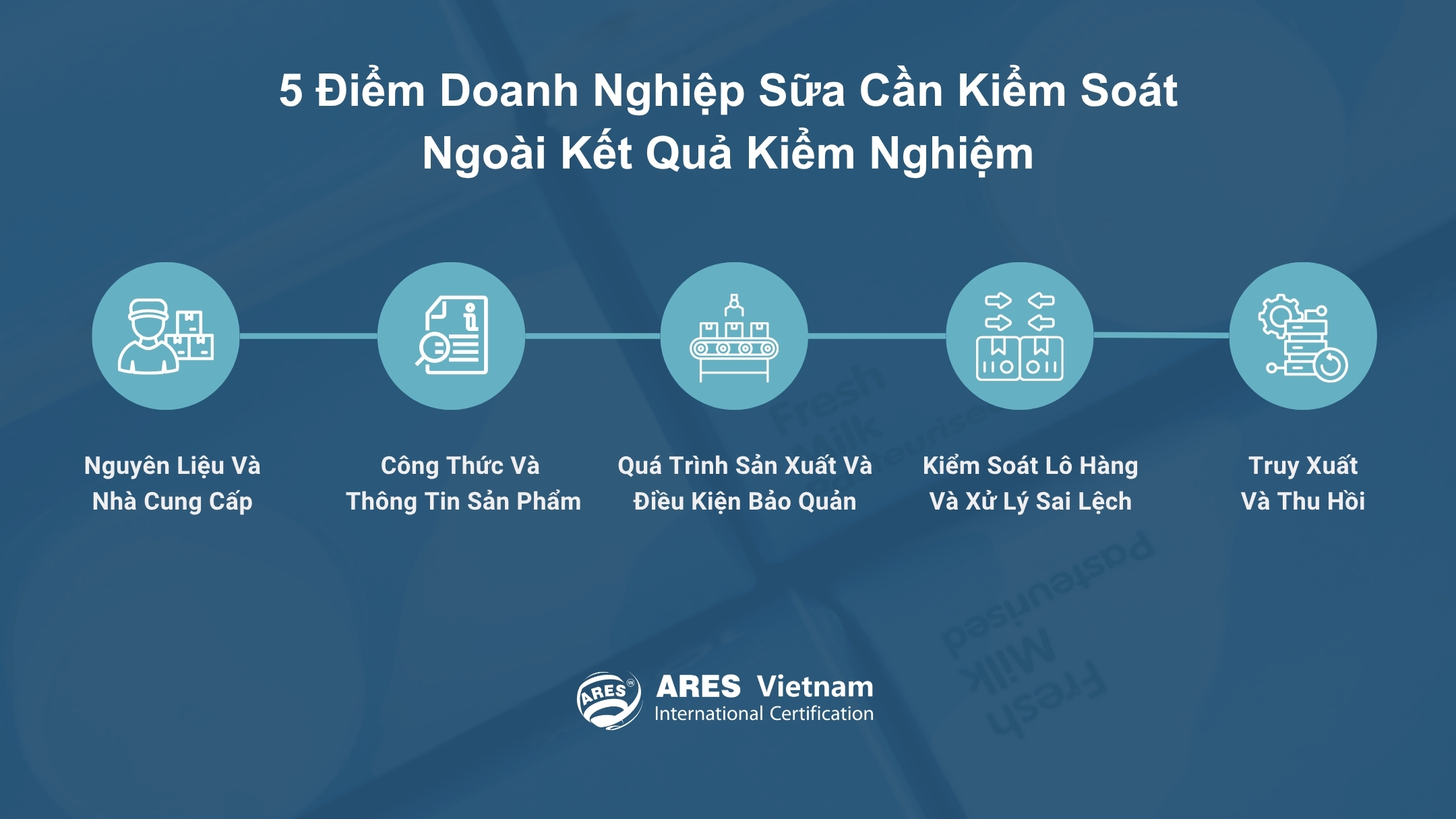
5 Areas Dairy Businesses Should Control Beyond Test Results
1. Raw Materials and Suppliers
Businesses should define acceptance criteria, incoming inspection information and supplier evaluation methods. Supplier documents provide supporting evidence, while a complete assessment of incoming materials requires additional controls. For imported finished products, businesses should verify the manufacturer, product specifications and batch information.
Review question: When a raw material source or supplier changes, who assesses the impact and approves the new source before acceptance?
2. Formulation and Product Information
The formulation should be managed consistently with the information used to control and identify the product. The formulation, technical specification, test results and label information should all reflect the same actual product.
When ingredients, usage ratios or technical specifications change, businesses should identify the affected documents and control activities. They can then review, update or reassess them as appropriate. For imported products, the same principle applies when an overseas manufacturer changes its formulation or technical specifications.
Review question: When a formulation changes, do the current test results still remain relevant? Should the business conduct further testing and update the technical specification and product label?
3. Production Processes and Storage Conditions
For manufacturing facilities, stages such as heat treatment, sanitation, filling, packaging and storage should operate according to parameters or criteria that suit the product. When operating conditions deviate, the system should enable timely detection and identification of related products.
Importers may not operate the production line directly. However, they still need to evaluate suppliers, coordinate with manufacturers to control product information, and manage receiving, storage and transportation within their own operations.
Review question: When process parameters or storage conditions deviate, can the business identify the scope of affected products?
4. Batch Control and Deviation Handling
Before releasing a batch from the warehouse or placing it on the market, businesses should clearly define acceptance criteria and the authorised person responsible for release approval. Supporting evidence may include inspection or testing results under the established plan, records confirming relevant control conditions, and the status of any deviations that have arisen.
When a product or batch shows signs of nonconformity, the business should identify the batch and control its status. It should also conduct an assessment before deciding on the appropriate action. This approach helps prevent products that have yet to meet acceptance conditions from entering distribution channels.
Review question: Can the current system prevent batches that have yet to meet release conditions from leaving the warehouse or reaching the market?
5. Traceability and Recall
Traceability data should link batches across each stage. For manufacturers and importers, the information chain may be organised as follows:
| Business type | Example of an information chain to link |
| Manufacturing business | Supplier → Raw materials/additives → Raw material batch → Production batch records → Finished products → Warehouse/distribution |
| Importing business | Overseas manufacturer → Production batch → Batch-related documents → Import batch → Warehouse → Distribution |
When an issue relates to a product batch, linked information can help businesses identify the relevant source, remaining stock, storage locations and distribution destinations. As a result, they have a clearer basis for defining the products that require review and selecting an appropriate response.
For recall activities, businesses should determine in advance the person in charge, notification methods for relevant parties and procedures for monitoring implementation results.
Review question: When an issue arises with a product batch, can the business trace relevant information and organise a recall that matches the scope requiring action?
How Does ISO 22000 Support These Control Activities?
ISO 22000 provides a management framework that helps businesses organise and maintain food safety controls consistently. In addition, the standard sets out food safety management system requirements for organisations across the food chain.
Through system management, prerequisite programmes and hazard analysis, businesses can define responsibilities, select control measures, and establish suitable monitoring and verification activities. The system also supports updates and continual improvement when operating conditions or relevant factors change.
However, ISO 22000 certification complements rather than replaces product-specific legal requirements. The standard focuses on an organisation’s food safety management capability. Accordingly, certification alone does not establish full compliance with requirements for product classification, quality parameters, labelling, declarations or other procedures under QCVN and relevant regulations.
ARES Vietnam provides food safety management system assessment and certification services in accordance with ISO 22000. These services confirm the conformity of a system with standard requirements within the certification scope.
- Hotline: 085.3858.553
- Email: service@aresvietnam.vn
Frequently Asked Questions (FAQ)
| Question | Answer |
| Do businesses need to test every batch of liquid milk products? | Businesses should establish testing plans based on applicable legal requirements, product characteristics, risk level, process control capability and relevant customer requirements. |
| Are a COA and a test report the same type of document? | Names may vary by issuing organisation. When using a COA (Certificate of Analysis) or test report, businesses should verify the sample or batch covered, parameters, methods and results instead of relying solely on the document title. |
| What is the role of a retained sample when a compliant test result is already available? | Retained samples can support product reviews when complaints, deviations or verification needs arise for a production batch. The retention method, quantity and period should suit product characteristics, the control system and applicable business requirements. |
| How should a business respond when internal inspection results differ from a supplier’s COA? | Before accepting or rejecting materials, the business should verify the correct batch, sampling conditions, test method, testing laboratory and applicable criteria. Where the difference remains unclear, related materials or products should stay under controlled status until sufficient evidence supports a decision. |
Related news
Greenhouse Gas Inventory Process for Businesses Under ISO 14064-1
Read more

Control of Measuring Equipment in Manufacturing Plants: What Should FDI Enterprises Consider Under ISO 9001?
Read more
ARES VIETNAM AT THE 2ND MEMBER CONGRESS OF TERM 19 & MID-AUTUMN FESTIVAL GALA
Read more

ARES Vietnam Conducts ISO 50001:2018 Surveillance Audit at Gemtek Vietnam Corporation Limited
Read more
Implementing ISO 50001: How Can FDI Companies Benefit from Systematic Energy Management?
Read more