Implementing ISO 50001: How Can FDI Companies Benefit from Systematic Energy Management?
For FDI companies, higher energy consumption does not always indicate lower energy performance. When data remains scattered across departments, companies also struggle to explain changes to headquarters. This situation also makes it harder to assess improvement results accurately.
ISO 50001 helps companies manage energy based on data. It helps them identify priority areas and monitor energy performance more consistently.
In this article, ARES Vietnam explains how ISO 50001 changes energy management practices. We also examine its key benefits for FDI companies and Vietnam’s 2026 energy management requirements. Finally, we cover what companies should review before implementation.
How Does ISO 50001 Change Energy Management?
The current version is ISO 50001:2018, together with Amendment 1:2024 on climate action. The standard moves energy management beyond tracking total consumption. It focuses on evaluating and improving energy performance.
Through an energy review, companies analyze their energy use and consumption. This process helps identify Significant Energy Uses (SEUs). An SEU may include a production line, process, equipment, or system. It may account for substantial energy consumption and/or offer significant improvement potential.
Companies also establish Energy Performance Indicators (EnPIs) and Energy Baselines (EnBs). These tools help them monitor and compare energy performance over time. As a result, energy management shifts from handling individual issues to data-driven analysis, control, and improvement.
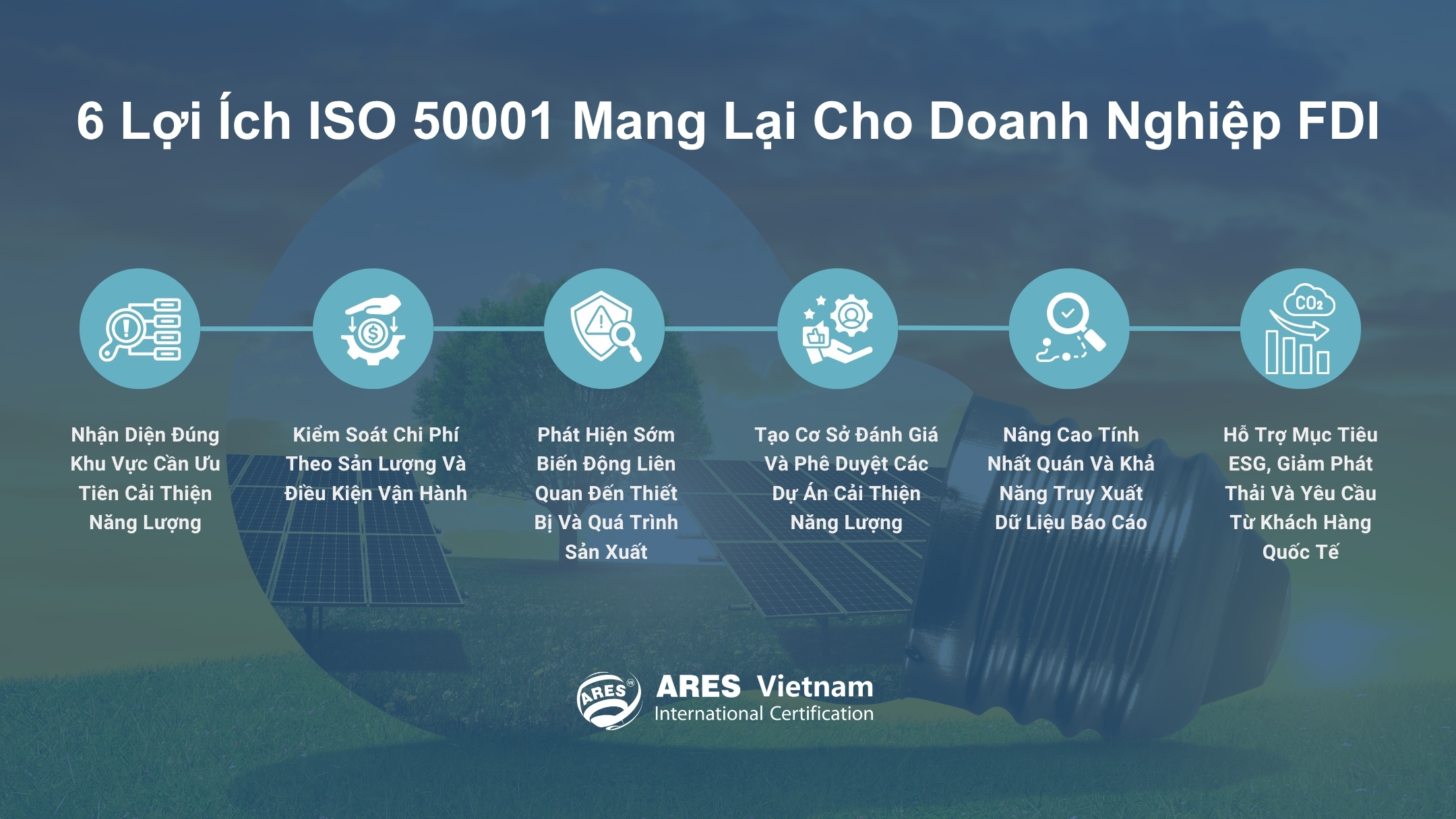
6 Benefits ISO 50001 Brings to FDI Companies
ISO 50001 creates value by integrating energy data into management and decision-making. For FDI companies, the following six benefits can directly support plant operations and management effectiveness.
1. Identify the Right Areas for Energy Improvement
high-impact areas. Companies may struggle to determine which production lines, processes, or utility systems deserve priority.
An energy review and appropriate data analysis help plants focus on SEUs. These may include steam, compressed air, refrigeration, HVAC, or specific production processes.
Companies can then direct budgets, technical resources, and energy-saving measures toward high-impact areas. They can also prioritize areas with significant improvement potential instead of spreading resources too widely.
2. Control Costs Based on Production Output and Operating Conditions
Energy costs depend on production output, product mix, operating hours, weather conditions, and other variables. When these factors significantly affect energy performance, companies need appropriate EnPIs and EnBs. This approach makes comparisons between reporting periods more meaningful.
Companies can then distinguish production-related changes from changes in energy efficiency. The analysis also supports cost control, target setting, and variance explanations. Management teams can use this information to explain differences between planned and actual results to headquarters.
3. Detect Changes in Equipment and Production Processes Earlier
Equipment and production lines may continue operating even when energy consumption begins to deviate. Equipment load, operating modes, maintenance conditions, or production changes can cause these deviations.
Appropriate EnPIs and EnBs help companies identify unusual changes earlier.
For example, a production line may consume steadily more electricity while output remains relatively stable. Operating conditions may also remain unchanged. This pattern can signal the need for further investigation.
ISO 50001 does not replace maintenance or technical diagnostics. However, energy data gives production and engineering teams additional evidence. They can use it to identify areas that need attention before deviations persist and increase operating costs.
4. Support the Evaluation and Approval of Energy Improvement Projects
Projects such as chiller replacement, compressed-air upgrades, boiler optimization, heat recovery, or high-efficiency equipment often require significant investment.
For FDI companies, regional management or headquarters may also need to approve these investments. Therefore, proposals need clear data on current conditions, targets, and expected performance.
ISO 50001 provides a structured data framework for comparing performance before and after improvements. Companies can use a consistent basis instead of relying only on changes in total energy bills.
Companies also consider energy performance criteria when designing, modifying, or purchasing relevant equipment, systems, and services. This approach applies when these decisions can significantly affect energy performance.
5. Improve Reporting Consistency and Data Traceability
Many FDI companies must regularly report energy consumption, progress toward targets, and significant changes at their plants.
Reporting becomes more complex when production, engineering, and accounting teams use different data sources. Different reporting cut-off dates can create additional discrepancies.
Clear data sources, responsibilities, and reporting cut-off dates improve consistency. Plants can compare results across periods and trace the causes of variances. They can also provide clearer explanations to headquarters.
ISO 50001 does not replace corporate reporting templates. Instead, it provides a systematic foundation for managing more consistent and reliable energy data
6. Support ESG, Emissions Reduction, and International Customer Requirements
Fuel use at a plant can generate direct emissions. Purchased electricity, steam, heat, or cooling can also contribute to indirect energy-related emissions.
Improving energy performance can therefore help reduce emissions associated with operations. It can also support a company’s environmental objectives.
Companies in international supply chains may face additional data requirements. ESG programs, supplier assessments, and corporate sustainability policies may require energy consumption data, improvement targets, and performance results.
ISO 50001 helps companies build a structured system for managing this data and supporting evidence. However, it does not replace greenhouse gas inventories, carbon footprint calculations, or ESG reporting. Companies must address those activities under their respective methods and scopes.
ISO 50001 and Energy Management Requirements in Vietnam in 2026
From 2026, companies should pay attention to Law No. 77/2025/QH15, effective January 1, 2026. Decree No. 30/2026/ND-CP, effective January 21, 2026, also sets requirements for economical and efficient energy use. Under Decree No. 30/2026/ND-CP, industrial and agricultural production facilities qualify as designated energy users when annual energy consumption reaches 1,000 TOE or more. The same threshold applies to transportation units. For certain buildings, the threshold starts at 500 TOE per year.
Designated energy users must fulfill the applicable responsibilities under Vietnamese regulations. These responsibilities cover energy-use planning, energy management models, energy managers, monitoring, reporting, and energy audits.
However, the requirement to implement an energy management model does not automatically mean that a company must obtain ISO 50001 certification.
Companies can use ISO 50001 as a framework to systematize energy management. However, the standard does not automatically replace applicable legal obligations.
Companies should assess the need for certification separately. Key considerations include corporate objectives and requirements from headquarters, customers, or contracts.
Which FDI Companies Should Prioritize ISO 50001?
FDI companies do not all have the same level of need for ISO 50001. Companies can use the following checklist for an initial assessment:
- Energy accounts for a significant share of production or operating costs.
- The plant operates boilers, compressed-air systems, refrigeration, HVAC, or high-capacity equipment.
- The company operates multiple plants, production lines, or shifts that require monitoring and comparison.
- The company qualifies or may qualify as a designated energy user.
- Headquarters has established energy-use or carbon-reduction targets.
- Customers require energy data, ESG information, or evidence of improvement activities.
- The company plans to invest in, renovate, or expand its plant.
If several of these conditions apply, the company should give ISO 50001 greater consideration. The company should define the implementation scope based on management objectives, operating conditions, and available resources.
What Should Companies Review Before Implementing ISO 50001?
Before establishing an Energy Management System (EnMS), companies should review their current situation. This review helps define an appropriate scope, data requirements, and resources.
| Review Area | What the Company Should Determine |
| Proposed scope | Sites, plants, processes, areas, and activities to include in the EnMS. |
| Types of energy used | Electricity, fuels, steam, and other energy sources relevant to the proposed scope. |
| Existing data and metering systems | Bills, meters, monitoring systems, historical data, production output, operating hours, and available data granularity. |
| Major energy-consuming areas, processes, and equipment | Areas with significant energy use or improvement potential that require deeper analysis. |
| Current performance indicators | Energy KPIs, specific energy consumption, benchmarks, or other existing management indicators. |
| Legal requirements | Applicable obligations related to economical and efficient energy use. |
| Corporate and customer requirements | Energy targets, ESG requirements, carbon requirements, reporting obligations, or certification requirements. |
| Available resources | Personnel, technical expertise, measuring equipment, and budgets for operating, monitoring, and improving energy performance. |
Note: Companies can still begin with existing data even without comprehensive sub-metering or detailed monitoring systems. They can then identify measurement gaps and add the necessary monitoring capabilities. This approach supports more effective analysis and performance evaluation over time.
Frequently Asked Questions (FAQ)
| Question | Answer |
| Is ISO 50001 certification mandatory for FDI companies? | Vietnam does not impose a general requirement for every FDI company to obtain ISO 50001 certification solely because it has foreign investment. Companies should separately review applicable legal obligations and requirements from headquarters, customers, or contracts. |
| What is the difference between an energy audit and ISO 50001? | An energy audit evaluates current energy use and identifies improvement opportunities at a specific point or on a defined cycle. ISO 50001 establishes an ongoing management system for monitoring, evaluating, and improving energy performance over time. |
| Does a company with ISO 14001 also need ISO 50001? | Not necessarily. ISO 14001 focuses on environmental management, while ISO 50001 focuses specifically on managing and improving energy performance. Companies should consider ISO 50001 when energy significantly affects costs, operations, or corporate objectives. |
| Can a company implement ISO 50001 before applying for certification? | Yes. A company can establish and operate an Energy Management System first. Once the system operates effectively, the company can apply for ISO 50001 certification to demonstrate conformity through third-party assessment. |
| Does ISO 50001 require a specific level of energy savings? | ISO 50001 requires organizations to demonstrate continual improvement in energy performance. However, the standard does not prescribe a fixed energy-saving percentage for all organizations. |
ISO 50001 Assessment and Certification at ARES Vietnam
After establishing and operating an Energy Management System, companies can apply for certification. A third-party assessment can then verify the system’s conformity with ISO 50001 requirements.
ARES Vietnam provides ISO 50001 assessment and certification based on the registered certification scope and the company’s established Energy Management System.
Contact ARES Vietnam to discuss the certification scope, applicable requirements, and assessment process.
- Hotline: 085.3858.553
- Email: service@aresvietnam.vn
Related news

Circular 49/2026/TT-BCT Takes Effect Soon: Which Environmental Records Should Factories Review?
Read more

ARES Vietnam Conducts the Second ISO 9001:2015 Surveillance Audit at KAISER 1 & KAISER 2 (Vietnam)
Read more

National Single Window and ASEAN Single Window: What Documents Should Import–Export Businesses Prepare?
Read more
ARES Vietnam Awards ISO 9001:2015 Certification to Simona Leather Company Limited
Read more
ARES Vietnam Conducts ISO 9001:2015 Surveillance Audit at Simona Leather Company Limited
Read more