ISO 22000 Certification – A Foundation for Agricultural Products to Enter Supermarkets and Expand Export Opportunities
In today’s food distribution landscape, supermarket chains, procurement systems, and B2B partners are placing increasing emphasis on suppliers’ food safety control capabilities. In particular, they focus on traceability, process transparency, and the ability to demonstrate risk control throughout the supply chain.
This shift has created significant pressure for agricultural businesses. In the past, good product quality, competitive pricing, and a stable supply were considered major advantages. Today, however, companies seeking to enter modern retail channels or access export markets must also demonstrate that the management systems behind their products are structured, reliable, and evidence-based.
As a result, ISO 22000 has become one of the key standards considered by businesses looking to establish a food safety management system that is systematic, controlled, and verifiable across the supply chain. This international standard specifies requirements for food safety management systems and can be applied to any organization within the food chain, regardless of its size or role.
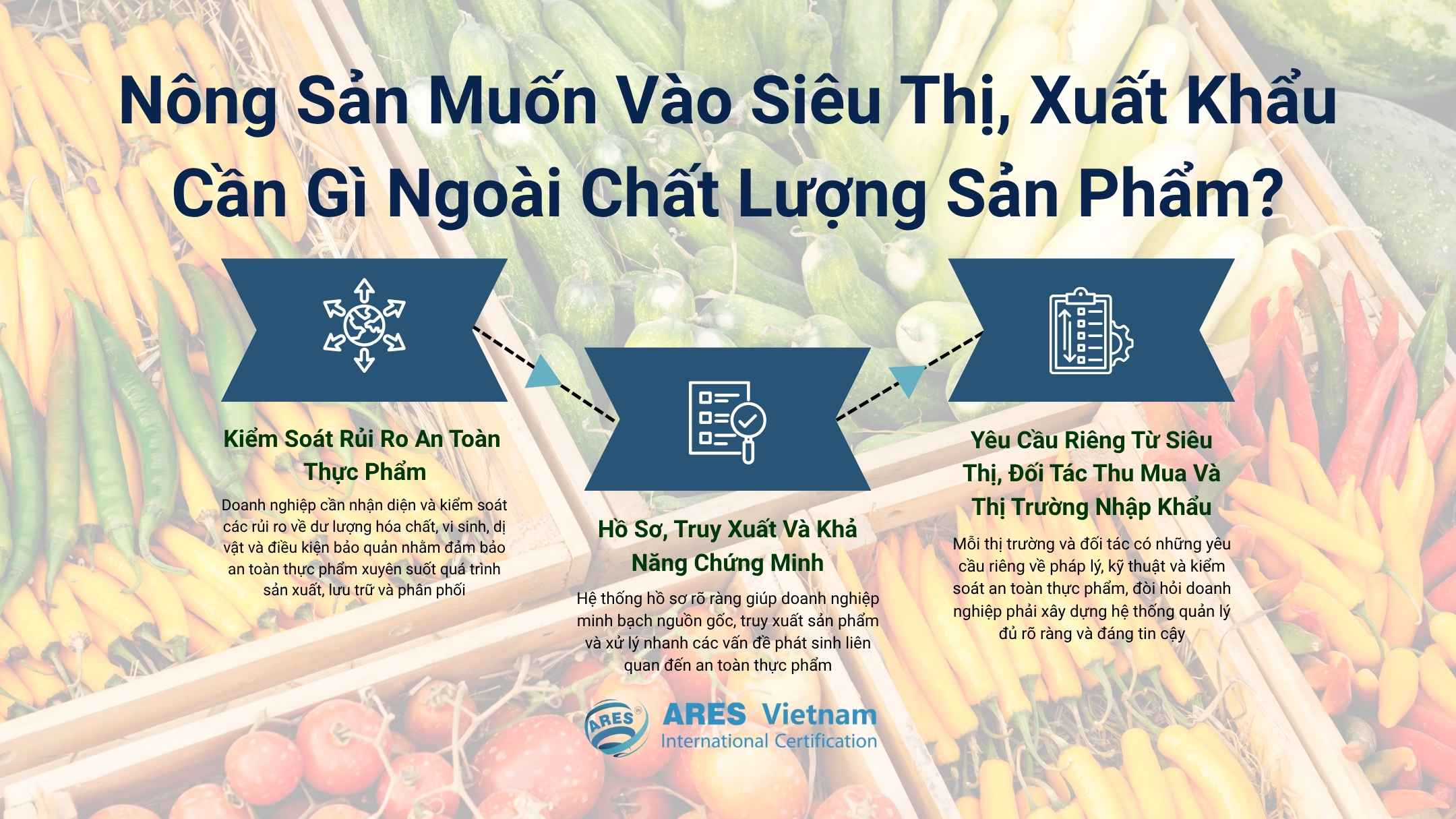
What Do Agricultural Products Need Besides Product Quality To Enter Supermarkets And Export Markets?
Agricultural products are heavily influenced by cultivation, harvesting, preliminary processing, storage, and transportation conditions. Without appropriate management mechanisms, food safety risks may arise at multiple stages, making it difficult for businesses to trace and demonstrate their control measures to partners.
Therefore, within modern distribution channels and export markets, businesses are often evaluated based on three key aspects.
1. Food Safety Risk Control
Depending on the type of product, common concerns may include:
- Pesticide residues or chemical levels exceeding permitted limits;
- Microbial contamination during processing, storage, or transportation;
- Foreign objects introduced during handling or packaging;
- Inappropriate temperature and humidity conditions that increase spoilage or safety risks;
- Improper packaging and storage practices that affect product safety during distribution.
Partners are concerned not only with the condition of the product at the time of inspection but also with whether the company has a consistent mechanism to identify and control these risks.
2. Documentation, Traceability And Demonstration Capability
In addition to product quality, businesses are increasingly expected to demonstrate operational transparency through information such as:
- Sources of incoming raw materials;
- Production or processing batch records;
- Monitoring, inspection, and testing records related to food safety;
- Product traceability information;
- Corrective actions taken when nonconformities or complaints occur.
These records provide partners with a basis for evaluating the professionalism of a supplier. At the same time, they help businesses investigate, isolate, and resolve issues more efficiently when necessary.
3. Specific Requirements From Supermarkets, Buyers, And Import Markets
Depending on the type of agricultural product, distribution channel, and target market, businesses may also need to comply with additional requirements, including:
- Product legal documentation;
- Quarantine requirements, residue limits, or technical specifications;
- Storage and transportation conditions;
- Supplier evaluation criteria;
- Documents, standards, or certifications related to food safety management.
Therefore, to expand sustainably, agricultural businesses need to shift from a “compliant product” mindset to a “trusted control system” mindset.
What do agricultural products need to go to supermarkets and export other than product quality?
What Is ISO 22000 And Why Is It Suitable for Agricultural Businesses?
ISO 22000 is an international standard for food safety management systems. It enables organizations to demonstrate their ability to control food safety hazards and ensure product safety within the scope of their operations.
ISO 22000 is built upon HACCP principles while extending them into a broader management system framework, including:
- Operational planning and control;
- Prerequisite programs;
- Hazard analysis and control measures;
- Traceability;
- Documented information control;
- Internal audits;
- Corrective actions and continual improvement.
The standard can be applied to various organizations within the food chain, such as:
- Agricultural cultivation, collection, and preliminary processing facilities;
- Food manufacturing companies;
- Packaging, storage, and cold-chain logistics providers;
- Raw material and ingredient suppliers;
- Food distributors and retailers.
For agricultural businesses, ISO 22000 provides value by establishing a systematic food safety control mechanism instead of relying solely on individual experience or inconsistent practices among departments.
Is ISO 22000 Mandatory For Agricultural Products To Enter Supermarkets And Export Markets?
No. ISO 22000 is not a general legal requirement for all businesses wishing to supply agricultural products to supermarkets or export markets.
Product acceptance still depends on factors such as:
- Regulations applicable to each product category;
- Import requirements of individual markets;
- Legal documents, testing results, and labeling requirements;
- Specific criteria established by supermarkets, buyers, or international customers.
- However, ISO 22000 can serve as an important foundation that helps businesses:
Demonstrate a systematic approach to food safety control;
- Enhance credibility when working with partners;
- Be more proactive during supplier evaluations;
- Better prepare for markets with stricter requirements.
In other words, ISO 22000 does not replace market requirements. Instead, it helps businesses establish a robust management foundation and improve their readiness to meet those requirements.
Is ISO 22000 required to get agricultural products into supermarkets and exported?
How Does ISO 22000 Support Agricultural Businesses?
1. Controlling Food Safety Hazards from Raw Materials to Finished Products
One of the most important values of ISO 22000 is that it helps businesses move from relying solely on end-product inspection to identifying and controlling risks throughout the operational process.
For agricultural products, hazards may arise at various stages, including:
- Incoming raw materials;
- Pre-processing and processing activities;
- Hygiene conditions of equipment and facilities;
- Storage and packaging;
- Transportation and warehousing.
ISO 22000 requires organizations to identify food safety hazards, select appropriate control measures, and monitor the effectiveness of those controls during operation.
The real value does not lie in having more documents. Instead, it lies in establishing a control mechanism that is systematic, accountable, and supported by objective evidence.
2. Improving Traceability And Response Capability When Problems Occur
Within the agricultural supply chain, traceability becomes particularly important when situations such as the following arise:
- Customer complaints;
- Suspected food safety incidents;
- Inspection requests from partners;
- The need to determine the scope of impact of a specific batch.
Businesses need to be able to quickly identify:
- The source of raw materials;
- The related production batch;
- The range of products potentially affected;
- Relevant data required for investigation and resolution.
ISO 22000 requires organizations to establish a traceability system appropriate to their role within the food chain. Consistent data management enables businesses to verify information faster, isolate affected products more accurately, and take corrective action based on reliable evidence.
3. Standardizing Records, Processes, And Operational Evidence
Many businesses already have certain control measures in place. However, they often face difficulties when they need to demonstrate:
- Whether procedures have been fully implemented;
- Who is responsible for each activity;
- How results are monitored;
- How deviations are handled.
ISO 22000 helps organizations standardize the information required for a food safety management system, including:
- Procedures for critical operational stages;
- Monitoring and inspection records;
- Data related to hygiene and storage conditions, where applicable;
- Records for handling nonconforming products;
- Information used for traceability, evaluation, and continual improvement.
As a result, businesses not only improve internal management efficiency but also gain clear evidence to demonstrate their control capability to customers and certification bodies.
4. Enhancing Readiness When Working With Supermarkets, Buyers, and Import Customers
During supplier evaluations, partners may review:
- Production, pre-processing, and storage conditions;
- Batch records, raw material information, and traceability data;
- How the company identifies and controls risks;
- Methods used to address nonconformities.
When ISO 22000 is implemented consistently, businesses are better prepared to:
- Prepare documentation;
- Cross-check data;
- Explain operational procedures;
- Cooperate effectively during audits and assessments.
Although ISO 22000 does not replace the specific requirements of each customer, it enables businesses to engage with partners through a clearer, more consistent, and more reliable management system.
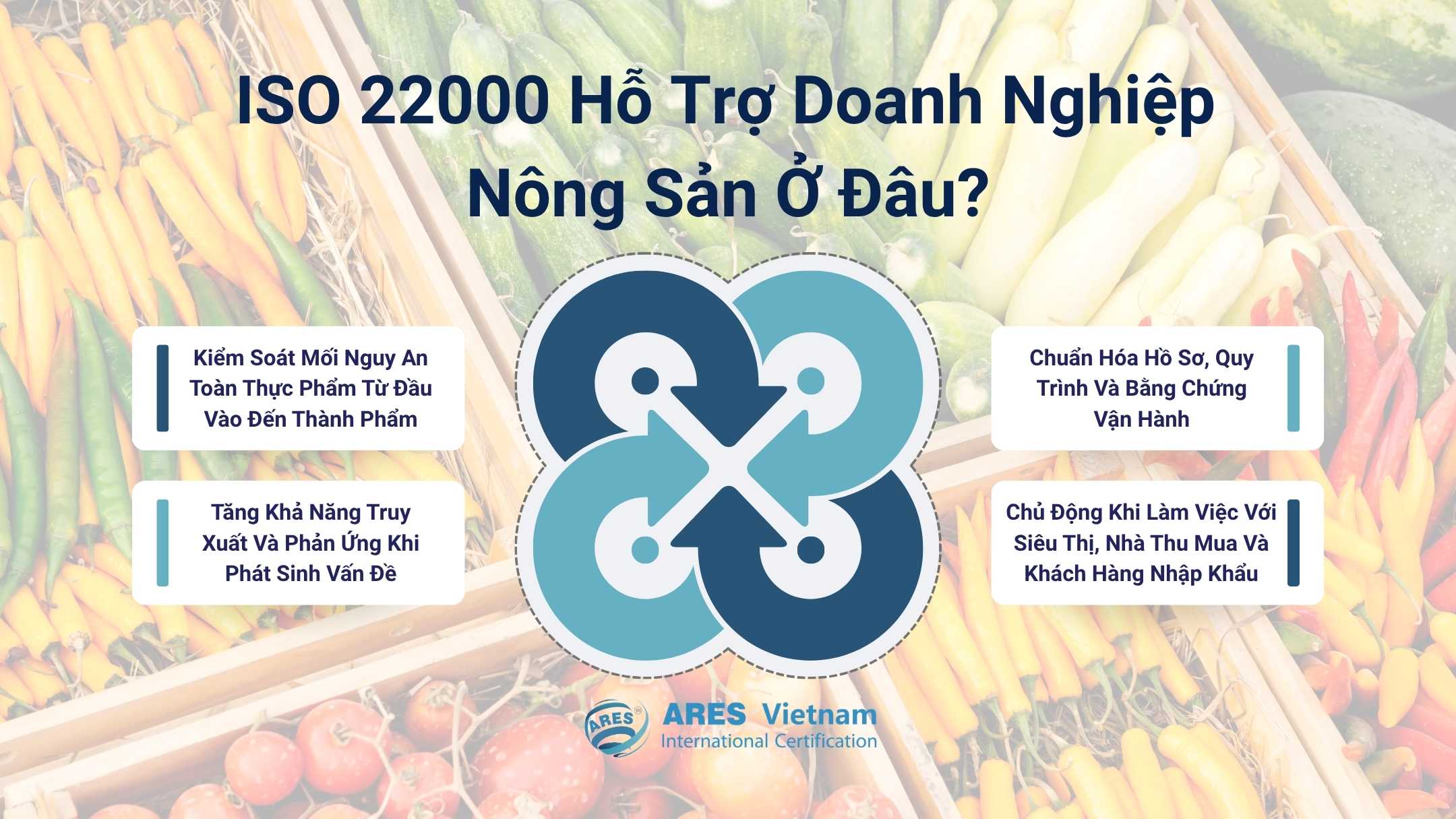
ISO 22000 Where to support agricultural businesses?
Which Agricultural Businesses Should Consider ISO 22000 Certification?
ISO 22000 is particularly suitable for organizations that are entering a stage of operational improvement and market expansion, such as those that:
- Intend to supply products to supermarkets or modern retail channels;
- Process agricultural products on a stable scale;
- Prepare for export activities or cooperation with overseas buyers;
- Supply raw materials to food processing manufacturers;
- Increase production capacity, expand partnerships, or join more demanding supply chains.
At these stages, ISO 22000 certification should not be viewed merely as an additional document. Instead, it should be regarded as a necessary standardization step that strengthens food safety management and supports sustainable market development.
What Should Businesses Prepare Before Applying For ISO 22000 Certification?
Before entering the certification process, organizations should review several key aspects.
1. Define the Scope of Certification
Clearly determine the products, locations, processes, and activities included within the food safety management system.
2. Describe the Operational Flow
Identify all stages, from receiving raw materials and pre-processing to processing, packaging, storage, and distribution.
3. Review Records and Traceability Capability
Verify the completeness and consistency of batch codes, raw material records, production documents, warehouse records, and distribution data.
4. Assess Control Conditions at the Facility
Review hygiene practices, equipment conditions, contact surfaces, storage environments, cross-contamination prevention measures, and other food safety-related factors.
5. Assign Responsibilities and Ensure Leadership Involvement
A management system can only operate effectively when responsibilities are clearly assigned, employees understand their roles, and top management actively participates in maintaining and improving the system.
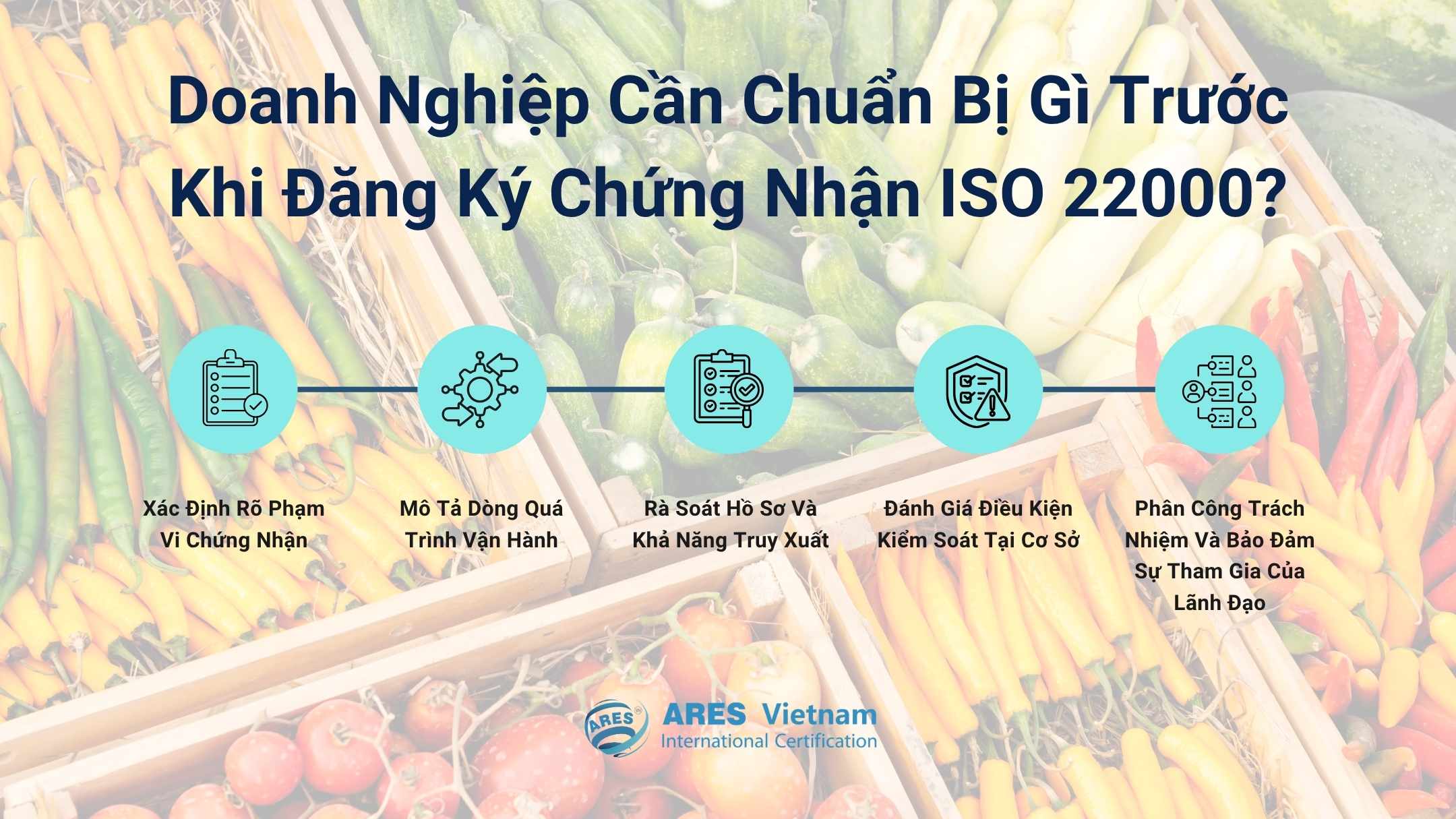
What do businesses need to prepare when registering for ISO 22000 certification?
ISO 22000 Certification Process At ARES Vietnam
At ARES Vietnam, ISO 22000 certification activities are conducted based on the principles of independence, impartiality, and evidence-based assessment to determine the conformity of the food safety management system with the requirements of the standard.
The certification process generally includes:
- Receiving the certification application;
- Reviewing the scope and assessment conditions;
- Preparing the audit plan;
- Conducting on-site assessments;
- Recording audit findings, including any nonconformities identified;
- Reviewing corrective actions implemented by the organization;
- Performing an independent review of the audit documentation;
- Making the certification decision;
- Conducting periodic surveillance audits throughout the certification cycle.
The entire process is carried out based on evidence collected at the organization’s premises to ensure that the certification decision accurately reflects the actual conformity of the management system at the time of assessment.
ISO 22000 – A Foundation For Strengthening The Competitiveness Of Agricultural Businesses
As food supply chains increasingly emphasize transparency, traceability, and risk control capability, agricultural businesses no longer compete solely through their products. They also compete through their ability to demonstrate that those products are managed within a safe, responsible, and verifiable system.
Although ISO 22000 does not replace market-specific requirements, it provides an important foundation that helps businesses:
- Strengthen food safety management capability;
- Standardize operational records and procedures;
- Improve traceability and response capability when issues occur;
- Enhance readiness when working with domestic and international partners.
For agricultural businesses pursuing long-term growth, ISO 22000 should not be viewed simply as a certificate for documentation purposes. Rather, it should be considered a strategic standardization step that improves management quality, strengthens market confidence, and creates opportunities to participate in more professional supply chains.
If your organization would like to learn more about ISO 22000, certification requirements, or the ISO 22000 certification process at ARES Vietnam, please contact us via: Hotline: 085.3858.553 or Email: Service@aresvietnam.vn. We will be pleased to provide detailed information and professional support.
Frequently Asked Questions About ISO 22000 Certification
| Questions | Answers |
| Is ISO 22000 mandatory for supplying products to supermarkets? | ISO 22000 is not a mandatory legal requirement for all businesses. However, some retail chains, purchasing organizations, and B2B customers may consider it as one of the criteria for evaluating a supplier’s food safety management capability. |
| Does ISO 22000 support agricultural exports? | Yes. ISO 22000 helps businesses establish a more structured food safety management system, thereby increasing their readiness when working with importers or entering markets with stricter food safety requirements. However, organizations should also review the specific regulations applicable to each country, product category, and customer. |
| What is the difference between ISO 22000 and HACCP? | HACCP focuses on identifying, evaluating, and controlling food safety hazards. ISO 22000 incorporates HACCP principles while expanding them with additional requirements related to management systems, operational control, documented information, performance evaluation, and continual improvement. |
| Can small businesses implement ISO 22000? | Yes. ISO 22000 can be applied to organizations of various sizes throughout the food supply chain, provided that the management system is designed to suit the organization’s scope of activities and level of complexity. |
| How long does ISO 22000 certification typically take? | The certification timeline depends on the scope of assessment, the size of the organization, the readiness of the management system, and the time required to implement corrective actions if nonconformities are identified during the audit process. |
| What factors affect the cost of ISO 22000 certification? | Certification costs are generally determined by factors such as the size of the organization, the certification scope, audit locations, the complexity of production processes, and the amount of audit time required. |
Related news

Emissions Data & CBAM: 5 Practical Questions from Factory Operations
Read more

Greenhouse Gas Inventory Challenges: What Data Should Businesses Prepare?
Read more
ARES Vietnam Conducts ISO 45001:2018 Surveillance Audit at A&J (VIETNAM) CO., LTD.
Read more
Rice Export and Import Business Under Decree 365/2026/ND-CP: What Should Enterprises Control?
Read more
ARES Vietnam Verifies Greenhouse Gas Report under ISO 14064-1:2018 at GE LAN Vietnam
Read more