ISO 9001 Process: Practical Implementation Steps And Estimated Completion Time
When learning about ISO 9001, many organizations often ask the same questions: Where should they start? What activities need to be implemented? How long does the process take? And how can they prepare without disrupting current operations?
In practice, ISO 9001 is not simply about preparing documents for certification purposes. It is a process through which an organization establishes, implements, monitors, and continually improves its quality management system based on actual operations. If ISO 9001 is approached merely as a documentation exercise to obtain certification, the system can easily become superficial, difficult to maintain, and limited in long-term management value.
This article provides an overview of the ISO 9001 implementation process, typical timelines, and key preparations organizations should consider before entering certification assessment.
What Is ISO 9001 Implementation?
ISO 9001:2015 is an international standard for quality management systems. It helps organizations maintain consistent operations and improve their ability to provide products and services that meet customer requirements and other applicable obligations.
Implementing ISO 9001 means integrating the requirements of the standard into the organization’s existing management system. This process involves more than developing documents. It also includes assigning responsibilities, controlling processes, monitoring performance, and making improvements when necessary.
According to the structure of ISO 9001:2015, the quality management system is built around several major requirement groups, including organizational context, leadership, planning, support, operation, performance evaluation, and improvement. These elements provide the basis for developing an implementation roadmap that suits the organization’s size and operational characteristics.
International standard ISO 9001:2015
What Are The Steps For Implementing ISO 9001 Within An Organization?
The ISO 9001 implementation process should be understood as the roadmap for building and applying a quality management system within the organization. This stage allows the company to standardize operations, establish control mechanisms, and build a foundation before entering certification assessment.
Step 1: Review the Current Situation and Identify Quality Management Needs
Before developing an ISO 9001 system, the organization needs to understand how it currently operates, what factors affect product or service quality, and which requirements need to be controlled.
The review typically covers internal factors such as:
- Personnel competence;
- Existing processes;
- Equipment;
- Infrastructure;
- Management methods.
At the same time, external factors should also be considered, including customer requirements, legal regulations, suppliers, business partners, and market conditions.
This step corresponds to the requirements related to organizational context and the needs and expectations of interested parties in ISO 9001:2015. Without this review, organizations may build a generic system that does not reflect actual operations.
Step 2: Define the Scope of ISO 9001 Application
After reviewing the current situation, the organization needs to clearly determine where the ISO 9001 system will apply, such as:
- The entire organization;
- A single factory;
- A branch office or department;
- Specific products, services, or locations.
The scope should clearly define the boundaries of the quality management system, the activities included, and any requirements considered not applicable. Where exclusions are justified, they must not affect the organization’s ability to provide products or services that meet customer requirements.
This step aligns with the requirement to define the scope of the quality management system in ISO 9001:2015. A clearly defined scope makes implementation easier to manage and helps minimize changes during certification assessment.
Step 3: Develop Process Maps and Assign Responsibilities
ISO 9001 emphasizes the process approach. Therefore, organizations need to identify which processes make up the quality management system and how those processes interact with one another.
Typical core processes include:
- Sales;
- Customer requirement review;
- Purchasing;
- Production or service delivery;
- Quality inspection;
- Delivery and customer support.
Supporting processes may include human resources, training, maintenance, measuring equipment, warehouse management, and documented information control.
For each process, the organization should determine inputs, outputs, responsible personnel, control criteria, required resources, and records to be retained. This helps establish clear responsibilities and avoids situations where processes exist but no one is accountable for them.
This step relates to the requirements for establishing, implementing, and maintaining QMS processes, as well as defining responsibilities and authorities within the organization.
Step 4: Establish the Quality Policy and Quality Objectives
Top management should establish a quality policy that aligns with the organization’s development direction, operating context, and commitments to customers. Based on this policy, quality objectives should be defined at relevant levels, departments, or processes.
Quality objectives should be measurable, communicated, monitored, and updated when necessary.
Examples include:
- On-time delivery rate;
- Nonconforming product rate;
- Complaint handling time;
- Supplier acceptance rate; Customer satisfaction level.
Organizations should clearly distinguish between the purpose of implementing ISO and quality objectives. Goals such as obtaining certification, supporting tender participation, or meeting customer requirements are reasons for adopting ISO. In contrast, quality objectives should be directly linked to operational performance and actual quality control capability.
Step 5: Identify Risks and Opportunities and Develop Control Plans
ISO 9001:2015 requires organizations to adopt risk-based thinking. Therefore, after defining quality objectives, the organization should consider factors that could affect its ability to achieve those objectives.
Risks may include product defects, delayed deliveries, insufficient competent personnel, unstable equipment, supplier issues, or documentation errors. At the same time, organizations should identify improvement opportunities such as process optimization, defect reduction, efficiency enhancement, and better customer experience.
Based on the identified risks and opportunities, the organization develops appropriate action plans, including what actions are required, who is responsible, what resources are needed, the implementation timeframe, and how results will be evaluated.
The key purpose of this step is to shift from reacting to problems after they occur to proactively preventing and controlling them in advance.
Step 6: Standardize Documents, Forms, and Employee Training
To ensure consistent operation, organizations need to standardize the necessary documented information. These documents typically include procedures, work instructions, forms, and related records. The organization should also define how documents are approved and updated during use. Storage, retrieval, and version control methods should be clearly established.
At the same time, relevant personnel should receive ISO 9001 awareness training. Training should cover how to apply procedures, complete forms, and maintain records and operational evidence.
If employees do not understand their roles within the ISO 9001 system, implementation effectiveness will be limited. In such cases, ISO 9001 can easily become the responsibility of only the documentation department.
Organizations should also note that ISO 9001:2015 does not require a standardized documentation package for all companies. The extent of documented information depends on the organization’s size, industry, process complexity, and actual control needs.
Step 7: Apply the ISO 9001 System to Daily Operations
Once the ISO 9001 system has been established, the organization begins applying it to daily activities. This stage verifies whether the system aligns with actual operations.
Common activities include customer requirement control and supplier management. Organizations also control production or service provision according to established procedures. Quality inspection, delivery, and after-sales service are implemented consistently. In addition, nonconforming outputs must be controlled, and operational records must be maintained.
At this stage, organizations do more than simply issue procedures for internal use. They must also monitor how those procedures are applied in practice. Operational data should be properly recorded and retained. This provides evidence for evaluating the effectiveness of quality control within the ISO 9001 system.
Step 8: Conduct Internal Audits and Improvements Before Certification
Before entering certification assessment, the organization should verify the effectiveness of the entire system. This step helps determine the organization’s readiness for formal certification.
Key activities include monitoring operational performance and analyzing collected data. Customer satisfaction should also be evaluated. In addition, internal audits and periodic management reviews should be carried out. Any nonconformities identified should be recorded and addressed promptly.
Internal audits help verify whether the ISO 9001 system conforms to both the standard and the organization’s internal requirements. Management reviews provide an overall evaluation of system performance. Typical review inputs include resources, risks, opportunities, and improvement needs.
When this step is performed effectively, the organization will be better prepared for certification assessment and can reduce the likelihood of nonconformities during the audit process.
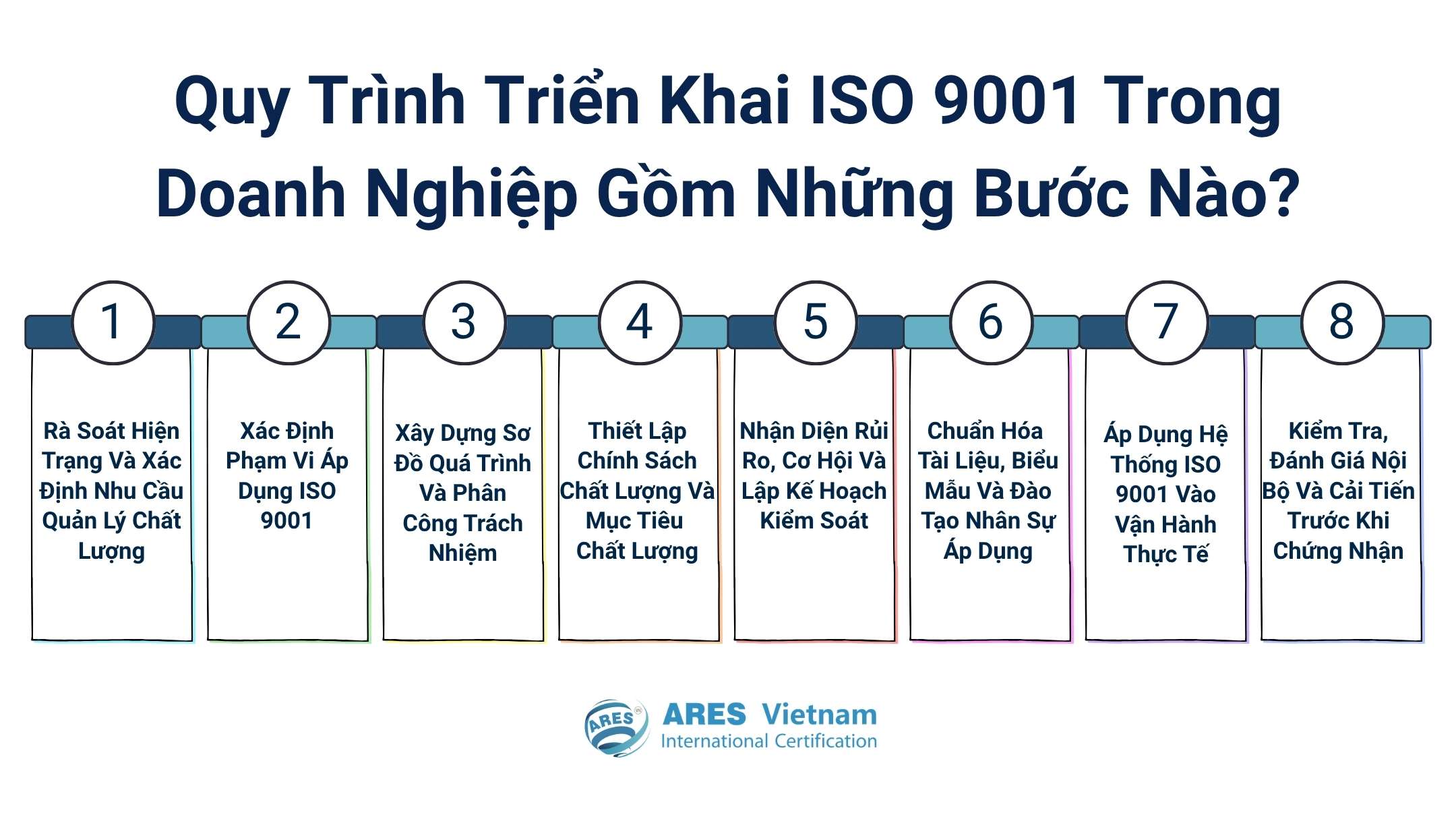
What steps does the ISO 9001 implementation process in an enterprise include?
Comparison Between Implementation Steps And ISO 9001:2015 Clauses
The table below helps organizations better understand the relationship between practical implementation activities and the requirement groups in ISO 9001:2015.
| Implementation Step | Main Content | ISO 9001:2015 Clause | Review Purpose |
| Review the current situation and quality management needs | Examine organizational context, customer requirements, and interested parties | 4.1, 4.2 | Identify factors affecting the system |
| Define the scope of application | Establish boundaries by product, service, location, or department | 4.3 | Ensure the scope is clear and manageable |
| Develop process maps and responsibilities | Define processes, inputs, outputs, responsibilities, and control criteria | 4.4, 5.3 | Ensure the system operates using the process approach |
| Establish the quality policy and quality objectives | Define quality direction and measurable objectives | 5.1, 5.2, 6.2 | Ensure objectives can be monitored |
| Identify risks, opportunities, and control plans | Determine risks, opportunities, and corresponding actions | 6.1, 6.3 | Proactively manage changes and uncertainties |
| Standardize documents and train personnel | Control documents, records, competence, awareness, and communication | 7.1 – 7.5 | Establish a consistent operational foundation |
| Apply the system to operations | Control product/service realization and nonconforming outputs | 8.1 – 8.7 | Demonstrate practical implementation of the system |
| Conduct internal audits and improvement activities | Monitor performance, perform management reviews, address nonconformities, and improve | 9.1 – 9.3, 10.1 – 10.3 | Evaluate system effectiveness before certification |
This comparison table is intended as a general reference. In practice, the level of implementation should be adjusted according to the organization’s size, industry, system scope, and process complexity.
What Happens After ISO 9001 Implementation?
Once the quality management system has been established, implemented, internally audited, and improved, the organization may apply for certification with a suitable certification body.
At this stage, the certification body evaluates the conformity of the system against ISO 9001:2015 requirements within the registered scope. If nonconformities are identified, the organization must implement corrective actions and provide objective evidence before certification can be considered.
It is important to note that certification assessment is an independent third-party activity and is not part of the organization’s internal implementation process. Therefore, organizations should ensure that the system is fully established and functioning before entering this stage.
See also: ISO 9001 Certification Audit Process at ARES Vietnam
How Long Does ISO 9001 Implementation Take and What Factors Affect the Timeline?
There is no fixed timeline for ISO 9001 implementation because each organization differs in size, scope, and level of readiness. The following timeframes are commonly used as references:
| Organizational Situation | Typical Timeline |
| Small organizations with a simple scope and relatively clear procedures and records | 2–4 months |
| Medium-sized organizations with multiple departments that require system standardization | 3–6 months |
| Manufacturing organizations with multiple processes or locations | 6 months or more |
| Organizations with complex systems, multiple products/services, or extensive supply chains | Longer periods depending on readiness |
The actual implementation period depends on factors such as the scope of application, operational complexity, the availability of procedures and records, coordination among departments, and the time required to operate the system before certification assessment.
Organizations with an established operational foundation can often shorten the standardization period. On the other hand, if processes are unclear, responsibilities are not defined, or monitoring data is insufficient, implementation will generally require more time.
What Should Organizations Prepare Before Implementing ISO 9001?
Before implementing ISO 9001, organizations should not begin immediately with document preparation. More importantly, they need to clarify their objectives, available resources, and existing operational foundation.
Organizations are encouraged to prepare the following:
- Clearly define the purpose of adopting ISO 9001, such as operational standardization, stronger internal control, customer satisfaction, tender participation, or market expansion.
- Assign a responsible person or department to coordinate progress, consolidate information, and connect relevant functions.
- Review current operations, including sales, purchasing, production or service delivery, quality control, complaint handling, supplier management, and operational data.
- Ensure the involvement of relevant departments, since ISO 9001 cannot be managed effectively by a single person or department alone.
- Allocate sufficient time for system operation before certification assessment so that the system can be implemented, reviewed, and adjusted when necessary.
Good preparation from the beginning helps organizations shorten implementation time, reduce deviations during application, and improve the long-term sustainability of the system after certification.
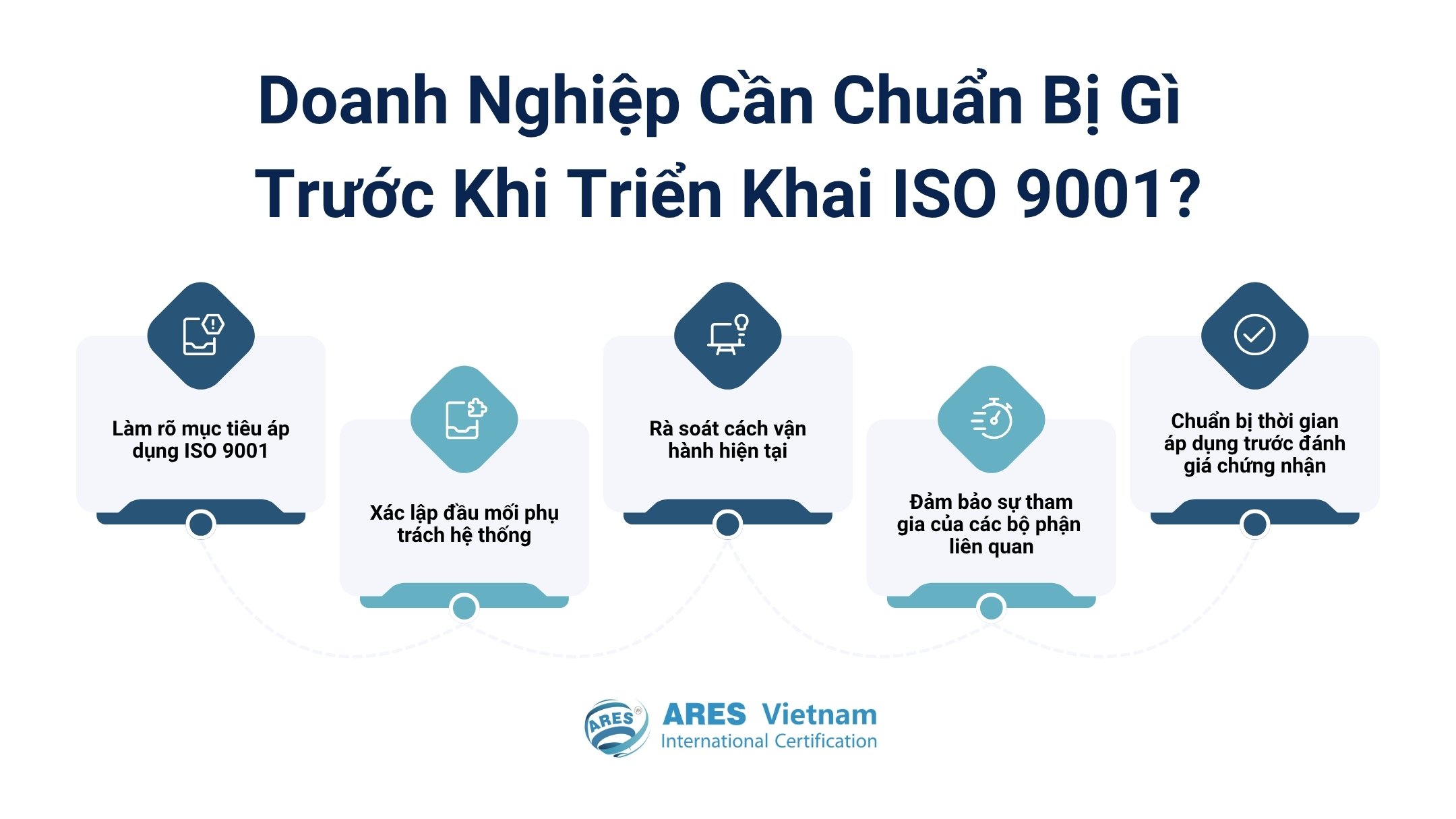
What do businesses need to prepare before implementing ISO 9001?
Common Mistakes During ISO 9001 Implementation
In many cases, difficulties do not come from the standard itself, but from the way organizations approach it. Common mistakes include:
- Treating ISO 9001 merely as a set of documents for certification rather than a management system to be applied in practice.
- Copying template procedures without adapting them to actual operations.
- Confusing the purpose of implementing ISO with quality objectives.
- Failing to provide adequate training for relevant personnel, resulting in inconsistent application.
- Neglecting evaluation and improvement after certification, causing the organization to gradually return to old operating methods.
ISO 9001 does not require organizations to create systems that are more complicated than necessary. The key is to establish a system that is appropriate, practical, supported by objective evidence, and capable of continual improvement.
Frequently Asked Questions About ISO 9001 Implementation
1. What is the difference between ISO 9001 implementation and ISO 9001 certification assessment?
ISO 9001 implementation is the process of establishing, applying, and improving the quality management system. Certification assessment is conducted by a certification body to determine whether the system conforms to ISO 9001:2015 within the registered scope.
2. How long does ISO 9001 implementation usually take?
In general, implementation takes between two and six months, depending on organizational size, scope, operational complexity, and the current condition of procedures and records.
3. Can ISO 9001 be completed within one month?
This may be possible only if the organization already has a relatively mature management system, sufficient records, and a simple scope. For most organizations, additional time is still needed to establish, implement, audit, and improve the system before certification.
4. Do small organizations need extensive ISO 9001 documentation?
Not necessarily. The amount of documented information depends on organizational size, process complexity, and actual control needs. Documentation should be sufficient to guide activities, control processes, and demonstrate that the system is functioning effectively.
5. What should organizations do after obtaining ISO 9001 certification?
Organizations should continue maintaining the system, updating records, monitoring quality objectives, conducting internal audits, performing management reviews, and participating in periodic surveillance audits according to the certification cycle.
ISO 9001 – A Foundation for Standardization and Continuous Improvement
ISO 9001 is not solely aimed at obtaining certification. The core value of the standard lies in helping organizations establish a management system capable of controlling, measuring, and continually improving operational performance.
When implemented properly, ISO 9001 enables organizations to standardize work across departments, improve product and service quality, reduce errors, enhance data-driven decision-making, and sustain continual improvement.
If your organization is exploring the ISO 9001 implementation roadmap, determining the appropriate scope, estimating the timeline, or assessing the readiness of your current system, ARES Vietnam can provide information and guidance to support a suitable implementation approach before certification assessment.
- Hotline: 085.3858.553
- Email: Service@aresvietnam.vn
Related news

Circular 49/2026/TT-BCT Takes Effect Soon: Which Environmental Records Should Factories Review?
Read more

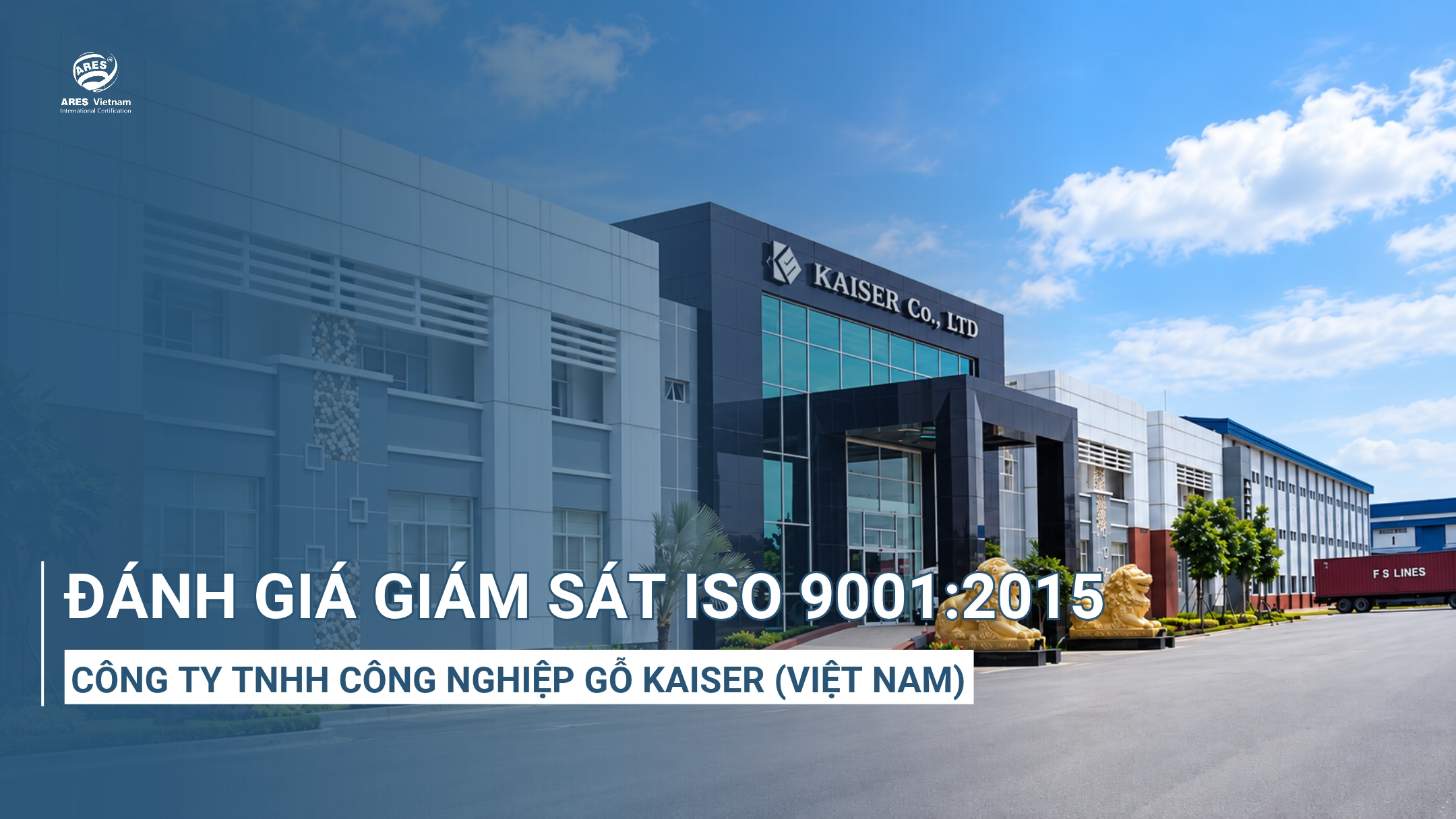
ARES Vietnam Conducts the Second ISO 9001:2015 Surveillance Audit at KAISER 1 & KAISER 2 (Vietnam)
Read more

National Single Window and ASEAN Single Window: What Documents Should Import–Export Businesses Prepare?
Read more

ARES Vietnam Awards ISO 9001:2015 Certification to Simona Leather Company Limited
Read more

ARES Vietnam Conducts ISO 9001:2015 Surveillance Audit at Simona Leather Company Limited
Read more