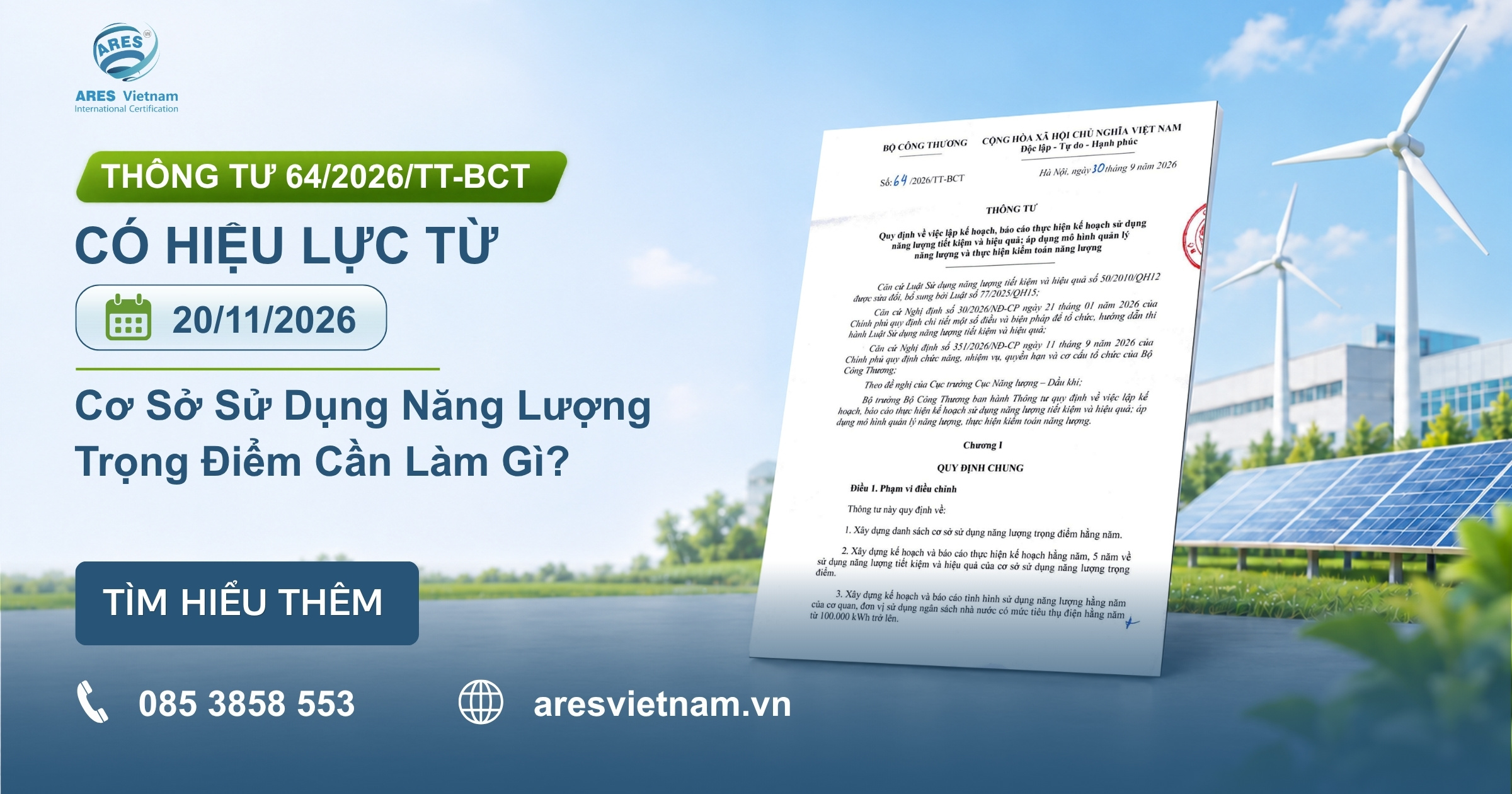
Circular 64/2026/TT-BCT Takes Effect: What Must Key Energy-Using Facilities Do?
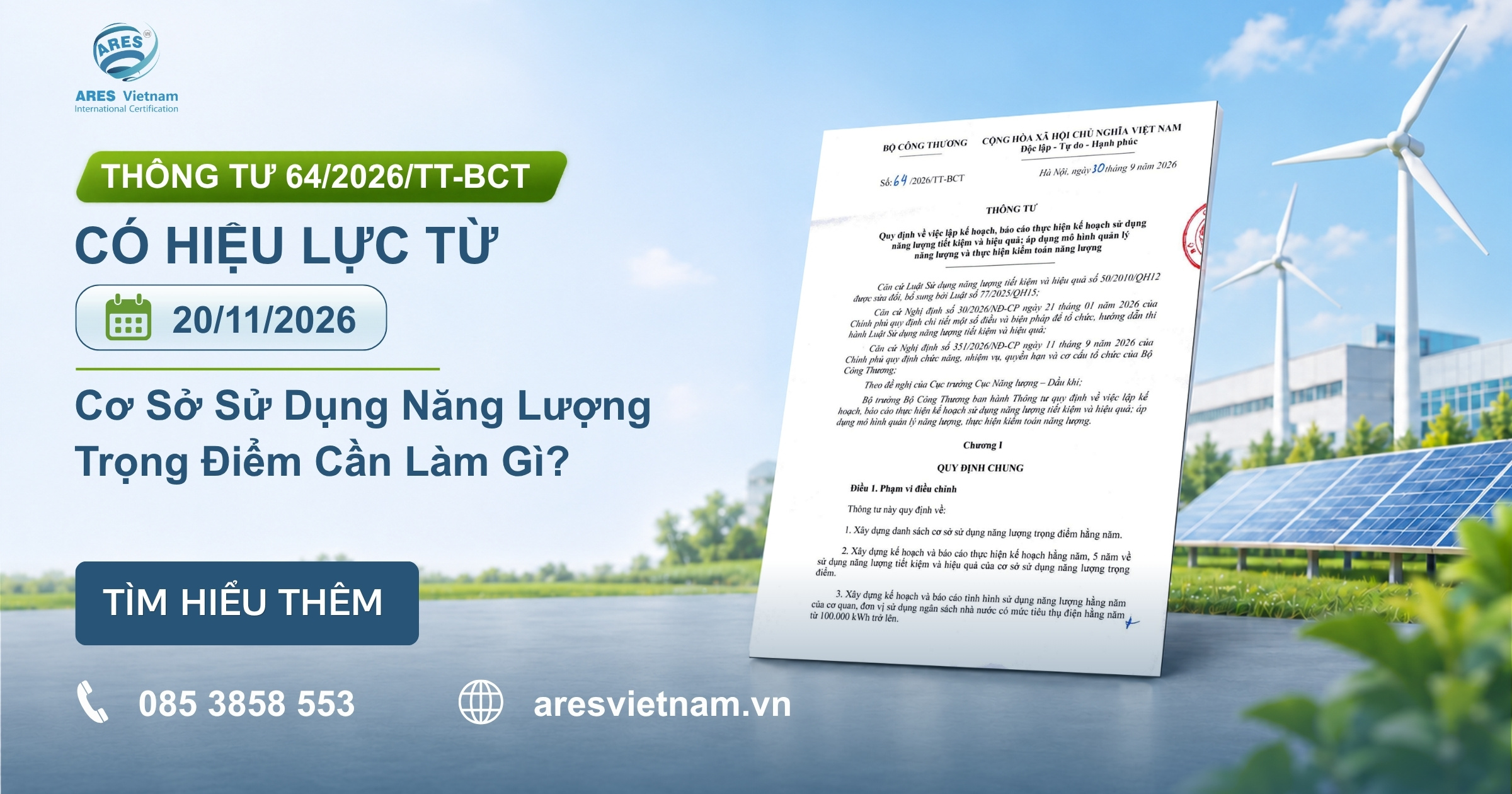
Effective November 20, 2026, Circular 64/2026/TT-BCT, issued by Vietnam’s Ministry of Industry and Trade, replaces Circular 25/2020/TT-BCT. It regulates the preparation of energy-saving and efficiency plans and implementation reports, the adoption of energy management models, and the conduct of energy audits.
For key energy-using facilities, identifying applicable obligations, deadlines, and reporting forms is essential for regulatory compliance. This article outlines the main requirements under Circular 64/2026/TT-BCT and explains how businesses can prepare their records, energy data, and internal responsibilities.
Which Facilities Are Subject to Circular 64/2026/TT-BCT?
Under Article 2 of Circular 64/2026/TT-BCT, the applicable entities include key energy-using facilities; agencies and units funded wholly or partly by the state budget; energy audit organizations; and other relevant parties.
Article 3 of Decree 30/2026/ND-CP sets the thresholds for identifying key energy-using facilities:
| Facility category | Annual energy consumption threshold |
|---|---|
| Industrial and agricultural production facilities, and transport operators | At least 1,000 TOE |
| Buildings such as offices, educational and healthcare facilities, hotels, supermarkets, restaurants, and other specified categories | At least 500 TOE |
TOE (tonne of oil equivalent) is a unit used to convert different types of energy into a common measurement basis.
Manufacturing facilities should consolidate their consumption of electricity, coal, oil, gas, and other energy sources, then convert the total into TOE to determine whether the relevant threshold applies.
Provincial-level People’s Committees approve and issue the list of key energy-using facilities each year.
When Must Key Energy-Using Facilities Prepare Plans and Submit Energy Reports?
Article 4 of Circular 64/2026/TT-BCT requires key energy-using facilities to prepare plans and report on the implementation of economical and efficient energy use on annual and five-year cycles.
These plans serve different purposes:
- Annual plan: Sets energy-saving targets and measures for the year while assessing the previous year’s implementation results.
- Five-year plan: Establishes energy-saving and efficiency objectives for the full period, including appropriate investments, equipment improvements, and technology upgrades.
Reporting Deadlines and Required Forms
Clause 4, Article 4 specifies the following deadlines and forms:
| Reporting requirement | Deadline | Applicable entities | Required form |
|---|---|---|---|
| Energy consumption report for year N−1 | Before January 15 of year N | Key facilities on the list approved for year N−2; state-budget-funded agencies and units consuming at least 100,000 kWh of electricity annually | Form 1.1, Appendix I |
| Annual plan for year N and implementation report for year N−1 | Before April 30 each year | Key energy-using facilities | Forms 1.2–1.7, Appendix I |
| Annual plan for year N and implementation report for year N−1 | Before April 30 each year | State-budget-funded agencies and units within the scope of application | Form 1.8, Appendix I |
| Five-year plan and implementation report for the preceding five-year period | Before April 30 of the first year of the five-year cycle | Key energy-using facilities | Forms 2.1–2.6, Appendix II |
N refers to the reporting year, based on the calendar year.
Industrial manufacturers and businesses involved in processing agricultural products use Form 1.2 for the annual plan and Form 2.1 for the five-year plan.
Submission method: Facilities, agencies, and units must prepare and submit their plans and reports through the National Energy Use Database System at dataenergy.vn. Provincial-level People’s Committees receive these submissions in accordance with the regulations.
What Are the Requirements for an Energy Management Model?
Under Article 6 of Circular 64/2026/TT-BCT, key energy-using facilities must adopt an energy management model to monitor, control, and improve energy efficiency.
The model must address the following areas:
- Policies and responsibilities: Publish energy-saving and efficiency policies and objectives. Assign relevant departments and personnel responsibility for implementing the measures in the established plans.
- Energy management personnel: Appoint an energy manager who meets the criteria under Clause 1, Article 35 of the Law on Economical and Efficient Use of Energy.
- Measurement and monitoring: Maintain metering systems that meet applicable standards and provide accurate data. Record monthly consumption by energy type. In addition, determine specific energy consumption (SEC), establish an energy baseline, calculate energy performance indicators, and prepare an energy balance table.
- Improvement and training: Select and implement management and technical measures to improve energy efficiency. Provide periodic training for employees.
Important: Clause 2, Article 6 provides that a facility newly included on the list of key energy-using facilities must establish and apply an energy management model within one year from the date the provincial-level People’s Committee issues the relevant decision.
Facilities report on the implementation of their energy management models through their annual energy plan implementation reports on the national database system.
How Must Energy Audits Be Conducted?
Article 8 of Circular 64/2026/TT-BCT requires key energy-using facilities to conduct an energy audit once every three years.
An energy audit assesses current energy use, identifies potential savings, and recommends measures to improve operational efficiency.
Energy Audit Cycles and Deadlines
| Situation | Cycle or deadline |
|---|---|
| Periodic energy audit | Once every three years |
| Facility newly included on the key energy-using facilities list | Within one year from the provincial-level People’s Committee’s decision, the facility must complete and submit an energy audit report |
| Submission after the energy audit report is issued | Within 30 days of the report’s issuance |
Energy Audit Report Content and Requirements
Under Clause 2, Article 8 and Appendix III, an energy audit report must cover the following main elements:
- Site survey and data collection: Inspect energy-consuming systems and collect operational data and measurement results at the facility.
- Energy efficiency analysis: Calculate energy intensity or specific energy consumption (SEC), prepare an energy balance diagram, and evaluate energy use efficiency.
- Identification of savings potential and recommended measures: Assess energy-saving opportunities, propose improvements, and evaluate their investment efficiency to support the facility’s decisions.
Facilities submit the energy audit report, in paper or electronic form, to the provincial-level People’s Committee through dataenergy.vn.
If a report fails to meet the required quality standards, the provincial-level People’s Committee will guide the facility in providing the supplementary information specified in Appendix III. The facility must complete the revisions and resubmit the energy audit report.
How Should Businesses Prepare to Comply With Circular 64/2026/TT-BCT?
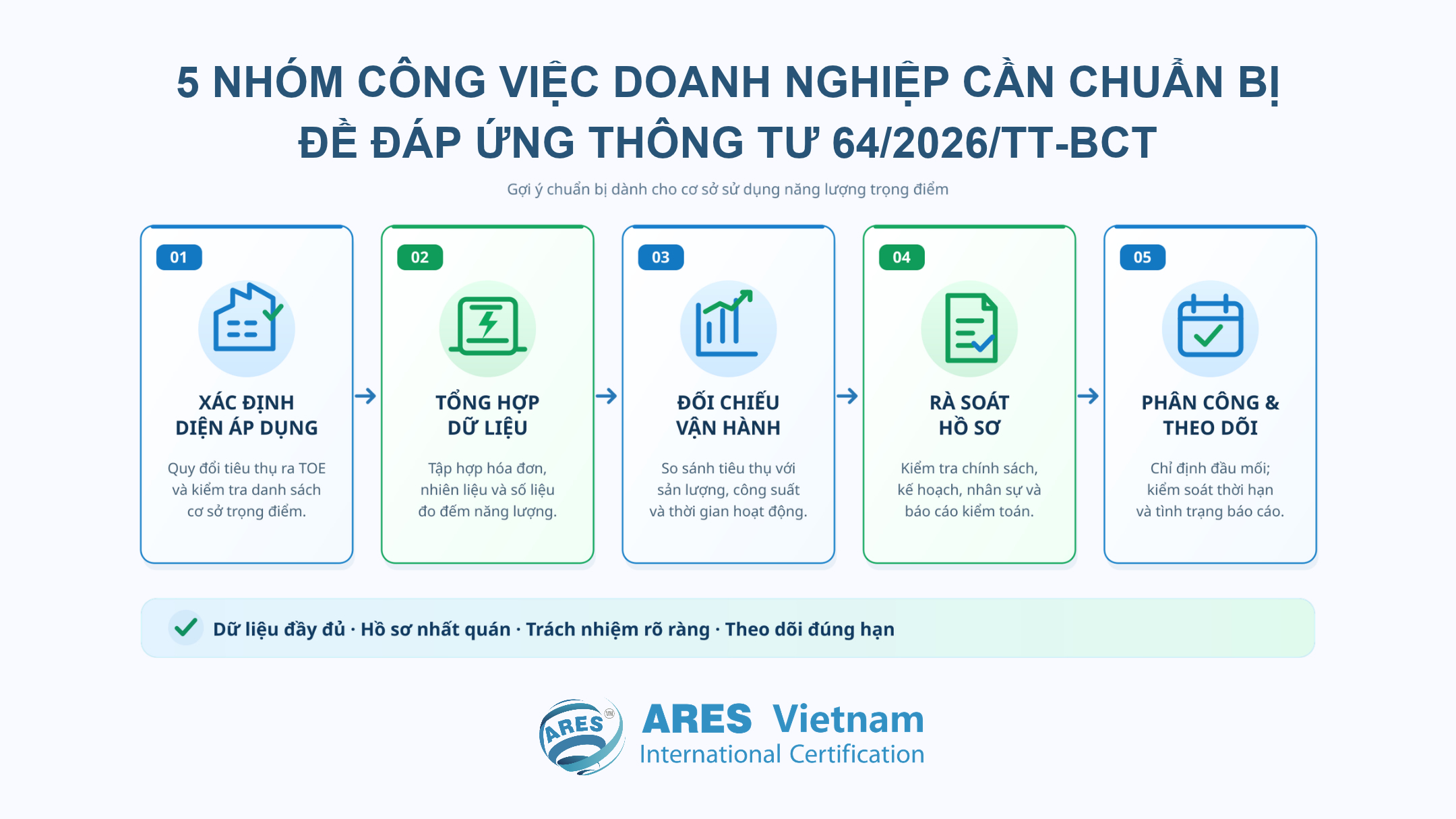
To prepare for the requirements of Circular 64/2026/TT-BCT, businesses should review the following five areas:
☐ 1. Determine the scope of application
Consolidate energy consumption data and convert it into TOE to compare it with the relevant thresholds. Check the provincial-level People’s Committee’s list of key energy-using facilities and identify which sites fall within the scope of application.
☐ 2. Consolidate energy consumption data
Collect electricity bills, fuel purchase records, and metering data for each reporting period. Verify that the information is complete and consistent before preparing reports
☐ 3. Cross-check production and operational data
Review production output, operating hours, and changes in capacity. Compare these figures with energy consumption to identify unusual data that may require further verification.
☐ 4. Review energy management records
Check energy policies and objectives, personnel responsibility records, energy use plans, and the latest energy audit report. Identify documents that need updating or supplementing.
☐ 5. Assign responsibilities and track deadlines
Designate personnel responsible for collecting, checking, and approving data. Establish a schedule for regulatory obligations and verify the status of the facility’s account on the national database system.
How Can ISO 50001 Support Business Energy Management?
ISO 50001:2018 is an international standard that specifies requirements for an energy management system. It helps businesses integrate energy management into their operations and systematically improve energy performance.
Implementing ISO 50001 can support businesses in three areas:
- Better decision-making: Analyze energy consumption data, identify energy-saving opportunities, and prioritize investments with measurable benefits.
- Stronger operational control: Incorporate energy efficiency requirements into production, maintenance, and equipment procurement activities.
- Evaluation of improvements: Monitor gains in energy efficiency and use the results to refine management and operating practices.
Importantly, Circular 64/2026/TT-BCT does not require key energy-using facilities to obtain ISO 50001 certification. Implementing or obtaining certification to this standard does not replace existing legal obligations.
Frequently Asked Questions (FAQ)
| Question | Answer |
|---|---|
| 1. Are energy audit reports issued before November 20, 2026 still valid? | Yes. Under Clause 3, Article 12, an energy audit report issued before the Circular takes effect remains valid for three years from its issuance date. |
| 2. Can a facility revise its energy use plan when production activities change? | Yes. Point d, Clause 4, Article 4 permits revisions when significant changes occur under the specified conditions, including changes in production methods, fuels, or maintenance plans. |
Conclusion
Proactively reviewing and meeting the requirements of Circular 64/2026/TT-BCT can help key energy-using facilities reduce compliance gaps and maintain greater consistency in energy management.
ARES Vietnam provides energy management system assessment and certification services against ISO 50001:2018, helping businesses confirm that their systems meet the standard’s requirements. Contact ARES Vietnam to learn more about certification options suited to your organization’s needs.

Related news

What Is a Green Project? Identification Criteria Under Decision 46/2026/QĐ-TTg
Read more


ARES Vietnam Conducts ISO 9001, ISO 14001 and ISO 45001 Surveillance Audit at ELECO VIET NAM COMPANY LIMITED
Read more
ARES Vietnam Presents ISO 9001, ISO 14001 and ISO 45001 Certificates to ELECO VIET NAM COMPANY LIMITED
Read more

Product and Goods Traceability Under Decree 372/2026/NĐ-CP: What Should Businesses Prepare?
Read more

Product Recall Procedures Under ISO 9001 and ISO 22000: What Should Businesses Prepare?
Read more