ISO 9001:2015 to ISO 9001:2026 Transition Roadmap: What Should Businesses Do?
On September 16, 2026, the International Organization for Standardization (ISO) officially published ISO 9001:2026, replacing ISO 9001:2015. According to Global ACI’s transition timeline, businesses holding ISO 9001:2015 certification within the applicable scope must complete their transition by September 30, 2029.
To ensure a smooth transition and maintain certification validity, businesses should review their existing management systems, identify necessary updates, and select an appropriate audit schedule. This article outlines five steps for transitioning to ISO 9001:2026, along with the key preparations required at each stage.
Step 1: Review ISO 9001:2015 Certification and Determine the Transition Timeline
1.1. Verify Certificate Validity and Key Transition Deadlines
First, businesses should check the expiry date, certification scope, and applicable sites listed on their ISO 9001:2015 certificates. They should also review the schedule for their next surveillance or recertification audit.
According to Global ACI’s transition timeline, two key deadlines require attention:
| Date | Transition Requirements |
| March 31, 2028 | From this date, new or initial accredited certifications may only be issued against ISO 9001:2026. |
| September 30, 2029 | This is the final deadline for completing the transition of ISO 9001:2015 certifications within the applicable scope. Certificates issued under the 2015 version will lose their validity after this date. |
Note: The overall transition deadline is separate from the expiry date of each certificate. Businesses must continue maintaining certification validity according to their applicable audit cycles.
For example: A business whose ISO 9001:2015 certificate expires in August 2027 must complete recertification on schedule to maintain its certification. If the relevant conditions are met, the business may also combine recertification with the transition to ISO 9001:2026.
1.2. Determine the Appropriate Transition Audit Approach
Depending on their certificate validity and existing audit schedule, businesses may consider three transition approaches:
| Transition Approach | Suitable Situation |
| Combined with a surveillance audit | The upcoming surveillance audit aligns with the business’s transition preparation schedule. |
| Combined with a recertification audit | The current certification cycle is approaching its end, and the business is ready to meet the updated requirements. |
| Combined with a recertification audit | The current certification cycle is approaching its end, and the business is ready to meet the updated requirements. |
Businesses should consult their certification bodies early to confirm their accreditation transition status, ability to conduct ISO 9001:2026 audits, and proposed audit schedules.
The final transition approach should be agreed upon after completing the gap analysis and determining the required workload and preparation time.
Step 2: Assess Gaps Between the Existing Management System and ISO 9001:2026
2.1. Compare Standard Requirements with the Existing Management System
Businesses should conduct a gap analysis by comparing ISO 9001:2026 requirements with their existing procedures, management activities, and operational evidence.
The assessment results can be classified into three categories:
| Compliance Status | Assessment Results |
| Fully compliant | The management system meets the requirements and has supporting evidence. |
| Partially compliant | Relevant measures have been implemented, but certain areas require further updates or additional evidence. |
| Not yet compliant | Existing activities require adjustments or additional measures to meet the requirements. |
The results should clearly identify the applicable clauses, current conditions, identified gaps, and required actions. These findings will provide the basis for developing the transition plan in the next step.
2.2. Identify Key Areas for Review and Updates
ISO 9001:2026 retains the quality management foundation of the 2015 version while revising and clarifying several requirements. During the gap analysis, businesses should focus on the following areas:
| Key Areas for Review | Required Actions |
| Quality culture and ethical behavior (5.1.1, 7.1.4, 7.3) |
Examine leadership’s role in promoting quality culture and ethical behavior, along with employees’ awareness of these requirements.
|
| Quality policy (5.2) |
Review whether the quality policy remains aligned with the organization’s current context and strategic direction.
|
| Risks and opportunities (6.1) |
Examine how risks and opportunities are identified and distinguished, as well as how corresponding actions are planned and implemented.
|
| Planning of changes (6.3) |
Review change planning, communication, effectiveness monitoring, and the evaluation of results after implementation.
|
| Management review (9.3) |
Review management review inputs, particularly changes in interested parties’ needs and expectations and the effectiveness of actions addressing risks and opportunities.
|
| Continual improvement (10.1) |
Examine how measurement results, data analysis, and management review findings are used to identify and implement improvement opportunities.
|
Note: The table summarizes key areas for review. Businesses should refer to the official ISO 9001:2026 standard to identify all applicable requirements and determine the necessary updates.
Regarding climate change under Clauses 4.1 and 4.2, these considerations were introduced through ISO 9001:2015/Amd.1:2024 and remain incorporated into the 2026 version. Businesses should review how these requirements are considered and applied within their existing management systems.
Read more: “ISO 9001:2026 Officially Published” for further details on the changes introduced in the new version.
Step 3: Develop a Transition Plan and Update the Quality Management System
3.1. Define Tasks and Assign Responsibilities
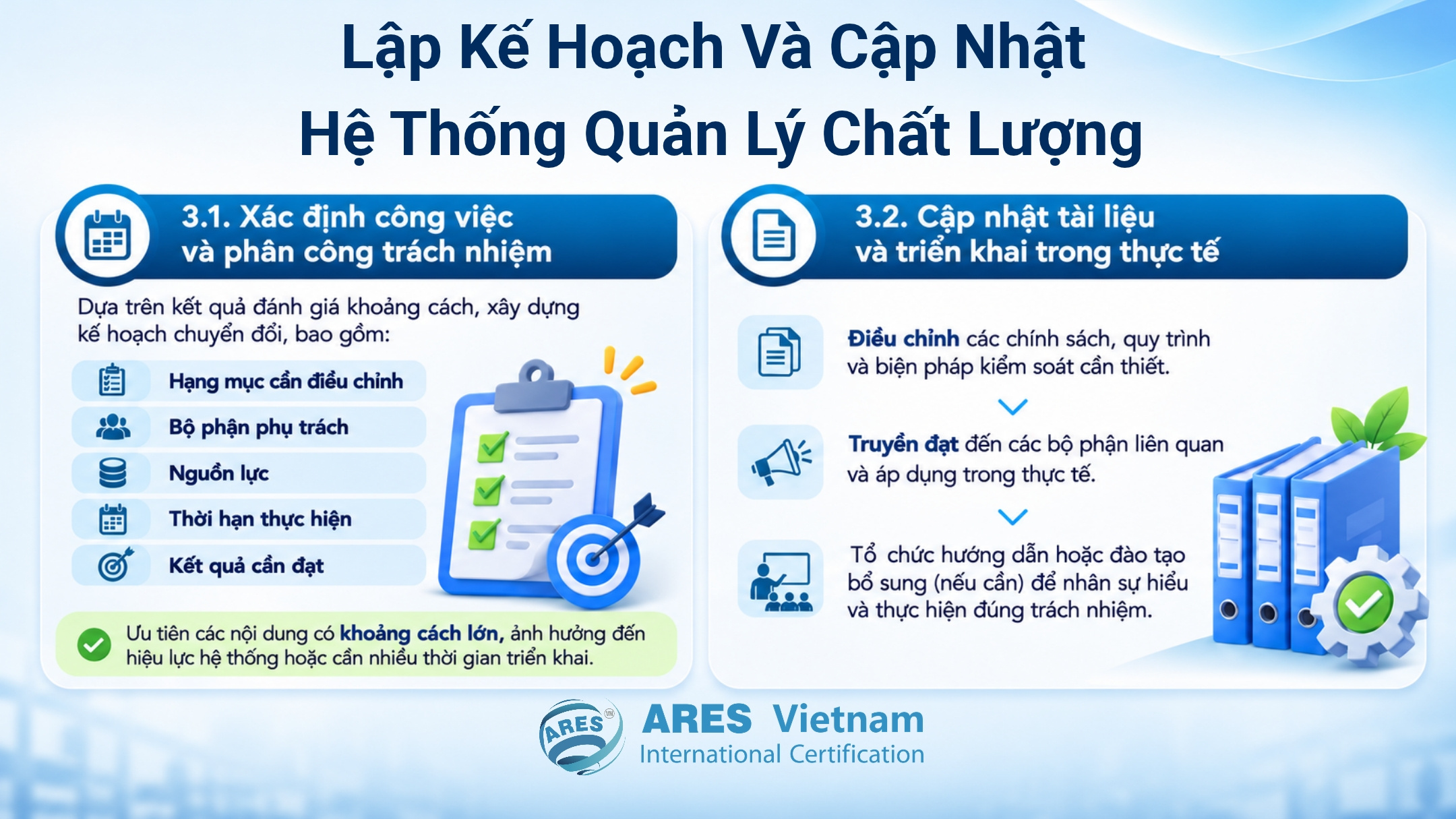
Based on the gap analysis results, businesses should develop a transition plan outlining the required adjustments, responsible departments, resources, deadlines, and expected outcomes.
Priority should be given to areas with significant gaps, substantial impacts on system effectiveness, or longer implementation timelines. The implementation schedule should also align with the planned transition audit identified in Step 1.
3.2. Update Documentation and Implement Changes
Businesses should revise relevant policies, procedures, and control measures to meet ISO 9001:2026 requirements. These changes should be communicated to affected departments, implemented in daily operations, and supported by documented evidence.
Depending on the extent of the changes, businesses may also provide additional guidance or training. This helps employees understand their responsibilities and perform their assigned tasks correctly.
Note: The scope of updates required for ISO 9001:2026 depends on the gap analysis results. Businesses can build on their existing quality management systems and focus on the necessary adjustments.
Step 4: Conduct Internal Audits and Verify Transition Readiness
4.1. Conduct Internal Audits
Businesses should update their internal audit criteria based on the applicable requirements of ISO 9001:2026. The audits should assess both the conformity and operational effectiveness of the updated management system.
Audit results should document any nonconformities, improvement opportunities, and supporting evidence. These findings will guide subsequent actions.
4.2. Implement Corrective Actions and Conduct Management Review
For identified nonconformities, businesses should determine their root causes, implement corrective actions, and evaluate the effectiveness of the measures taken.
Top management should then review the quality management system against the relevant ISO 9001:2026 requirements. The review should cover internal audit results, corrective action status, system effectiveness, and resource needs.
Pre-Transition Audit Checklist:
☐ ISO 9001:2026 requirements have been compared with the existing management system.
☐ Necessary adjustments have been completed, with supporting implementation evidence.
☐ Internal audits have been conducted against ISO 9001:2026 requirements.
☐ Identified nonconformities, if any, have been addressed, and the effectiveness of corrective actions has been evaluated.
☐ Management review has been completed in accordance with the relevant requirements.
☐ The audit schedule and preparation requirements have been agreed upon with the certification body.
This checklist supports businesses in assessing their transition readiness. The applicable requirements of ISO 9001:2026 and the certification body remain the primary references for audit preparation.
Step 5: Complete the Transition Audit and Obtain ISO 9001:2026 Certification
5.1. Prepare for and Coordinate the Transition Audit
According to the agreed audit plan, businesses should prepare the necessary documentation and operational evidence. Relevant personnel should also be available to coordinate with the certification body.
During the audit, the audit team will assess conformity with ISO 9001:2026 requirements through document reviews, employee interviews, and on-site verification of actual operations.
The audit scope and duration will depend on the selected transition approach and the current condition of the management system.
5.2. Address Audit Findings and Complete Certification
If nonconformities are identified, businesses must implement corrective actions and provide supporting evidence as required by the certification body.
Once the audit is completed, any identified nonconformities are addressed, and all certification conditions are met, the certification body will review the results and make a certification decision. The ISO 9001:2026 certificate will then be issued following a successful decision.
Note: For accredited certification, the certification body must complete its accreditation transition for the relevant scope before issuing an accredited ISO 9001:2026 certificate.
To support businesses in developing their internal audit teams, ARES Vietnam plans to organize an ISO 9001 Internal Auditor Training Course in December 2026. Interested businesses and individuals can register to receive detailed information about the program.
Related news
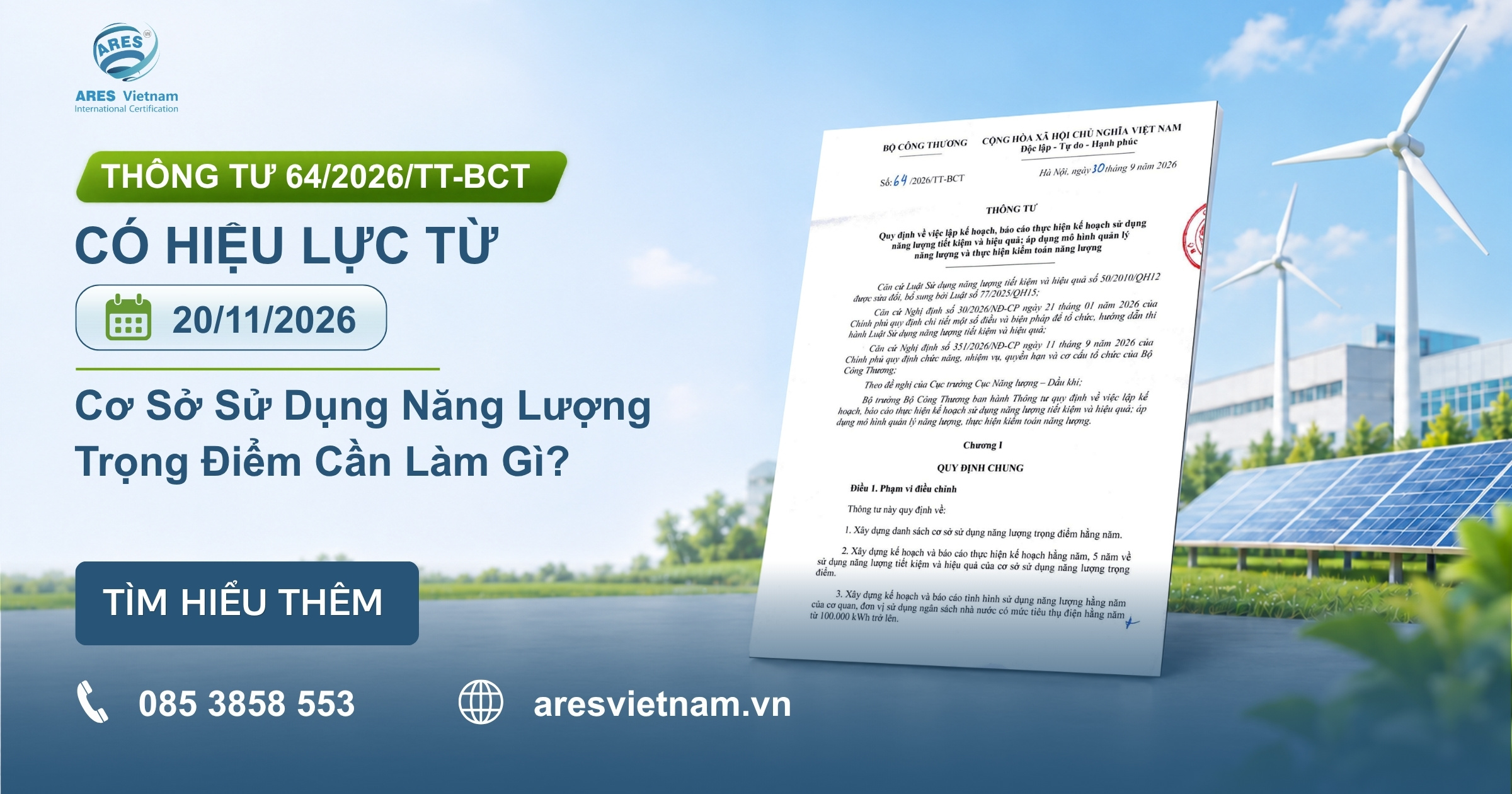
Circular 64/2026/TT-BCT Takes Effect: What Must Key Energy-Using Facilities Do?
Read more


What Is a Green Project? Identification Criteria Under Decision 46/2026/QĐ-TTg
Read more
ARES Vietnam Conducts ISO 9001, ISO 14001 and ISO 45001 Surveillance Audit at ELECO VIET NAM COMPANY LIMITED
Read more
ARES Vietnam Presents ISO 9001, ISO 14001 and ISO 45001 Certificates to ELECO VIET NAM COMPANY LIMITED
Read more

Product and Goods Traceability Under Decree 372/2026/NĐ-CP: What Should Businesses Prepare?
Read more