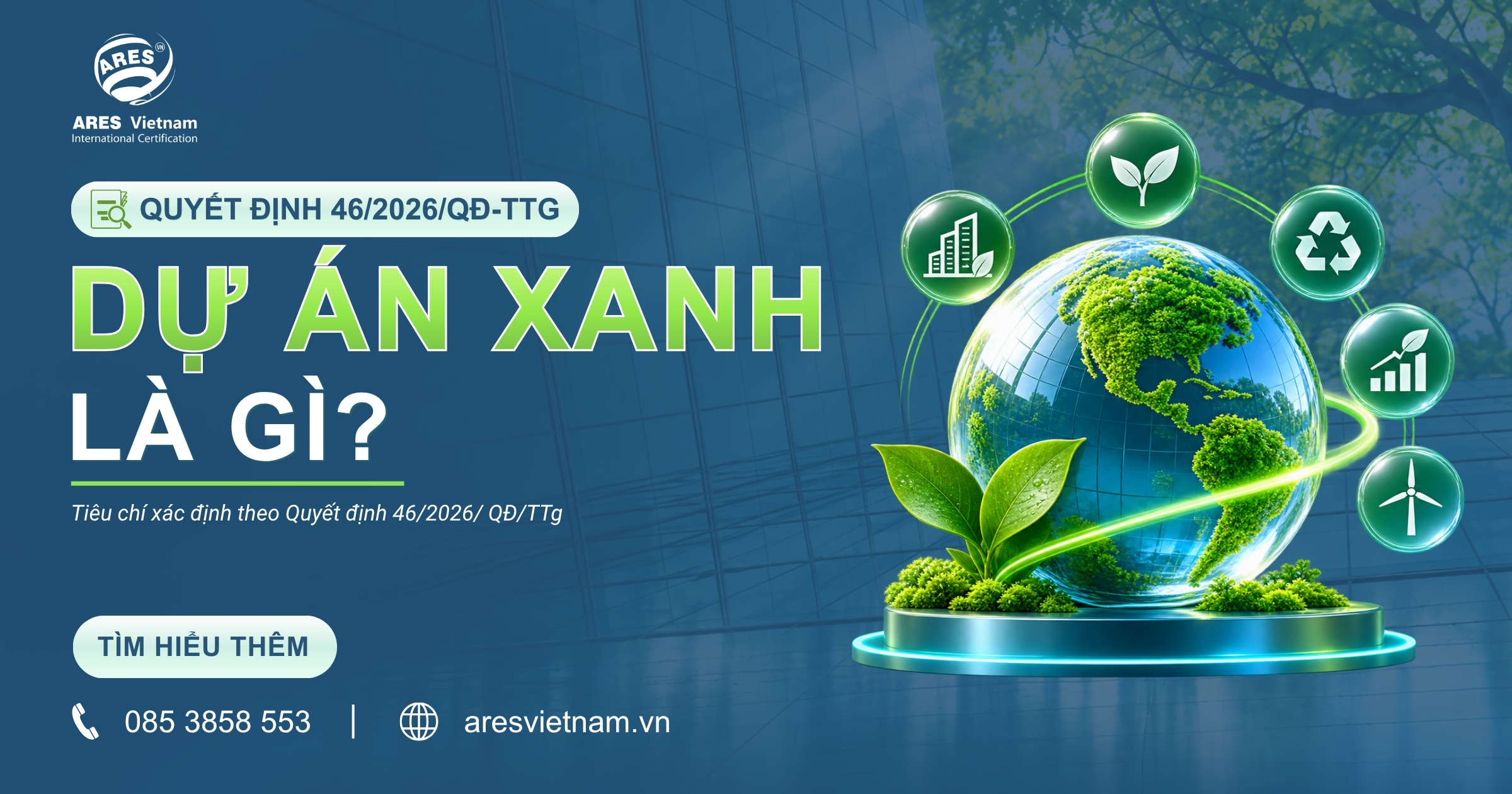
What Is a Green Project? Identification Criteria Under Decision 46/2026/QĐ-TTg
Businesses may invest in energy-saving production lines, wastewater treatment systems, or eco-friendly packaging. These investments are a strong start. However, a project meets green criteria only after it satisfies the specific requirements set by regulation.
Decision 46/2026/QĐ-TTg takes effect on November 1, 2026. It sets out the criteria and methods for identifying green projects. It also provides for the application of the Environmental, Social, and Governance (ESG) standards framework.
What Is a Green Project?
- Under Clause 1, Article 3 of Decision 46/2026/QĐ-TTg, a green project meets three criteria at the same time. These criteria appear in Annex I:
- Project type: The project belongs to the prescribed list of green projects.
- Objective: The project aligns with the environmental objective of its project type.
Under Article 2, the Decision applies to private-sector enterprises as defined by law. It also covers business households and individual businesses within the scope of Resolution 198/2025/QH15. In addition, it applies to independent assessment organizations and to related agencies and organizations.
Meanwhile, projects meeting circular criteria are identified under Clauses 2–6, Article 3 and Annex II. These projects follow a separate set of criteria.
Criteria for Identifying Green Projects Under Decision 46/2026/QĐ-TTg
Annex I sets out 45 types of green projects across 7 sectors, as follows:
| Sector | Number of types | Typical project examples |
| Energy | 10 | Solar power, wind power, biomass power generation |
| Transport | 3 | Electric vehicles, low-emission transport infrastructure |
| Construction | 2 | Green buildings, energy-efficient buildings |
| Water resources | 3 | Water supply and drainage works; clean water treatment and supply |
| Agriculture, forestry, fisheries, and biodiversity conservation | 12 | Sustainable agriculture, resource restoration, nature conservation |
| Processing and manufacturing industry | 6 | Energy-saving equipment production, eco-friendly packaging |
| Environmental services | 9 | Collection, recycling, and treatment of waste, wastewater, and emissions |
Note: These examples are representative only. The specific list and requirements appear in Annex I.
Depending on the project type, a business should compare its project with the requirements in Annex I. These include conditions that must be met at the same time, as well as optional alternatives where they apply.
Example: A project producing eco-friendly packaging
Under Item E.4 of Annex I, the project must meet three requirements at the same time:
- Product: The product belongs to the group of eco-friendly packaging as regulated.
- Technical requirements: The product meets the national technical regulations on safety and hygiene for packaging, as prescribed by law.
- Eco-label: The product is certified with the Vietnam Eco-label. Alternatively, it holds an eco-label certified by an international or national organization that has a mutual recognition agreement with the competent authority.
Therefore, using recycled materials is only one part of the picture. The project must also meet the corresponding technical and eco-label requirements.
What Should Businesses Review to Identify a Green Project?
Before requesting an independent assessment, a business should conduct a self-review in 4 steps:
| Step | Question to check |
| 1. Identify the project type | Which type in Annex I does the project belong to? |
| 2. Check the objective | Does the investment objective align with the identified type? |
| 3. Compare the requirements | Which conditions are already met, and which are still missing? |
| 4. Check the supporting evidence | Which documents prove that each condition is met? |
Supporting documents that may need review include:
- Investment and technology: Project explanation, capacity, production process, and equipment specifications.
- Legal compliance: Environmental permit, standard or technical regulation conformity certificates, or eco-label (where applicable).
- Technical data: Measurement results on resource use, energy use, and emissions.
Note: Supporting documents depend on the project type and the requirements that apply. A self-review complements the determination by an independent assessment organization under Article 4, but cannot replace it.
Dossier and Procedure for Identifying a Green Project
Under Clause 3, Article 4 of Decision 46/2026/QĐ-TTg, the dossier requesting green project identification includes:
| Dossier component | Basis |
| Written request for green project identification | Form in Annex III |
| Project explanation showing that green project criteria are met | Form in Annex IV |
The business submits the dossier to an independent assessment organization. This organization must meet the legal and capacity conditions under Clause 2, Article 4. It then reviews the dossier, compares it against the criteria, and issues the green project determination document under Clause 6, Article 4.
The timeline and cost of the determination follow an agreement between the parties, consistent with legal provisions.
Responsibilities After Being Identified
Under Article 6, the business must fulfill the following obligations:
| Obligation | Requirement |
| Notify the result | Within 30 days of receiving the determination document, notify the provincial People’s Committee where the project is carried out, using Annex VIII. |
| Maintain the criteria | Meet and maintain the applicable criteria regularly and continuously throughout project implementation. |
| Notify when the project stops or the requirements lapse | Within 05 working days of the project stopping, failing to meet the criteria, or failing to complete the ESG framework reporting content, notify the provincial People’s Committee using Annex IX. |
How Do Green Projects Relate to ESG and Interest Rate Support Policies?
Under Article 5 of Decision 46/2026/QĐ-TTg, a business carrying out a green project must prepare a report on applying the Environmental, Social, and Governance (ESG) standards framework. The report follows Annex VI and the form in Annex VII. The business must also publish it on its website, if it has one. The report is built on two groups of criteria:
- Legal compliance criteria: Follow Section I of Annex VI. These apply to the corresponding environmental, social, and governance content.
- Voluntary compliance criteria: Select from Section II of Annex VI. The minimum number depends on enterprise size:
| Enterprise size | Minimum voluntary criteria |
| Small and micro | 6 |
| Medium | 12 |
| All other enterprises | 18 |
For business households and individual businesses, the minimum is 3 criteria. The selected criteria must represent all three groups: environmental, social, and governance. The exception is a business applying an international-standard ESG framework under Clause 4, Article 5.
Under Clause 5, Article 5, the green project determination document and the ESG framework report together form the basis for considering interest rate support under the law. Being identified as a green project is the first step. A business must still go through the relevant procedure to receive this policy benefit.
How Do ISO 14001 and Related Standards Support Businesses?
ISO standards can help businesses manage and monitor environmental, energy, and emissions data related to a project.
| Standard | Supporting role |
| ISO 14001 | Controls environmental aspects, tracks compliance obligations, and evaluates management effectiveness. |
| ISO 50001 | Tracks energy performance, sets baselines, and evaluates the effectiveness of improvements. |
| ISO 14064-1 | Quantifies and reports greenhouse gas emissions at the organization level. |
Notably, Annex VI of Decision 46/2026/QĐ-TTg refers to an environmental management system conforming to ISO 14001 or equivalent within the ESG framework.
However, applying or being certified to ISO standards complements, but cannot replace, green project identification under Annex I and Article 4 of the Decision.
Frequently Asked Questions (FAQ)
| Question | Answer |
| 1. Can a project already in operation request identification as a green project? | Yes. Decision 46/2026/QĐ-TTg lets projects at any operating stage request identification. The project must still meet the corresponding requirements in Annex I. |
| 2. Does a green project determination document have a fixed validity period? | The Decision leaves the validity period open-ended, with no general term for the determination document. The business must maintain the applicable criteria and follow the requirements stated in the document. |
Conclusion
Identifying a green project under Decision 46/2026/QĐ-TTg requires businesses to compare all applicable requirements. They must also prepare suitable supporting evidence. By reviewing proactively from the early stage, businesses can spot any missing conditions. This creates a foundation for the assessment process and for maintaining the results.
ARES Vietnam provides management system certification and greenhouse gas information verification services. These services help businesses strengthen their capacity in environmental, energy, and emissions management. Contact ARES Vietnam to learn about the services that fit your business needs.
Related news
Circular 64/2026/TT-BCT Takes Effect: What Must Key Energy-Using Facilities Do?
Read more

ARES Vietnam Conducts ISO 9001, ISO 14001 and ISO 45001 Surveillance Audit at ELECO VIET NAM COMPANY LIMITED
Read more
ARES Vietnam Presents ISO 9001, ISO 14001 and ISO 45001 Certificates to ELECO VIET NAM COMPANY LIMITED
Read more

Product and Goods Traceability Under Decree 372/2026/NĐ-CP: What Should Businesses Prepare?
Read more
Product Recall Procedures Under ISO 9001 and ISO 22000: What Should Businesses Prepare?
Read more