Product and Goods Traceability Under Decree 372/2026/NĐ-CP: What Should Businesses Prepare?

Imagine a batch of raw materials fails to meet requirements. Can your business quickly identify the related finished-product batches and the units that received them? If data across production, warehousing, and sales is poorly linked, tracing can take a lot of time for cross-checking.\
Decree 372/2026/NĐ-CP takes effect on January 1, 2027. It governs the identification, authentication, and traceability of products and goods in the digital environment. However, mandatory application depends on the product group and on the roadmap of each sector regulator. This article clarifies who is covered. It also outlines five steps for preparing identifiers, traceability data, and system connectivity.
What Does Decree 372/2026/NĐ-CP Stipulate on Traceability?
Decree 372/2026/NĐ-CP was issued on September 29, 2026, and takes effect on January 1, 2027. It regulates the identification, authentication, and traceability of products and goods in the digital environment through the National Platform.
Under Article 1, application differs by product and goods group:
| Product and goods group | Applicable provisions |
| High risk | Identification, master data authentication, and traceability are mandatory. The list, roadmap, and method are decided by the ministry managing the relevant sector or field. |
| Medium and low risk | Voluntary implementation is encouraged. |
| Export goods | Voluntary application is the principle, unless specialized legislation provides otherwise. |
Note: The Decree excludes certain types of goods. These include temporary import for re-export, transit, transshipment, and imported goods stored in bonded warehouses for export to a third country. Products in national defense, security, and cipher fields that require confidentiality of origin are also outside mandatory application.
Regarding implementation deadlines, businesses should distinguish the following:
| Milestone | Key points |
| January 1, 2027 | The Decree takes effect. This date is a starting point rather than a common completion deadline for all businesses. |
| Per sector-specific roadmap | The managing ministry decides the list, timing, and method of mandatory application for high-risk products. |
| Within 6 months at most from the date the National Platform is announced as ready | This is the deadline for connecting and synchronizing data for agencies, organizations, and individuals under Clause 1, Article 37. |
To determine its obligations, a business should compare its products and goods with the high-risk list and roadmap announced by the managing ministry. Its line of business alone is insufficient for this purpose.
5 Steps Businesses Should Take to Prepare for Traceability
Businesses can prepare in five steps, depending on their scope and roadmap. Treat this as a reference guide rather than a sequence mandated by Decree 372/2026/NĐ-CP.
Step 1: Identify Products and Applicable Requirements
First, a business should list the products it manufactures, imports, or trades. It should then verify the following:
- Applicable list: Compare products with the list announced by the ministry managing the relevant sector or field.
- Role in the supply chain: Identify responsibilities at each stage, including production, contract manufacturing, import, distribution, and storage.
- Implementation requirements: Check the application timeline, the traceability method (by lot/batch or by individual unit), and related sector-specific regulations.
The comparison results should be recorded together with the legal basis and deadlines. This record supports planning.
Step 2: Review Identifiers and Traceability Data
Under Article 9 of Decree 372/2026/NĐ-CP, the product and goods identifier (UID) is generated automatically on the National Platform. It is based on the Global Trade Item Number (GTIN) and master data. A business should check the following:
- Identifiers: The GTIN, product code, lot/batch number, or serial number currently in use. Products without a GTIN must first register the right to use a code and barcode as required, before a UID can be generated.
- Master data: Information identifying the product and related entities. Examples include product name, industry group code, origin, brand, and details of the manufacturing or trading unit.
- Related records: Compare product data with production records, warehouse records, and delivery documents to detect missing or inconsistent information.
In addition, businesses should review certificates of product quality, origin, standard conformity, and technical regulation conformity. This prepares them to digitize, authenticate, and synchronize the documents covered by the competent authority’s roadmap.
Note: Automatic UID generation on the National Platform is free of charge under Clause 5, Article 9. Related service and technology costs are considered separately.
Step 3: Define Traceability Events and Assign Responsibilities
Master data identifies the product. Traceability event data, by contrast, records activities that occur in the supply chain. For example, it shows when, where, and by whom a product was manufactured, packaged, transferred between warehouses, or delivered.
Under Clause 3, Article 11 of Decree 372/2026/NĐ-CP, data at each stage includes the UID, event type, time, location, product status, and related entities.
Below is an example of how responsibilities can be assigned at a factory:
| Stage | Information to record | Responsible department
(for reference) |
| Raw material receipt | Supplier, lot number, time of receipt | Purchasing, Warehouse, QA/QC |
| Production and packaging | Raw material lot, finished-product lot, process stage | Production, QA/QC |
| Storage and delivery | Dispatched lot number, delivery time, receiving unit | Warehouse, Logistics, Sales |
Events such as lot splitting, lot merging, and transfer of goods should also be considered. This keeps the data linked end to end.
For key events within the scope of application, digital certificates are initiated through the UID. This must comply with Article 11 and sector-specific guidance, including the exceptions provided there.
Step 4: Assess Systems and Data Connection Options
Under Article 37 of Decree 372/2026/NĐ-CP, systems, codes, barcodes, and data that have been used lawfully can continue to be inherited under the transitional mechanism. They must meet the prescribed conditions.
Three areas need to be assessed:
- Traceability management: Can the system record and link the history of products and lots/batches across stages?
- Connectivity: Does the system support standardizing and synchronizing data with the National Platform through a suitable method?
- Data protection: Does the system provide access control, change logging, and information security?
Depending on the existing system, a business can choose direct connection, connection through a sector-specific system, or connection through a technology solution provider. Data can be updated through an API, the National App, or another permitted method.
At the same time, businesses should refer to the technical requirements in Article 23 of Decree 37/2026/NĐ-CP. These help them decide whether to keep, adjust, or upgrade the system.
Step 5: Test Traceability and Finalize the Plan
A business should select one representative product lot to test real-world traceability.
Illustrative example: Raw material lot NL-001 is used to produce two finished-product lots. These lots are then distributed to different units.
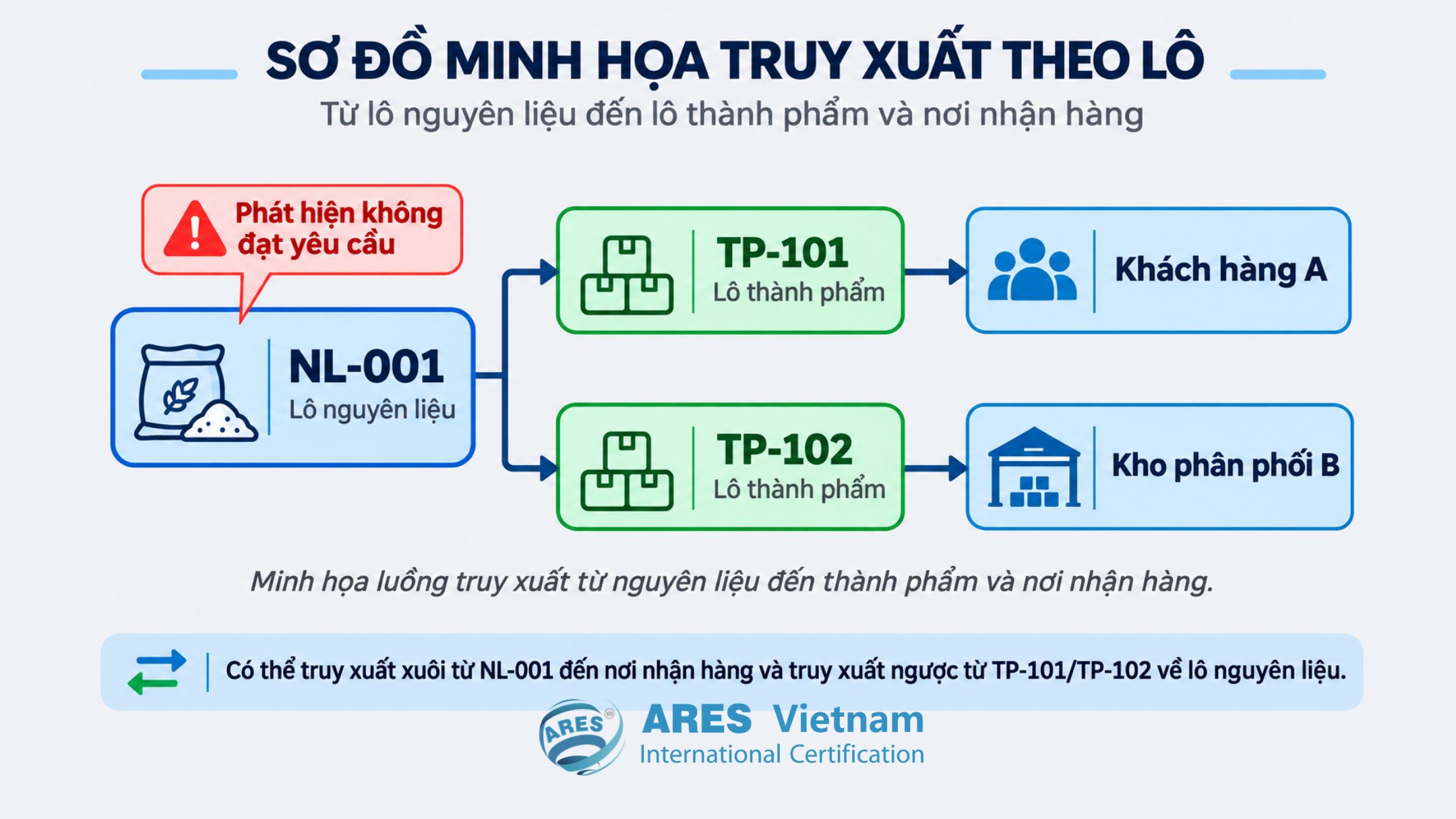
When NL-001 is found to be non-conforming, the business should check the following:
- Forward tracing: Identify the affected finished-product lots, their quantities, and where they were received.
- Backward tracing: Identify the raw material source, supplier, and production records from each finished-product lot.
- Document reconciliation: Verify that traceability data, production records, inventory, and delivery documents are consistent.
The test results show where discrepancies exist. They also guide the assignment of corrective actions and the finalization of the plan. Traceability capability further helps determine the scope of impact when a non-conforming product must be recalled.
See also: Product Recall Process Under ISO 9001 and ISO 22000: What Should Businesses Prepare?
Quick Preparation Checklist
| Review item | Expected outcome |
| Product list and applicable obligations | Products, legal basis, and implementation roadmap |
| Identifiers and master data | Identification information checked and supplemented |
| Records and traceability events | List of data to record and responsible departments |
| Management and connection systems | Plan to keep, adjust, or upgrade |
| Actual traceability test | Test results, discrepancies, and corrective action plan |
How Do ISO 9001 and ISO 22000 Support Traceability?
ISO 9001 and ISO 22000 help businesses control processes, manage records, and maintain traceability. They do so within the scope of the applicable management system.
| Standard | Relevant clause | Value to the business |
| ISO 9001:2026 | Clause 8.5.2 – Identification and traceability | Controls product identification and inspection status. It also retains the information needed for tracing when required. |
| ISO 22000:2018 | Clause 8.3 – Traceability system | Links data on raw materials, production lots, and distribution. It also verifies system effectiveness to help identify potentially unsafe products. |
Note: ISO certification complements, but cannot replace, the legal obligations under Decree 372/2026/NĐ-CP. Businesses within scope must still meet the requirements for identification, authentication, and traceability, following the prescribed roadmap.
Conclusion
To prepare for Decree 372/2026/NĐ-CP, businesses should first determine the correct obligations for each product. Next, they should review their traceability data and assess how well their existing systems meet the requirements. On this basis, they can proactively build an implementation plan that fits the application roadmap. This helps them time any investment or system adjustment after the requirements are clearly defined.
ARES Vietnam provides assessment and certification services for ISO 9001 quality management systems and ISO 22000 food safety management systems. Contact ARES Vietnam to learn about the certification scope and programs that fit your business operations.

Frequently Asked Questions (FAQ)
| Question | Answer |
| 1. Does a QR code mean a product’s origin has been authenticated? | It depends on the data behind the code. A QR code is only a means of accessing information. Authentication relies on traceability data and a valid verification mechanism under the regulations. |
| 2. Must businesses disclose all traceability data? | Only part of the data is disclosed. Data sharing must follow the rules on access scope, purpose of use, and information confidentiality. Businesses still provide the data that is mandatory under the regulations. |
| 3. Must a business with an existing traceability system replace it? | Replacement is optional in many cases. Under Article 37 of Decree 372/2026/NĐ-CP, systems, codes, barcodes, and data used lawfully can continue to be inherited under the transitional mechanism. They must meet the prescribed conditions. |
Legal basis:
- Decree 372/2026/NĐ-CP dated September 29, 2026, of the Government, regulating the identification, authentication, and traceability of products and goods.
- Decree 37/2026/NĐ-CP dated January 23, 2026, of the Government, detailing a number of articles and measures for organizing and guiding the implementation of the Law on Product and Goods Quality.
Related news

Circular 64/2026/TT-BCT Takes Effect: What Must Key Energy-Using Facilities Do?
Read more


What Is a Green Project? Identification Criteria Under Decision 46/2026/QĐ-TTg
Read more
ARES Vietnam Conducts ISO 9001, ISO 14001 and ISO 45001 Surveillance Audit at ELECO VIET NAM COMPANY LIMITED
Read more
ARES Vietnam Presents ISO 9001, ISO 14001 and ISO 45001 Certificates to ELECO VIET NAM COMPANY LIMITED
Read more

Product Recall Procedures Under ISO 9001 and ISO 22000: What Should Businesses Prepare?
Read more