Which ISO Certifications Do Suppliers to FDI Companies Need?
There is no single set of ISO certifications that applies to every supplier serving foreign direct investment (FDI) companies. The right standards depend on the products or services the supplier provides, customer requirements, operational risks, and industry-specific requirements.
Instead of choosing ISO standards simply because they are popular, companies need to identify which requirements actually apply to their operations. This article helps suppliers narrow down the standards they should review and set the right priorities.
What Do FDI Companies Usually Require from Suppliers?
Before looking at ISO standards, suppliers need to understand what their FDI customers assess. Requirements often vary according to the type of product or service the supplier provides.
| Supplier Type | What Customers Commonly Look For |
| Raw materials, components, or finished products | Quality, technical specifications, traceability, change control, production capacity, and delivery performance |
| Operational or logistics services | Service consistency, delivery schedules, compliance, and service continuity |
| Contractors or technical service providers working at customer sites | Technical capability, occupational health and safety, workforce control, and contractor management |
| IT, software, or data-processing services | Information security, access control, data management, and system availability |
Suppliers should not assume that one widely used standard will satisfy every customer requirement. They need to determine which requirements actually apply to their activities.
What Requirements Should Suppliers Identify Before Choosing an ISO Standard?
Customers may include supplier requirements in many different documents. They may not always refer to a specific ISO standard by name. Before selecting a standard, companies should review four key areas:
| What to Identify | What to Check |
| What does the customer require? | Supplier manuals, Requests for Quotation (RFQs), Requests for Proposal (RFPs), contracts, audit checklists, and supplier quality requirements |
| How strict is the requirement? | Mandatory certification, a certification roadmap, preferred criteria, or a request for data or supporting evidence |
| What scope does the requirement cover? | Legal entity, factory, product, service, or specific activity |
| Does the customer have requirements beyond ISO? | Traceability, change control, quality KPIs, supplier assessment, codes of conduct, cybersecurity, or carbon data |
These four areas help suppliers define what they need to address and determine which standards deserve priority.
Which ISO Standard Should My Company Prioritize?
The right priority does not depend on industry alone. Companies need to consider what they supply, what risks their activities create for the customer, and what conditions the customer sets for suppliers.
The table below helps companies identify which standards to review first. It can also prevent them from implementing several ISO standards that they may not actually need.
| Supplier Type | Standards to Review First | Also Consider When |
| Manufacturers, processors, and suppliers of raw materials, components, or finished products | ISO 9001 | The customer has environmental requirements, or operations involve significant occupational health and safety risks |
| Operational, logistics, or on-site technical service providers | ISO 9001 or ISO 45001, depending on the assessment focus | Operations create significant environmental impacts |
| IT, software, design, or data-processing service providers | ISO/IEC 27001 | The customer also requires service quality management |
Case 1. Manufacturers, Processors, and Suppliers of Raw Materials or Components
This group includes companies that manufacture raw materials, packaging, components, semi-finished goods, or finished products. Their products often enter the customer’s production process directly. As a result, suppliers need to maintain consistent input quality, technical specifications, and delivery performance.
When customers ask suppliers to demonstrate effective quality control, ISO 9001 often deserves the highest priority. The standard focuses on process control, nonconformity management, and change management.
Companies may also consider ISO 14001 when customers set environmental requirements or when operations create significant environmental impacts. ISO 45001 may apply when work activities involve significant occupational health and safety risks. Companies only need to integrate all three standards when these requirements arise together.
Case 2. Operational, Logistics, or On-Site Technical Service Providers
This group includes transportation companies, warehouses, freight forwarders, industrial cleaning contractors, maintenance providers, installers, repair companies, on-site processors, and contractors working at customer facilities.
Customers often assess service quality, schedules, work records, and compliance with site rules.
Companies should prioritize ISO 9001 when customers focus on service quality or incident handling. They should also consider ISO 45001 when work involves occupational risks or when employees work at customer sites.
Companies only need to review ISO 14001 when their activities create significant environmental impacts or when the customer sets specific environmental requirements.
Case 3. IT, Software, or Data-Processing Service Providers
This group includes software companies, system administrators, data storage providers, outsourced design companies, and service providers that access customer drawings, product information, or IT systems.
Companies should prioritize ISO/IEC 27001 when customers require information security, access control, technical data protection, or system availability. If customers also require service quality control, incident management, and continual improvement, companies may consider ISO 9001 as well.
Note: Companies only need to consider ISO 50001 when customers require them to manage or improve energy performance.
ISO 22301 may become more relevant when customers want suppliers to demonstrate business continuity, especially when the customer cannot easily replace the supplier’s product or service.
When Do Suppliers Need Industry-Specific Standards or Carbon Requirements?
In addition to the management system standards above, companies should review any requirements that relate to their industry, products, or professional activities. They also need to check whether customers request greenhouse gas (GHG) or carbon data.
1. Industry-, Product-, or Activity-Specific Requirements
Testing and calibration
| Situation | What to Check |
| Automotive supply chain | IATF 16949 and customer-specific requirements |
| Medical devices | ISO 13485, applicable regulations, and customer requirements |
| Food supply chain | ISO 22000 or other relevant food safety requirements |
| Testing and calibration | Accreditation to ISO/IEC 17025 |
These standards and requirements do not apply to every FDI supplier. Companies need to identify the exact product, their role in the supply chain, and the customer’s conditions before implementation.
2. When Customers Request GHG or Carbon Data
Customers may ask for organization-level emissions data, product carbon footprint data, or verification of GHG statements. Companies need to distinguish between these requirements before choosing the right method or standard.
- Organization-level GHG inventory or emissions data: review the requirements of ISO 14064-1
- Product carbon footprint: review the requirements of ISO 14067.
- Verification of GHG statements: review ISO 14064-3 or the requirements of the applicable verification program.
These standards do not function as management system certifications in the same way as ISO 9001, ISO 14001, or ISO 45001. Companies therefore need to identify the exact type of data that customers require and the level of verification they expect.
How Should Suppliers Prioritize Multiple Requirements?
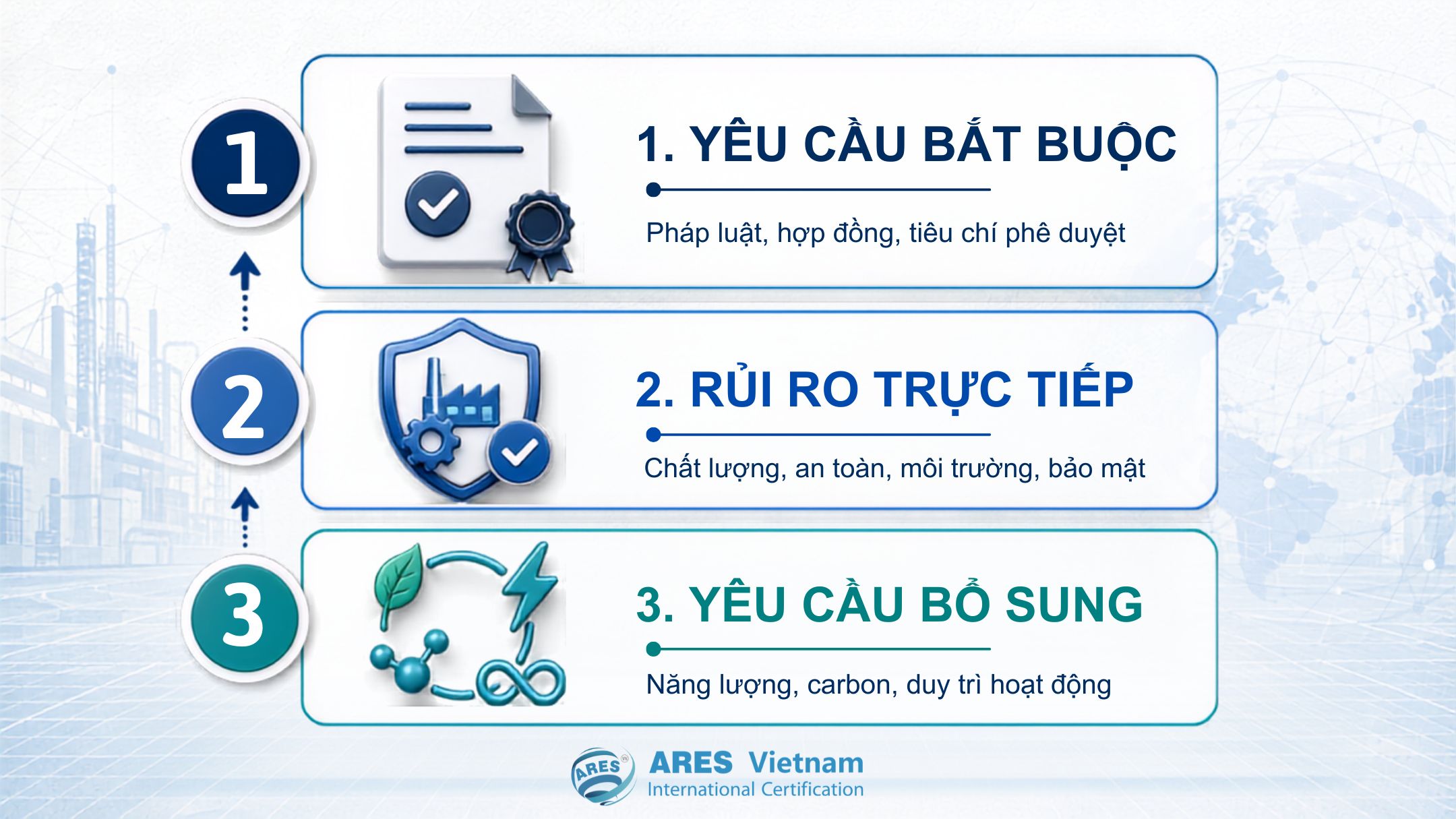
When customers set several requirements at the same time, suppliers should establish a clear order of priority rather than trying to address everything at once.
1. Mandatory Requirements
Companies should first address requirements linked to laws and regulations, industry rules, contractual obligations, supplier requirements, and customer approval criteria.
If the customer specifies a deadline, scope, or certification condition, the supplier should place that requirement at the top of its implementation plan.
2. Requirements Linked Directly to Key Operational Risks
Sau yêu cầu bắt buộc, doanh nghiệp nên ưu tiên nội dung có ảnh hưởng trực tiếp đến chất lượng, an toàn, môi trường, bảo mật hoặc khả năng thực hiện dịch vụ đối với khách hàng.
Suppliers should base their priorities on the products or services they provide and the actual risks involved. They should not apply the same sequence to every supplier.
3. Additional Supply Chain Requirements
Companies should prioritize energy, GHG, carbon, or business continuity requirements when the customer, corporate group, or supply chain specifically asks for them.
In these cases, companies may need to review ISO 50001, ISO 14064-1, ISO 14067, or ISO 22301, depending on the required scope.
Suppliers do not need to chase a large number of certificates. They should address mandatory requirements first, then the direct risks associated with their activities, and finally any additional customer or supply chain requirements.
Checklist for FDI Suppliers Before Applying for ISO Certification
Before applying for an audit or certification, companies should clarify the following points:
- Which standard does the customer require?
- Does the customer require certification, or only the implementation of a management system?
- Which version of the standard does the customer accept?
- Which legal entity or site must fall within the required scope?
- Does the certification scope cover the products or services the company actually supplies?
- What deadline has the customer set?
- Does the customer set specific requirements for the certification body or accreditation?
Not sure which standard your FDI customer requires?
If your company has received supplier requirements, an RFQ, an assessment checklist, or a certification request but still cannot determine the required scope, contact ARES Vietnam to learn more about the assessment scope, certification process, and applicable requirements.
- Hotline: 085.3858.553
- Email: service@aresvietnam.vn
Frequently Asked Questions (FAQ)
| Question | Answer |
| Do suppliers to FDI companies have to obtain ISO certification? | No. Not every supplier to an FDI company needs ISO certification. Requirements depend on the products or services supplied, risk levels, industry requirements, and the customer’s specific conditions. |
| Is ISO 9001 enough to become an approved supplier to an FDI company? | ISO 9001 can play an important role when customers assess quality management capability. However, customers may also review technical requirements, production or service capacity, actual quality performance, delivery performance, commercial terms, and their own supplier approval criteria. |
| Should a manufacturing company prioritize ISO 9001, ISO 14001, or ISO 45001? | Companies should start with the customer’s mandatory requirements. If the customer does not specify a standard, ISO 9001 often deserves the first review when product and process quality form the main focus. Companies should also consider ISO 14001 or ISO 45001 when environmental requirements or occupational health and safety risks apply. |
| Does ISO certification guarantee approval as a supplier? | No. ISO certification may serve as a mandatory condition or supporting evidence during supplier assessment. Customers may still review actual quality performance, technical capability, audit results, delivery capability, and commercial terms before approving a supplier. |
Related news

Emissions Data & CBAM: 5 Practical Questions from Factory Operations
Read more


Greenhouse Gas Inventory Challenges: What Data Should Businesses Prepare?
Read more
ARES Vietnam Conducts ISO 45001:2018 Surveillance Audit at A&J (VIETNAM) CO., LTD.
Read more
Rice Export and Import Business Under Decree 365/2026/ND-CP: What Should Enterprises Control?
Read more
ARES Vietnam Verifies Greenhouse Gas Report under ISO 14064-1:2018 at GE LAN Vietnam
Read more