Product Recall Procedures Under ISO 9001 and ISO 22000: What Should Businesses Prepare?

When a nonconforming product is identified after delivery, businesses need to promptly assess its impact, trace affected batches, and determine appropriate actions. In the event of a recall, incomplete records or delayed coordination may allow affected products to remain in circulation, increasing risks and corrective costs.
So, what do ISO 9001 and ISO 22000 require regarding product recalls? What steps should businesses follow, and what records and resources should they prepare to ensure an effective response? In this article, ARES Vietnam explores these questions in detail.
When Is a Product Recall Necessary?
A product recall involves preventing further distribution or use and controlling products that have already been delivered to customers or placed on the market when an incident requiring action is identified. A recall may be necessary in the following situations:
- Quality or technical defects: Products fail to meet specified requirements, affecting their functionality or safe use.
- Food safety hazards: The detection of pathogenic microorganisms, contaminants exceeding permissible limits, or undeclared allergens.
- Regulatory requirements or safety alerts: Regulatory authorities require a recall, or relevant parties identify potential risks associated with distributed products.
The need for a recall depends on the product’s status and the associated risks. For products still under the organization’s control, businesses may apply segregation, suspend shipments, and address the nonconformity.
For products already delivered or placed on the market, businesses should assess the level of risk, scope of impact, and applicable legal obligations to determine whether a recall is necessary.
What Do ISO 9001 and ISO 22000 Require for Product Recalls?
Both ISO 9001 and ISO 22000 establish requirements related to the control of nonconforming products. However, their scope of application and specific provisions for product recalls differ.
| Criteria | ISO 9001:2026 | ISO 22000:2018 |
| Scope of application | Quality management systems applicable to various types of organizations | Food safety management systems applicable to organizations within the food chain |
| Relevant clauses | 8.5.2 – Identification and Traceability; 8.5.5 – Post-delivery Activities; 8.7 – Control of Nonconforming Outputs; 10.2 – Nonconformity and Corrective Action | 8.3 – Traceability System; 8.9.4 – Handling of Potentially Unsafe Products; 8.9.5 – Withdrawal/Recall |
| Recall requirements | Recalls may be used depending on the nature of the nonconformity, its consequences, and applicable requirements. The need for a dedicated recall procedure depends on the organization’s activities and obligations. | Establishes specific requirements for the ability to promptly withdraw or recall batches of finished products identified as potentially unsafe. |
| Key control focus | Output conformity, customer requirements, post-delivery activities, and corrective actions | Food safety, traceability, notification, product control, and verification of recall effectiveness |
These differences affect how businesses establish responsibilities, maintain records, and implement response measures.
For organizations applying both standards, recall procedures can be integrated to reduce documentation duplication. However, the integrated process must still address the specific requirements of quality management and food safety management.
What Are the 6 Steps in the Product Recall Process Under ISO?
Product recall procedures should reflect the nature of the products, distribution scope, and applicable requirements.
The following six steps provide a practical framework based on relevant requirements of ISO 9001 and ISO 22000. They serve as a reference rather than a prescribed sequence under both standards. In practice, assessment, traceability, and emergency control activities may take place simultaneously.
Step 1: Assess the Incident and Determine the Need for a Recall
Upon receiving failed test results, customer complaints, or alerts from suppliers or regulatory authorities, businesses should verify the information and assess three key aspects:
- Nature of the incident: Which quality, technical, or safety requirements does the product fail to meet?
- Level of risk: What potential consequences could the incident have for customers, users, and related products?
- Distribution status: Where have the suspected batches been delivered, and what quantities may be affected?
During verification, businesses should implement initial control measures. These may include suspending shipments, segregating suspected batches, or requesting customers to temporarily stop distribution or use when necessary.
Protective measures can begin while the root cause is being investigated.
For food products that have left the organization’s control and are subsequently determined to be unsafe, Clause 8.9.4.1 of ISO 22000:2018 requires the organization to notify relevant interested parties and initiate a withdrawal/recall.
Step 2: Trace Products and Identify the Scope of Impact
Traceability enables businesses to connect raw material, production, inventory, and distribution records to identify products potentially affected by an incident.
Businesses should cross-check four categories of information:
- Product batches: The affected batch codes and other potentially affected batches that share raw materials, production processes, or manufacturing conditions.
- Quantities: Total quantities produced, remaining in stock, dispatched, and delivered to each receiving location.
- Locations: Warehouses, customers, distributors, and other relevant receiving points.
- Unverified information: Quantity discrepancies, receiving locations awaiting confirmation, or batches requiring further verification before exclusion from the affected scope.
Businesses should maintain traceability from raw materials to finished products and from finished products to customers, within the applicable scope.
The results help identify the batches, quantities, and locations requiring control or recall.
Step 3: Activate the Recall Plan and Issue Notifications
Based on the assessment results, authorized personnel make recall decisions and coordinate the required activities. The recall plan should define the affected scope, departmental responsibilities, required resources, and implementation schedule.
Recall notifications sent to relevant parties should include:
- Product name, batch code, and identifying information.
- Reason for the recall and associated risks.
- Instructions to stop distribution or use.
- Guidelines for segregation, return, or handover.
- Contact details and required completion deadlines.
After issuing notifications, businesses should monitor receipt confirmations and update alerts whenever new information changes the affected scope or required actions.
Important considerations for food businesses:
Under Articles 54 and 55 of the Law on Food Safety, applicable food producers and businesses are responsible for product traceability, recalls, handling, and public disclosure of information concerning recalled food products.
Notification procedures, reporting obligations to competent authorities, and implementation deadlines should be reviewed against the regulations applicable to each product category.
Step 4: Conduct the Recall and Control Affected Products
Once the recall plan is activated, businesses should coordinate with relevant departments and distribution points to carry out the recall.
The process focuses on four key activities:
- Prevent further distribution: Confirm that receiving locations have stopped selling, distributing, or using products covered by the recall.
- Verify actual product status: Check quantities remaining in stock, transferred to other locations, already used, or awaiting verification.
- Collect and segregate products: Receive, count, identify, and store recalled products under appropriate conditions.
- Update recall results: Record quantities brought under control, handover status, and outstanding cases.
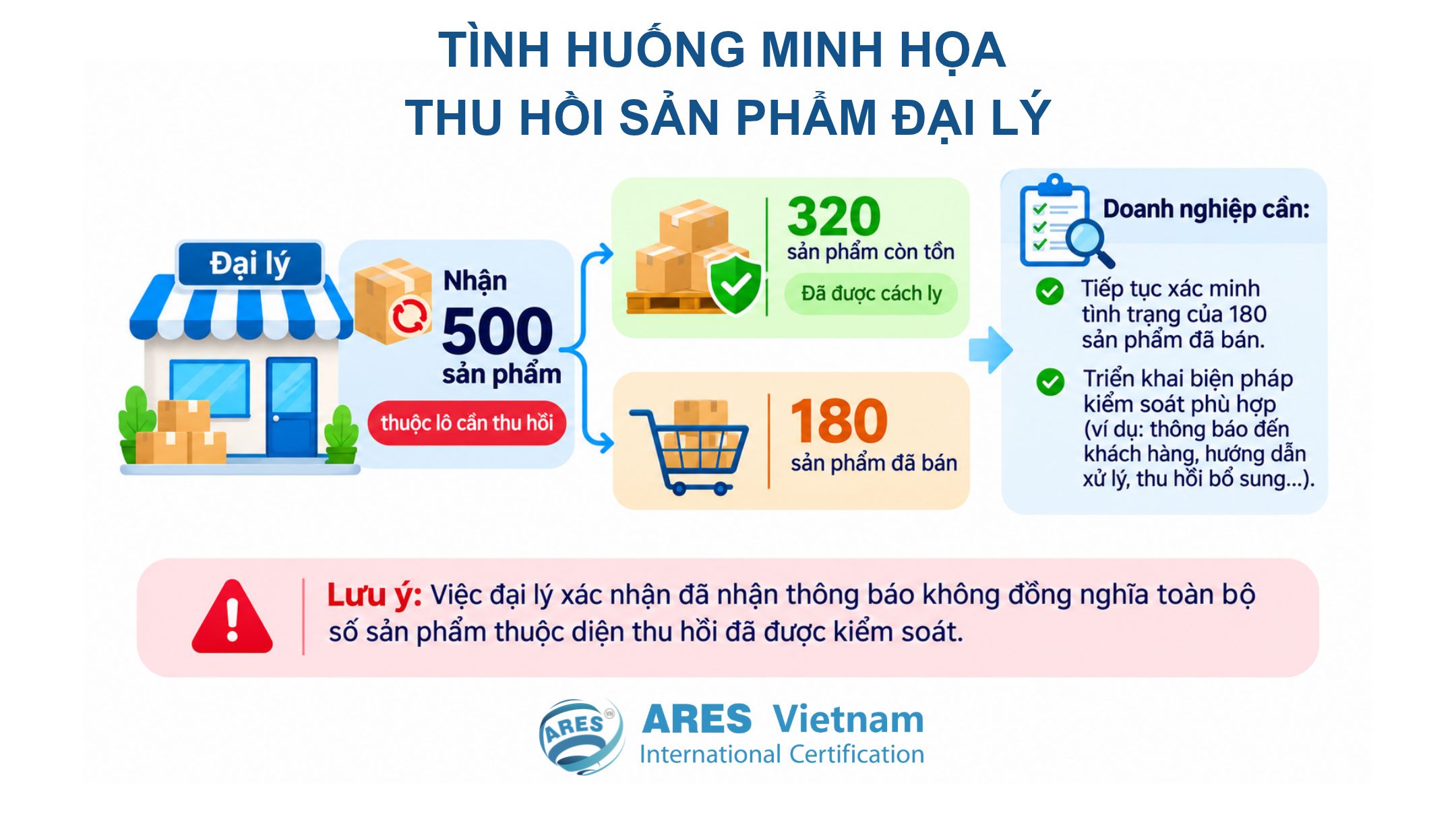
Step 5: Evaluate and Handle Recalled Products
Before selecting a handling method, businesses should evaluate the condition and risk level of recalled products.
Under ISO 9001, when a nonconforming product has been corrected, its conformity with applicable requirements must be verified before acceptance.
For ISO 22000:2018, Clause 8.9.4.3 specifies the following disposition methods for products that are unacceptable for release:
- Reprocessing or further processing: Reduce food safety hazards to acceptable levels.
- Alternative use: Redirect products to another use that maintains food safety throughout the food chain.
- Destruction or disposal: Remove products in accordance with applicable conditions and regulations.
In addition to the standard’s requirements, food businesses should review Article 55 of the Law on Food Safety. This provision includes handling methods such as correcting product defects, rectifying labeling errors, and re-exporting products.
The selected method must have an appropriate basis, receive approval from authorized personnel, and be supported by records of its implementation results.
Step 6: Reconcile Recall Results and Implement Corrective Actions
Before closing a recall, businesses should complete three main activities:
- Reconcile recall results: Consolidate the total quantities within the affected scope. Compare quantities recalled, segregated, handled, and still awaiting control. Identify discrepancies, outstanding cases, and further actions required. Each quantity should be accounted for once across the different product statuses.
- Report and evaluate results: Prepare a report covering the recall scope, implementation results, and unresolved issues. This information supports decisions on whether to continue or close the recall. Under ISO 22000:2018, the cause, extent, and results of the withdrawal/recall must be retained and reported to top management as input for management review.
- Implement corrective actions: Analyze root causes, determine measures to prevent recurrence, assign responsibilities, and evaluate the effectiveness of implemented actions.
Even after the recall has been completed, businesses must continue monitoring and evaluating the effectiveness of corrective actions.
What Should Businesses Prepare for an Effective Product Recall?
To respond proactively to incidents, businesses should establish the necessary personnel arrangements, data systems, resources, and records in advance.
The following checklist helps organizations assess their recall readiness.
| Category | Preparation Requirements |
| 1. Personnel and authority | Authorized recall decision-makers; recall coordinators; responsibilities of QA/QC, production, warehouse, and sales departments; designated substitutes when necessary. |
| 2. Traceability data | Batch identification systems; raw material, production, inventory, and delivery records; methods for accessing and cross-checking data across departments. |
| 3. Notification and communication | Contact lists for customers, distributors, and relevant parties; notification templates; emergency communication channels; and methods for confirming receipt. |
| 4. Recall resources | Transportation providers, segregation areas, receiving locations, appropriate storage conditions, and resources required for implementation. |
| 5. Forms and records | Forms for incident reporting, recall decisions, quantity tracking, product handover, disposition, and results reporting; clearly assigned responsibilities for record updates and retention. |
| 6. Legal requirements | Regulations applicable to the products and relevant markets; obligations regarding safety alerts, public disclosure, reporting, and implementation deadlines. |
These arrangements should be regularly updated to reflect the organization’s product characteristics, operational scale, and distribution system.
Product Recall Testing and Simulation Under ISO 22000
Clause 8.9.5 of ISO 22000:2018 requires organizations to verify the implementation and effectiveness of withdrawals/recalls using appropriate techniques.
Businesses may conduct simulated recall scenarios to evaluate traceability time, data accuracy, communication capabilities, and coordination between departments.
Test results should be retained as documented information to identify gaps and support improvement activities. ISO 22000:2018 allows organizations to establish appropriate testing methods and frequencies based on product characteristics, risk levels, and applicable requirements, rather than prescribing a uniform simulation frequency for all organizations.
An effective product recall depends on more than response speed. It also requires complete traceability records, clearly assigned responsibilities, and effective control measures. Applying the relevant requirements of ISO 9001 and ISO 22000 helps businesses strengthen incident response capabilities and continuously improve their management systems.
ARES Vietnam provides ISO 9001 and ISO 22000 audit and certification services for businesses seeking certification of their quality management and food safety management systems.
Contact ARES Vietnam to learn more about the certification audit scope and process suitable for your business.
Related news

Circular 64/2026/TT-BCT Takes Effect: What Must Key Energy-Using Facilities Do?
Read more


What Is a Green Project? Identification Criteria Under Decision 46/2026/QĐ-TTg
Read more
ARES Vietnam Conducts ISO 9001, ISO 14001 and ISO 45001 Surveillance Audit at ELECO VIET NAM COMPANY LIMITED
Read more
ARES Vietnam Presents ISO 9001, ISO 14001 and ISO 45001 Certificates to ELECO VIET NAM COMPANY LIMITED
Read more

Product and Goods Traceability Under Decree 372/2026/NĐ-CP: What Should Businesses Prepare?
Read more