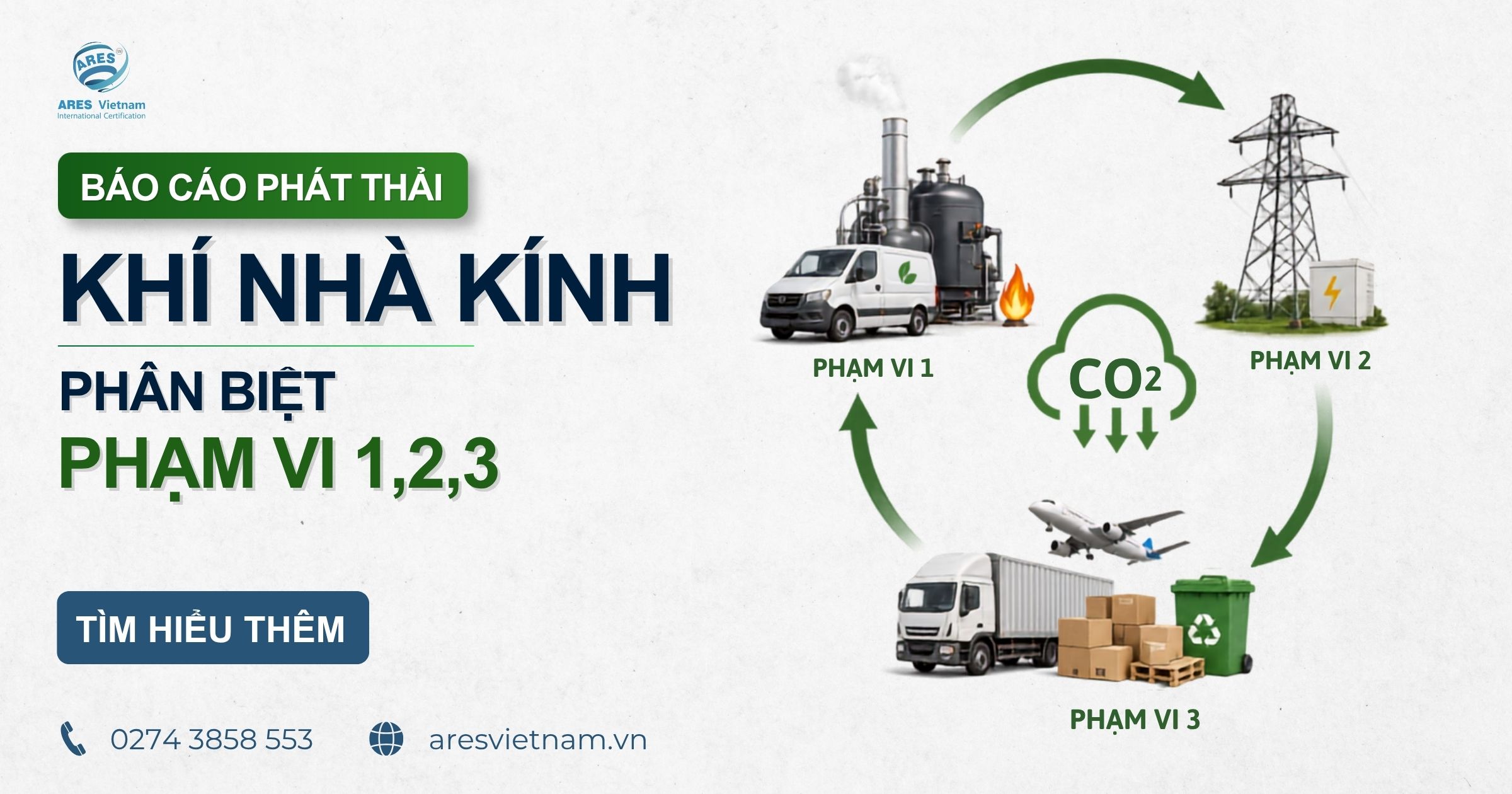
Greenhouse Gas Inventory Process for Businesses Under ISO 14064-1
Conducting a greenhouse gas (GHG) inventory under ISO 14064-1 requires organizations to define boundaries, identify sources, collect data, perform calculations, and prepare reports. When data is distributed across multiple departments, emission sources may be overlooked and figures can become difficult to reconcile.
This article outlines a seven-step GHG inventory process, along with the data and records organizations should prepare and common errors to address.
What Does ISO 14064-1 Require for Greenhouse Gas Inventories?
ISO 14064-1:2018 specifies principles and requirements for quantifying and reporting greenhouse gas emissions and removals at the organizational level. A GHG inventory should follow five principles: relevance, completeness, consistency, accuracy, and transparency.
When a report is prepared to meet legal, customer, corporate, or specific GHG program requirements, the organization also needs to address the corresponding requirements. Applying ISO 14064-1 alone does not automatically fulfill every reporting requirement.
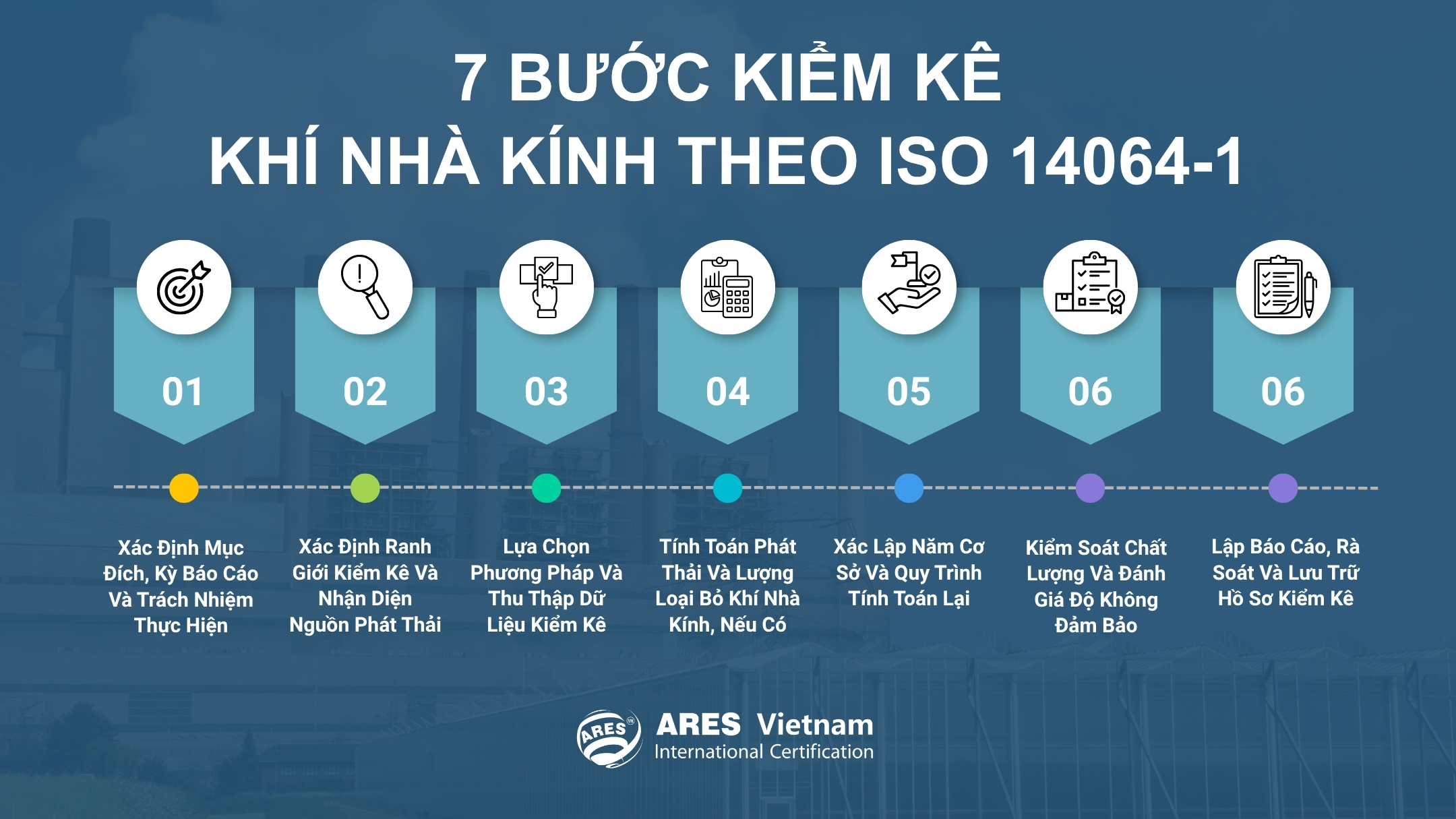
Greenhouse Gas Inventory Process Under ISO 14064-1: 7 Steps
The following seven steps provide a structured approach to the GHG inventory process. Base-year selection and quality control should be considered from the beginning and maintained throughout the process.
Step 1: Define the Purpose, Reporting Period, and Responsibilities
Responsibilities should also be assigned for providing, consolidating, and reviewing data. In addition, departments should agree on completion deadlines.
Output: Inventory purpose, reporting period, applicable requirements, and responsibility assignment matrix.
Step 2: Define Inventory Boundaries and Identify Emission Sources
The organization should determine which facilities are included in the inventory based on a control approach or ownership share. It should then establish reporting boundaries and identify direct emission sources and GHG removal activities, where applicable.
Indirect emissions should be assessed against established significance criteria. The basis for any exclusions should also be documented.
Under ISO 14064-1:2018, GHG inventory results are classified into six categories:
- Direct GHG emissions and removals.
- Indirect GHG emissions from imported energy.
- Indirect GHG emissions from transportation.
- Indirect GHG emissions from products used by the organization.
- Indirect GHG emissions associated with the use of products from the organization.
- Indirect GHG emissions from other sources.
“Imported energy” refers to energy brought in from outside the organizational boundary, rather than only energy imported from another country.
Output: Organizational boundaries, reporting boundaries, and a source list with the basis for inclusion or exclusion.
Step 3: Select Quantification Methods and Collect Inventory Data
Next, the organization should select an appropriate quantification method for each source to determine the required data. The reporting period, units, completeness, and supporting records should be checked carefully.
Data from different departments should also be reconciled to prevent duplication. When estimation is required, the basis, assumptions, and limitations should be clearly documented.
Output: Quantification method for each source, verified datasets, and procedures for handling missing data.
Step 4: Calculate GHG Emissions and Removals, Where Applicable
Calculations should follow the selected methods. For certain sources, emissions may be calculated by multiplying activity data by an emission factor.
The organization should verify the units and scope of application of each emission factor. Each greenhouse gas should then be converted into carbon dioxide equivalent (CO₂e) using the appropriate Global Warming Potential (GWP). If an emission factor is already expressed in CO₂e, the GWP should not be applied again.
Output: Calculation sheets for each source, including emission factors, GWP values, reference sources, and assumptions used.
Step 5: Establish the Base Year and Recalculation Procedure
The organization should select a base year with verifiable data for comparison or to meet the purpose of the inventory. If historical data is unavailable, the first inventory period may be selected as the base year.
A recalculation procedure should be established for significant changes in organizational structure, methodologies, emission factors, or identified errors. Changes in production volume alone do not require base-year recalculation.
Output: Base year, base-year inventory results, basis for selection, and recalculation procedure.
Step 6: Perform Quality Control and Assess Uncertainty
The organization should review omitted sources, duplicate data, incorrect units, emission factors, and unusual fluctuations. Any discrepancies identified during the review should be addressed.
Uncertainty associated with data and methodologies should also be assessed for each inventory category. When quantitative assessment is impractical or not cost-effective, the organization should explain the reason and provide a qualitative assessment.
Output: Review results, evidence of discrepancy resolution, uncertainty assessment, and remaining limitations.
Step 7: Prepare the Report, Review Results, and Retain Inventory Records
The GHG report should be prepared in accordance with Clause 9.3. It should cover organizational information, the reporting period, boundaries, significance criteria for indirect emissions, exclusions, methodologies, results, the base year, uncertainty, and verification status.
Before the report is issued, the results should be reconciled with the calculation sheets. Records should also be retained so that reported results can be traced back to the original supporting documents.
Output: GHG report, controlled calculation sheets, source documents, and review evidence.
What Data and Records Should Organizations Prepare?
Depending on the reporting boundaries and quantification methods, organizations may refer to the following groups of data and supporting records:
| Source Category | Data to Collect | Supporting Records | Responsible Department |
| Fuel | Fuel type, consumption, and inventory during the reporting period | Goods receipt and issue records, invoices, operating logs | Warehouse, Accounting, Production |
| Purchased energy | Electricity, steam, heat, or cooling energy consumption | Invoices, meter readings, contracts | Engineering, Accounting |
| Refrigerants | Refrigerant type; quantities charged, topped up, and recovered | Maintenance logs, service records | Maintenance |
| Production processes | Raw materials, production volume, and parameters related to emissions | Production records, analysis results | Production, Engineering |
| Outsourced transportation | Cargo weight, distance traveled, and mode of transportation | Bills of lading, delivery logs, carrier data | Logistics |
| Externally treated waste | Waste type, quantity, and treatment method | Waste transfer records, waste treatment provider records | Environment |
| Purchased goods and services | Type, quantity purchased, or data required by the selected calculation method | Procurement records, supplier data | Procurement, Accounting |
Common Errors in Greenhouse Gas Inventories
| Common Error | Impact | Control Measure |
| Incorrect activity data for the reporting period | Reconcile fuel receipts, consumption, and inventory | Using purchased fuel quantities instead of actual consumption |
| Omitting refrigerants or process emissions | Incomplete GHG inventory results | Review sources by equipment, area, and process |
| Excluding indirect emissions solely because data is unavailable | Potential omission of significant emissions | Assess emissions against established criteria and document the basis for inclusion or exclusion |
| Using inappropriate emission factors | Incorrect calculation results | Check the source, scope of application, data period, and units |
| Retaining only consolidated figures | Difficulties in reviewing and substantiating results | Link reported figures to calculation sheets and original supporting records |
Frequently Asked Questions (FAQ)
| Question | Answer |
| Can an organization conduct its own greenhouse gas inventory? | Yes. An organization can conduct its own inventory when it has personnel with appropriate competence and the ability to control data in accordance with applicable requirements. The results should be supported by evidence, consistent, and verifiable. |
| When does an organization need to have its GHG report verified? | Verification may be required by applicable requirements or by the party receiving the report. An organization may also choose verification to enhance the reliability of reported information. Preparing an inventory under ISO 14064-1 and verifying it are separate activities. ISO 14064-3 specifies principles and requirements for the verification and validation of greenhouse gas statements. |
Verification of a greenhouse gas inventory report helps organizations assess the reliability of reported data and its conformity with applicable requirements.
Contact ARES Vietnam to discuss your needs for verification of greenhouse gas inventory reports prepared in accordance with ISO 14064-1.
- Hotline:085.3858.553
- Email:service@aresvietnam.vn

Related news
Control of Measuring Equipment in Manufacturing Plants: What Should FDI Enterprises Consider Under ISO 9001?
Read more


ARES VIETNAM AT THE 2ND MEMBER CONGRESS OF TERM 19 & MID-AUTUMN FESTIVAL GALA
Read more

Liquid Milk Has Passed Testing: What Else Should Businesses Control?
Read more

ARES Vietnam Conducts ISO 50001:2018 Surveillance Audit at Gemtek Vietnam Corporation Limited
Read more

Implementing ISO 50001: How Can FDI Companies Benefit from Systematic Energy Management?
Read more