Why ISO/IEC 27001 is Becoming Essential for Logistics and Supply Chain Enterprises
Modern logistics goes beyond simple freight transportation; it is the management of complex information flows across multiple supply chain stakeholders.
In Vietnam, the logistics sector is shifting toward modernization, digitalization, and enhanced connectivity and sustainability. While this creates significant growth opportunities, it simultaneously heightens the demand for robust security, risk management, and operational continuity.
Consequently, an increasing number of logistics enterprises are adopting ISO/IEC 27001 as the international standard for building a systematic Information Security Management System (ISMS). Beyond data protection, this standard empowers businesses to strengthen risk governance, meet the stringent requirements of clients and partners, and secure a competitive edge in modern supply chains.
Logistics Data: The New Core Corporate Asset
In today’s operational landscape, it is increasingly difficult to process orders effectively relying solely on manual workflows. The processes of intake, dispatching, warehousing, transportation, tracking, and hand-over require constant information exchange across numerous systems, departments, and external partners.
Many logistics firms now operate as supply chain data hubs, managing critical information categories including:
| Data Category | Description |
| Identity Data | Customer, supplier, consignee, and carrier information |
| Commercial and Transport Data | Bills of lading, contracts, price lists, delivery terms, and tracking data |
| Warehousing and Inventory Data | Inventory levels, goods location, SKU, and status of warehouse intake, dispatch, and movement |
| Financial and Legal Data | Invoices, payment documents, electronic customs declarations, and tariff data |
| Integrated System Data | Connection flows between TMS, WMS, ERP and clients/partners via APIs, EDI, and integrated platforms |
A disruption, error, or unauthorized access to any information link extends far beyond the IT department.
What Information Security Risks Do Logistics Firms Face?
Khi dữ liệu trở thành nền tảng vận hành, các sự cố an toàn thông tin có thể nhanh chóng chuyển hóa thành rủi ro vận hành, tài chính và uy tín. Một số tình huống đáng chú ý trong ngành logistics gồm:
|
Risks |
Impact on logistics business |
| Customer/Order Data Breach | Exposure of customer info, price lists, contracts, and shipping data; damaging trust and business relationships. |
| Ransomware Attacks / Data Encryption | Disrupting dispatch, warehousing, transport, or documentation systems; impacting revenue and delivery SLAs. |
| Compromised Employee/Partner Accounts | Fraudulent delivery orders, unauthorized changes to payment details, and illegal access to internal data. |
| Inventory/Bill of Lading Discrepancies | Shipping errors, stock shortages, SLA violations, and increased rework costs. |
| Weak Third-Party Security | Creating entry points into corporate systems via APIs, integrated accounts, or third-party platforms. |
These scenarios are receiving increasing attention as ransomware, software vulnerability exploits, and third-party risks continue to rise on a global scale.
According to the 2026 Verizon DBIR, 48% of data breaches involve ransomware, while 31% originate from software vulnerabilities. The 2025 IBM report also notes that the global average cost of a data breach reached approximately $4.4 million.
For logistics enterprises, information security risk is no longer solely an IT concern. It has become a critical component of operational management capability, especially as businesses must handle sensitive data from customers, suppliers, consignees, drivers, transport partners, and various stakeholders across the supply chain.
Additionally, in Vietnam, Decree 13/2023/ND-CP on personal data protection sets critical compliance requirements. ISO/IEC 27001 does not replace legal obligations but serves as a framework to build a more structured information control mechanism.
What is ISO/IEC 27001?
ISO/IEC 27001 is the international standard for Information Security Management Systems (ISMS). It provides requirements for organizations to establish, implement, maintain, and improve their management system using a risk-based approach.
Three Core Principles:
| Principle | English Name | Goal |
| Confidentiality | Confidentiality | Ensuring information is accessible only by authorized parties. |
| Integrity | Integrity | Maintaining the accuracy and completeness of information and preventing unauthorized modification. |
| Availability | Availability | Ensuring information and related systems are accessible when needed for business operations. |
Unlike implementing isolated security solutions, ISO/IEC 27001 focuses on building a comprehensive management system that integrates people, processes, technology, responsibilities, and mechanisms for continuous improvement. As a result, enterprises can identify, assess, address, and monitor risks that may affect information throughout their operational processes.
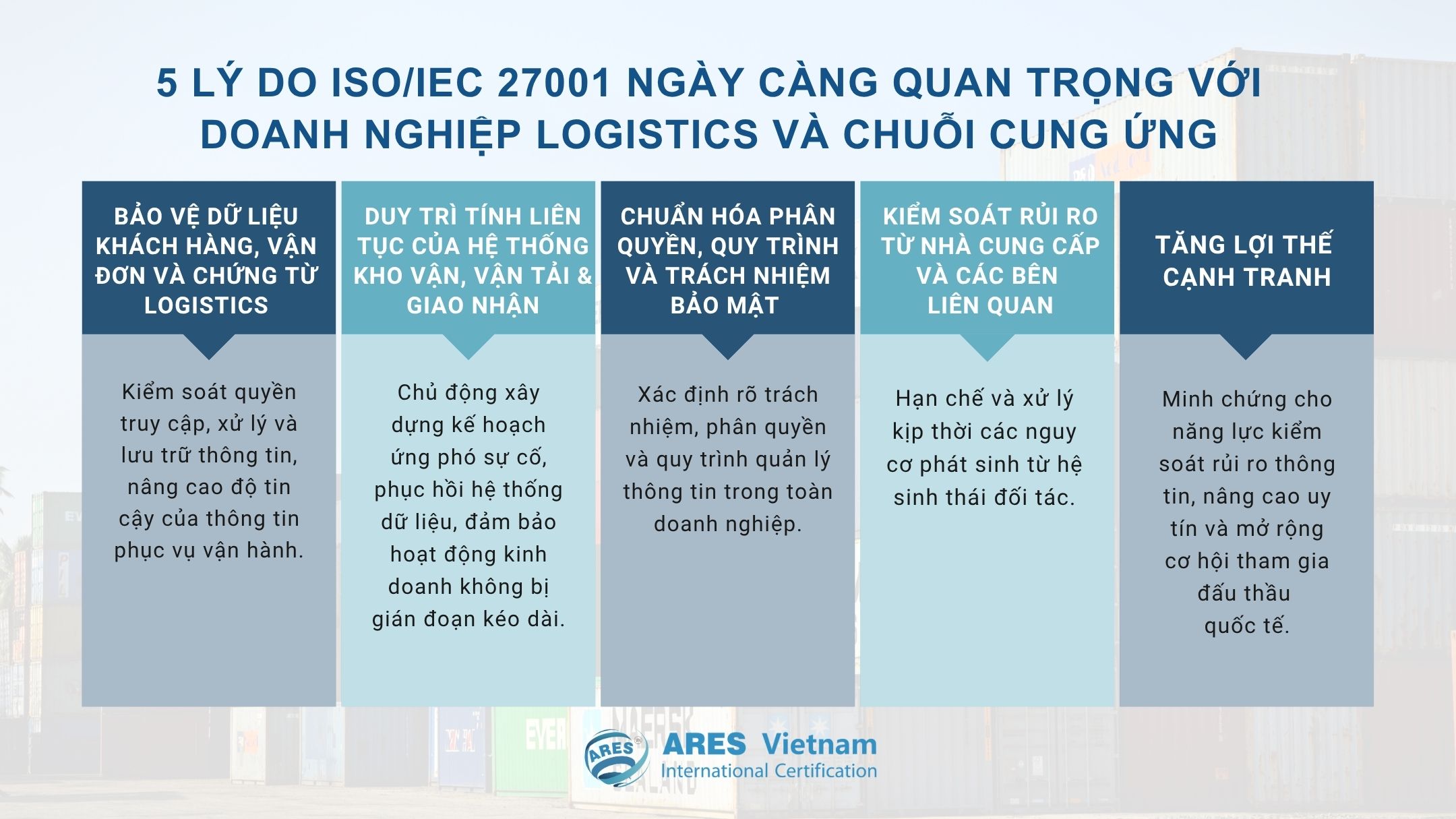
5 Reasons Why ISO/IEC 27001 is Vital for Logistics:
1. Bảo Vệ Dữ Liệu Khách Hàng, Vận Đơn Và Chứng Từ Logistics
Logistics enterprises often manage vast amounts of sensitive information from customers and partners, including order data, bills of lading, price lists, contracts, payment vouchers, import-export documents, and consignee information.
As data volumes grow, the risks of data fragmentation, unauthorized access, or uncontrolled sharing increase proportionally. ISO/IEC 27001 helps enterprises clearly identify critical information assets, establish access controls, and govern the processing, storage, and sharing of information. This supports better data protection while enhancing reliability throughout the logistics service delivery process.
2. Ensuring Business Continuity in Warehousing, Transport, and Delivery Operations
One of the most critical requirements from logistics clients is consistent, on-time, and reliable service. If warehouse management systems, bills of lading, fleet dispatch, tracking systems, or documentation processes are disrupted, enterprises may face delivery delays, data discrepancies, increased rework costs, and negative impacts on customer experience.
Through systematic risk assessment and the implementation of appropriate controls, ISO/IEC 27001 provides the framework for enterprises to establish incident response, backup, and recovery plans, ensuring the availability of critical information systems. This serves as a foundation for minimizing the impact of incidents and limiting prolonged operational disruptions.
3. Standardizing Access Control, Processes, and Information Security Responsibilities
Logistics is a collaborative industry, requiring constant coordination between departments such as Sales, Documentation, Warehousing, Dispatch, Accounting, Customer Service, and IT. If access rights, data handling responsibilities, and approval processes are not clearly defined, operational errors or security vulnerabilities are likely to emerge.
ISO/IEC 27001 assists organizations in building delegation mechanisms, defining responsibilities, and standardizing information security-related processes. By clarifying the role of each department, enterprises can reduce reliance on individual experience, improve consistency, and maintain better control over sensitive points within the information flow.
4. Mitigating Risks from Vendors and Stakeholders
Logistics operations frequently depend on various partners, including transport carriers, warehouse providers, freight forwarders, software vendors, integration platforms, service contractors, and supply chain clients. Consequently, a vulnerability in a third party can easily become a risk to the enterprise’s own information systems.
ISO/IEC 27001 supports enterprises in setting security requirements for vendors, controlling access rights, monitoring data exchanges, and assessing risks arising from the partner ecosystem. This is particularly crucial as enterprises frequently connect data via APIs, EDI, tracking platforms, or client order management systems.
5. Gaining a Competitive Advantage with Large-scale, FDI, and Global Supply Chain Clients
In the B2B environment, large-scale clients, FDI enterprises, and multinational corporations are increasingly focused on the information security capabilities of their service providers. Before entering into partnerships, logistics enterprises are often subject to rigorous vendor assessments, covering security posture, data control, and risk management capabilities.
ISO/IEC 27001 certification serves as objective proof that an enterprise has built and operates an information security management system in accordance with international standards. This not only boosts credibility with clients but also facilitates the pre-qualification and bidding process, opening up opportunities to participate in global supply chains.
Which Logistics Enterprises Should Consider Implementing ISO/IEC 27001?
The need to implement ISO/IEC 27001 is often more pronounced for organizations with high levels of digitalization, those handling large volumes of information, and companies that frequently exchange data with customers, suppliers, or partners within the supply chain.
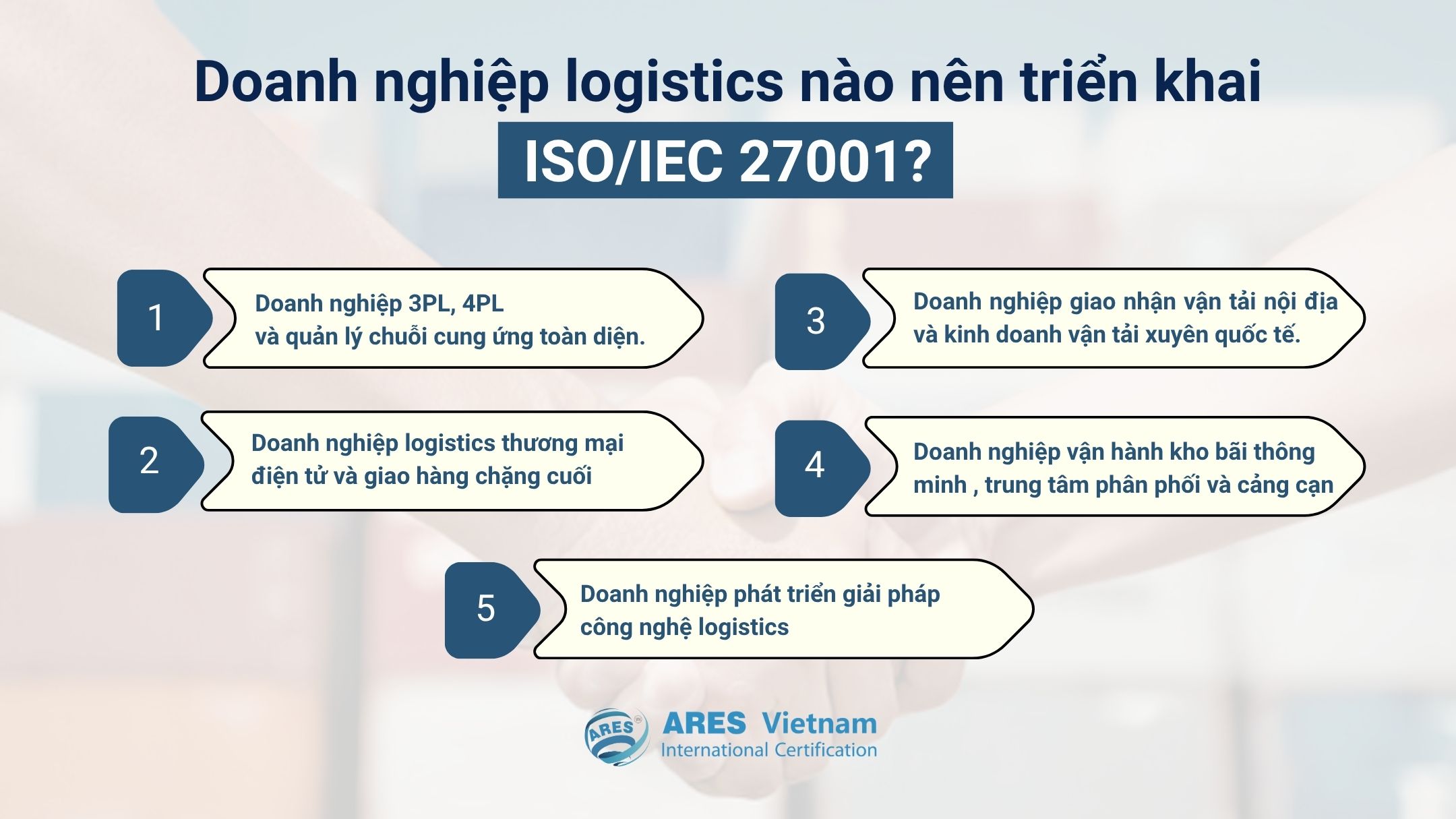
Some groups of logistics enterprises that should consider implementing ISO/IEC 27001 include:
- 3PL, 4PL, and comprehensive supply chain management service providers.
- Domestic, international, or cross-border freight forwarding and transport enterprises.
- E-commerce logistics and last-mile delivery companies.
- Operators of smart warehouses, distribution centers, dry ports, or fulfillment centers.
- Logistics technology developers, such as those providing TMS, WMS, tracking platforms, or API integration systems.
- Logistics enterprises serving FDI clients, multinational corporations, or industries such as electronics, pharmaceuticals, food, high-value goods, or any supply chains with strict security requirements.
What Should Logistics Enterprises Prepare Before Implementing ISO/IEC 27001?
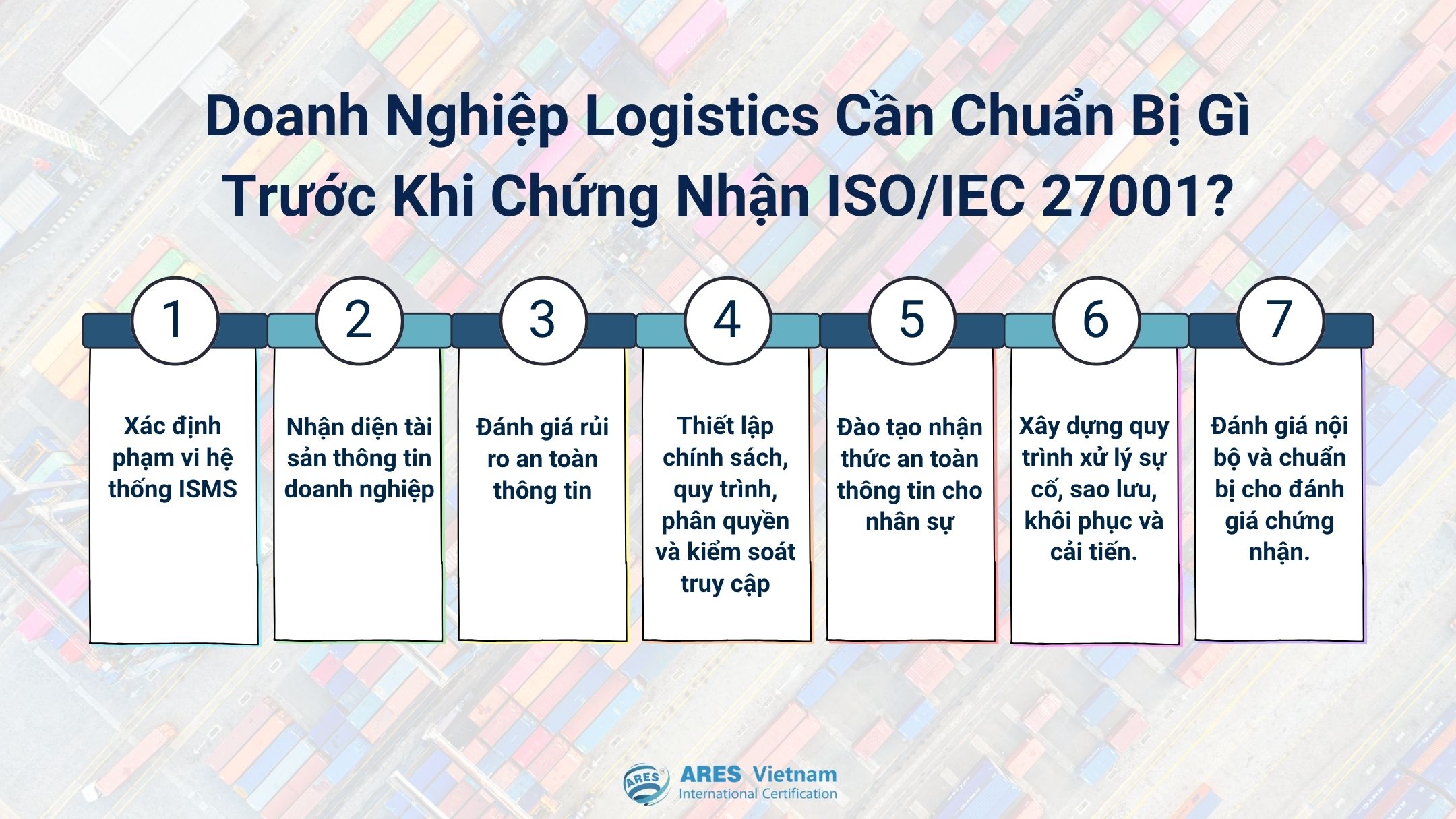
To ensure the ISO/IEC 27001 implementation process is effective and compliant with standard requirements, logistics enterprises need to prepare the following key items:
- Define the ISMS scope: Determine whether it applies to the entire enterprise, a specific branch, a warehouse, a particular system, or a specific group of services.
- Identify critical information assets: Catalog customer data, contracts, bills of lading, documentation, TMS/WMS/ERP systems, servers, access accounts, and integrated data.
- Identify requirements: Outline legal, contractual, and client-specific requirements related to information security.
- Conduct information security risk assessments: Perform these assessments based on the defined scope.
- Establish policies, processes, and access controls: Develop clear security policies, standard operating procedures, and delegation of authority.
- Manage third-party risks: Establish controls for vendors, technology partners, and other third parties involved in the information system.
- Provide information security awareness training: Ensure all personnel are trained on security best practices.
- Develop incident management, backup, and recovery procedures: Establish protocols for incident response, data backup, system recovery, and continuous improvement.
- Perform internal audits and prepare documentation: Gather all necessary records and prepare files for the formal certification audit process.
Methodical preparation from the outset helps enterprises gain a clear understanding of their current status, define the correct scope of application, and enhance the operational efficiency of the system. This also serves as a crucial foundation for a smoother certification audit process.
See also: ARES Vietnam’s Certification Audit Process
ISO/IEC 27001 – The Foundation for Information Risk Management in Logistics
In an era where logistics is increasingly dependent on data and multi-party connectivity, information security has become a critical factor for enterprises to maintain stable operations, protect their reputation, and meet the collaboration requirements of customers and partners.
ISO/IEC 27001 is not just a security certification; it is a foundational framework that helps logistics enterprises manage information risks systematically, in alignment with operational realities and the increasingly demanding requirements of the modern supply chain.
If your logistics enterprise is exploring ISO/IEC 27001 certification or requires a gap analysis of your current Information Security Management System, ARES Vietnam is ready to partner with you through our international-standard assessment and certification services.
Hotline: 085.3858.553
Email: service@aresvietnam.vn
Related news
Circular 49/2026/TT-BCT Takes Effect Soon: Which Environmental Records Should Factories Review?
Read more

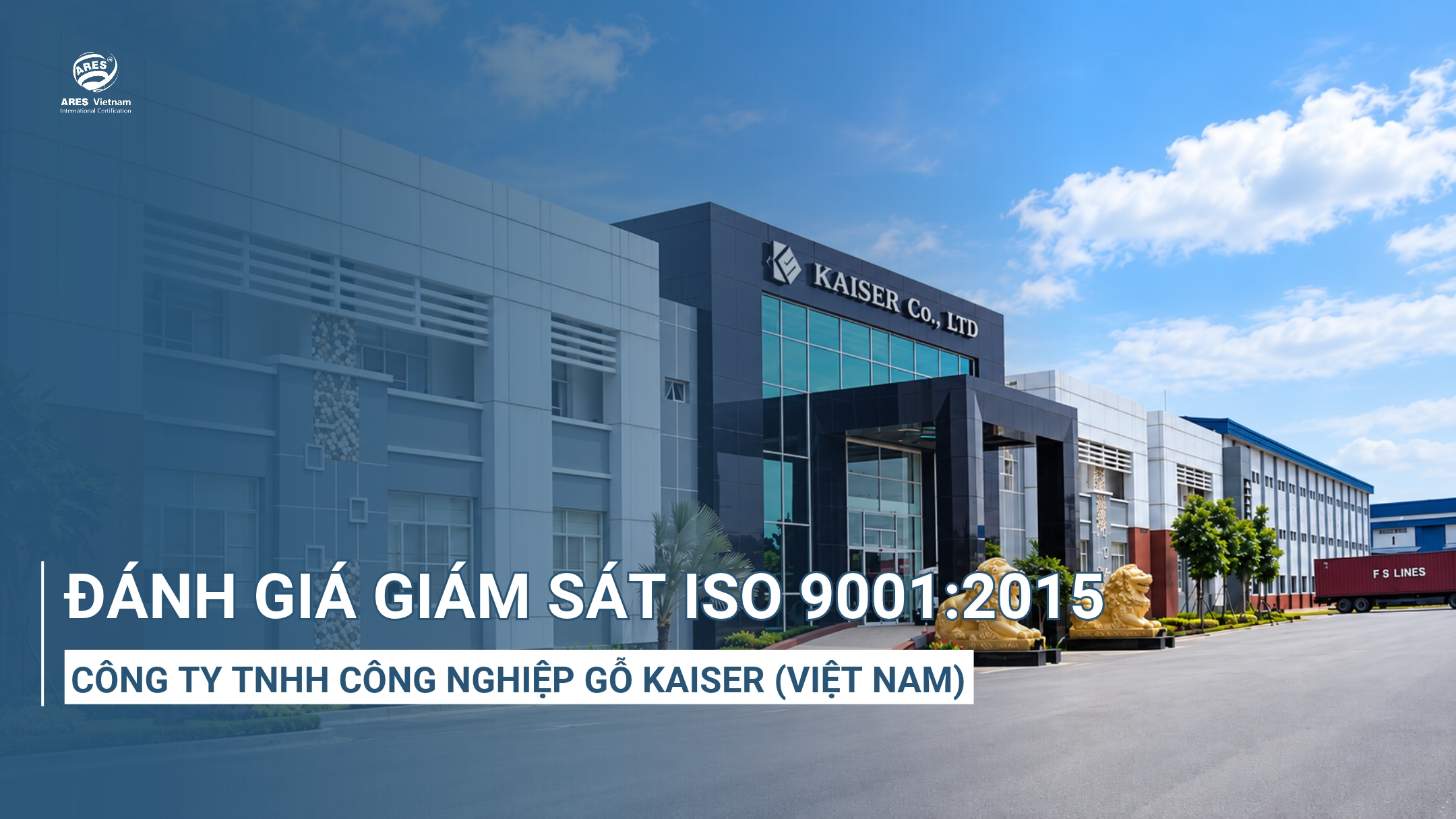
ARES Vietnam Conducts the Second ISO 9001:2015 Surveillance Audit at KAISER 1 & KAISER 2 (Vietnam)
Read more
National Single Window and ASEAN Single Window: What Documents Should Import–Export Businesses Prepare?
Read more

ARES Vietnam Awards ISO 9001:2015 Certification to Simona Leather Company Limited
Read more
ARES Vietnam Conducts ISO 9001:2015 Surveillance Audit at Simona Leather Company Limited
Read more