Why Do Many Businesses Fail To Meet KPIs After The First Four Months Of The Year? 6 Management System Issues
As businesses enter the fifth month of the year, many begin to notice that the gap between their initial plans and actual results is gradually widening. Daily operations continue as usual, yet KPIs are already showing signs of falling behind schedule. Workloads are increasing, while coordination between departments is starting to reveal inconsistencies.
This indicates that the risk of missing KPIs does not stem solely from business results falling short of expectations. It also reflects how well growth objectives align with the organization’s actual operational capabilities.
So, why do KPIs start to lose momentum after only a few months of implementation? More importantly, what should businesses review before this gap continues to widen in the coming quarters?
Delayed KPIs After The First Four Months Are An Early Warning Sign
After nearly one-third of the annual planning cycle, businesses already have enough data to identify gaps between targets and actual execution. Although it is still too early to conclude that the plan has failed, this is the right time to review performance before deviations become harder to correct.
Delayed KPIs may indicate that:
- Growth targets are not fully aligned with available resources;
- Operational processes cannot keep pace with actual workloads;
- Monitoring data is not available early enough to detect deviations;
- Responsibilities among departments are not clearly defined and connected.
Timely reviews help businesses not only identify which KPIs are lagging, but also understand why they are behind and where adjustments should begin.
6 Reasons Why Businesses Fail to Meet KPIs After the First Four Months
1. KPIs Are Based On Growth Expectations Rather Than Execution Capability
Many businesses increase revenue targets, production volumes, or market expansion goals without making corresponding adjustments to operational resources. Staffing levels remain largely unchanged, processing capacity does not increase, and existing processes continue to operate in the same way.
When objectives grow faster than the system’s ability to support them, overload eventually becomes inevitable. Processing times become longer, internal issues increase, and downstream functions struggle to keep up with sales activities.
The issue is not setting ambitious targets. Rather, the problem is that the targets are not built on clearly defined execution capabilities.
2. Company-Level Objectives Are Not Translated into Clear Departmental Responsibilities
A common objective is difficult to achieve if it is not converted into specific responsibilities across departments.
For example, a company may pursue growth targets while:
- Sales focuses on closing deals;
- Production prioritizes output;
- Operations manages schedules;
- Warehousing handles backlogs;
Meanwhile, the connections between departments are not clearly designed.
As a result, individual departments may complete their own tasks, yet overall performance remains behind because the objectives are not managed as a unified chain of responsibilities.
3. Businesses Focus Only On Final Results Instead Of Early Warning Indicators
Many organizations only monitor revenue, production volume, order quantities, or monthly and quarterly KPI completion rates. However, warning signs of performance gaps often appear much earlier during operations, such as:
- Declining conversion rates;
- Longer order processing times;
- Increasing defect rates;
- Delivery delays;
- Deteriorating lead quality.
By focusing solely on output results, businesses may realize they are behind but struggle to identify where the delays actually began.
4. Operational Bottlenecks Exist, But Businesses Only Increase Output Pressure
When KPIs begin to fall short, many organizations react by tightening schedules, pushing teams to work faster, or increasing pressure to achieve targets. However, these actions do not solve the problem if the root cause lies within the operating process itself.
Bottlenecks may result from:
- Lengthy approval processes;
- Inconsistent information between departments;
- Complicated workflows;
- Workloads exceeding current capacity.
Without addressing the real constraints, increasing output pressure may simply amplify errors, backlogs, and delays.
5. KPIs Exist in Reports But Not In Daily Management
In many organizations, KPIs mainly exist in dashboards or periodic review meetings. Daily operations, however, continue to rely on personal experience, old habits, or reactive decisions.
As a consequence:
- Managers spend most of their time handling issues;
- Data across departments becomes inconsistent;
- Employees fail to understand how their work contributes to organizational goals;
- Minor deviations are not addressed promptly.
In this situation, KPIs merely record results instead of functioning as a true management tool.
6. KPIs Are Not Linked To Review And Improvement Mechanisms
KPIs rarely drive improvement when organizations simply record results after each review period or continue pushing for higher performance without analyzing root causes.
Without a structured review mechanism:
- Existing problems repeat month after month;
- Resources continue to be allocated inefficiently;
- Process weaknesses remain unresolved;
- Corrective responsibilities are not clearly assigned.
As a result, KPI reports may show different numbers, but the underlying operational weaknesses remain unchanged.
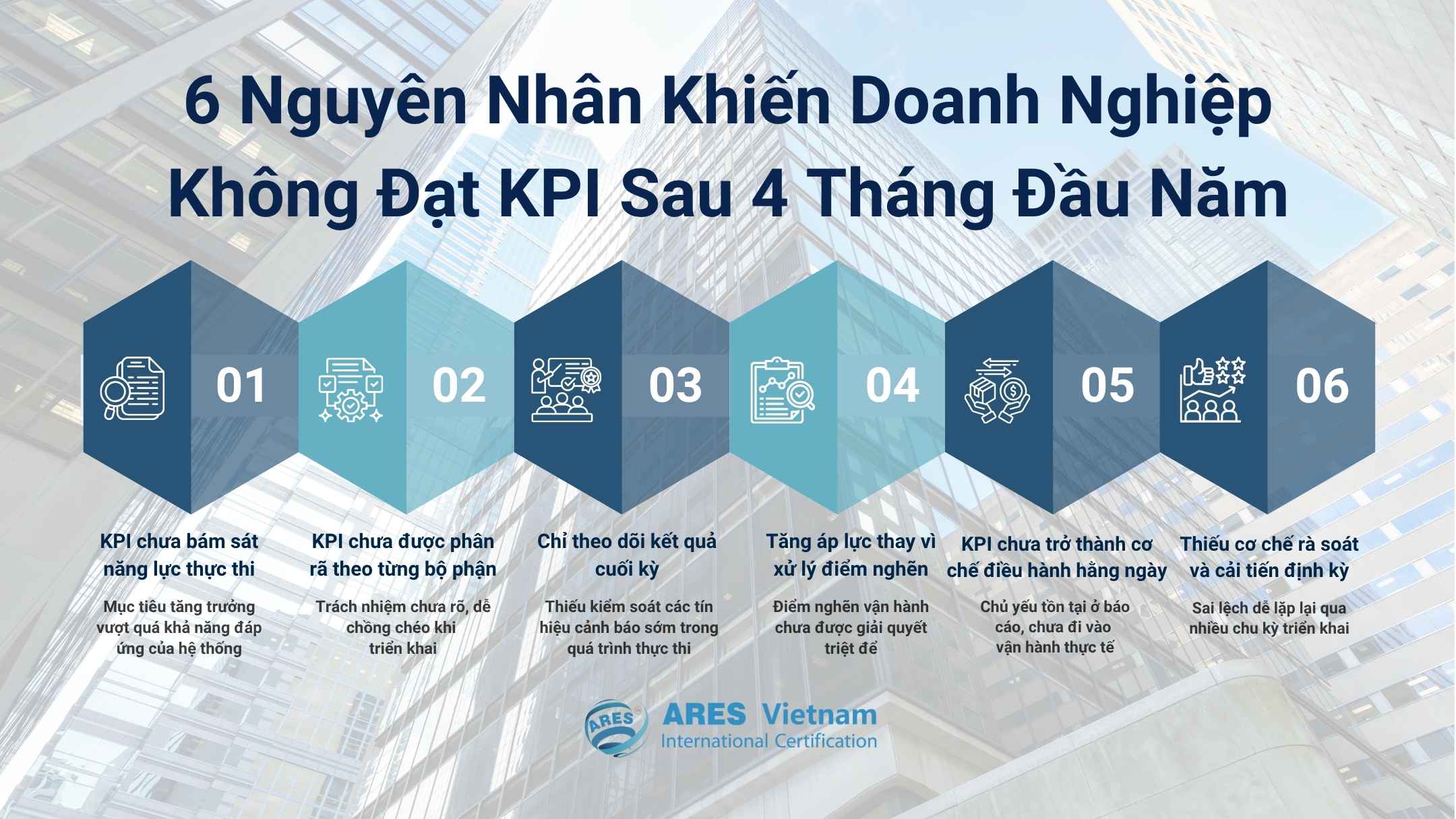
6 Reasons why businesses do not meet KPIs after the first 4 months of the year
What Should Businesses Review After the First Four Months?
Before adjusting their plans, businesses should ask several fundamental questions:
- Are current KPIs still aligned with business conditions and actual capabilities?
- Have company objectives been clearly translated into departmental responsibilities?
- Are we monitoring only outcome indicators, or do we also have early warning metrics?
- When KPIs are missed, do we have mechanisms to analyze causes and implement corrective actions?
- Have operational bottlenecks been clearly identified?
Based on these questions, reviews should focus on four key areas.
1. Reassess the Alignment Between KPIs And Actual Capabilities
Review targets, resources, processing capacity, and the alignment between growth plans and execution capability.
2. Break Down KPIs Across Cross-Functional Responsibility Chains
Clarify how each department contributes to common objectives, where handover responsibilities lie, and which data should be connected throughout the process.
3. Introduce Early Warning Indicators
Instead of focusing only on revenue or output, businesses should identify early signs of disruption in sales, quality, order processing, and logistics activities.
4. Establish Regular KPI Reviews Linked To Corrective Actions
Each review cycle should include root cause analysis, assignment of responsibilities, and updates to implementation plans.

Items businesses need to review immediately after the first 4 months of the year
How Does ISO 9001 Support Goal Management and Operational Control?
ISO 9001 is not a tool that guarantees all KPIs will be achieved. However, it helps organizations build a more structured management system by enabling them to:
- Establish and monitor clear objectives;
- Define responsibilities across departments;
- Standardize operational processes;
- Control issues arising during operations;
- Maintain periodic review and continual improvement activities.
For businesses that are expanding or managing increasingly complex operations, ISO 9001 can serve as a foundation that transforms goals from simple plans into controlled and continuously improved execution processes.
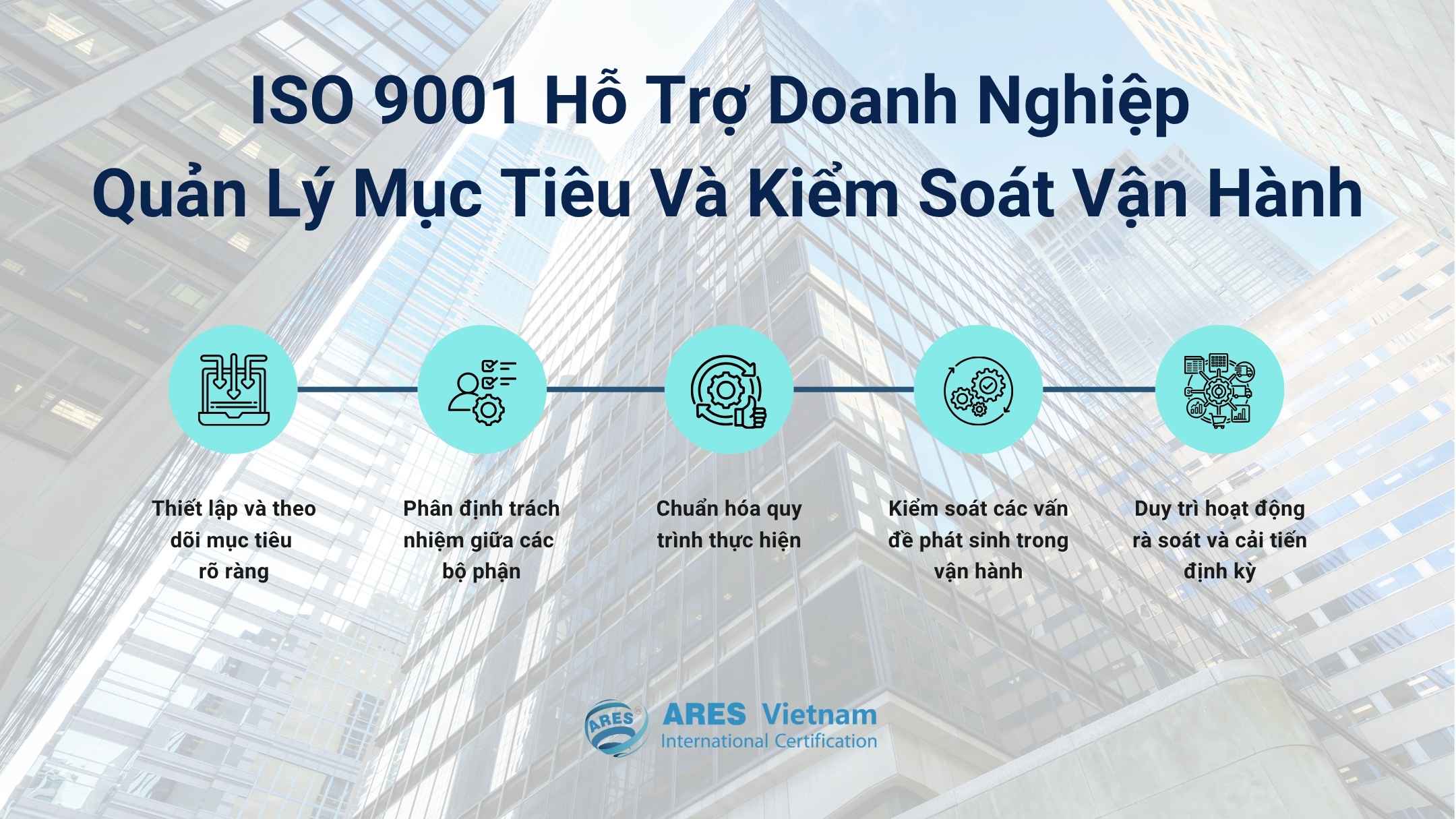
ISO 9001 supports businesses in managing objectives and controlling operations.
KPIs Reflect Operational Capability, Not Just Business Targets
Falling behind on KPIs after the first four months of the year does not simply mean that several targets have not been achieved. It is also a signal for businesses to reassess how they set objectives, allocate resources, control data, and maintain management discipline.
The effectiveness of KPIs is not determined by how ambitious the targets are. Instead, it depends on how effectively the organization can convert those targets into measurable and controllable results.
If your organization would like to learn more about ISO 9001 or other ISO standards that support process standardization and stronger operational control, please contact ARES Vietnam for detailed assistance. Hotline: 085.3858.553 or Email: Service@aresvietnam.vn

Related news

Circular 49/2026/TT-BCT Takes Effect Soon: Which Environmental Records Should Factories Review?
Read more


ARES Vietnam Conducts the Second ISO 9001:2015 Surveillance Audit at KAISER 1 & KAISER 2 (Vietnam)
Read more

National Single Window and ASEAN Single Window: What Documents Should Import–Export Businesses Prepare?
Read more

ARES Vietnam Awards ISO 9001:2015 Certification to Simona Leather Company Limited
Read more

ARES Vietnam Conducts ISO 9001:2015 Surveillance Audit at Simona Leather Company Limited
Read more