Which ISO Standards Should Electronic Component Suppliers Implement?
The electronic components industry places stringent requirements on precision, consistency, and traceability. Even a minor change in raw materials, technical drawings, or production parameters can affect batch quality, assembly operations, and the quality of customers’ finished products.
For this reason, many manufacturers, OEMs, and international corporations assess more than the conformity of delivered components. They also examine how suppliers manage their processes, technical data, operational risks, and other applicable requirements. ISO certification is often used as a reference for evaluating how systematically these management activities are structured and implemented.
However, each ISO standard focuses on a different management objective. Businesses should select the appropriate standards based on the types of components they supply, their manufacturing technologies, downstream industries, customer requirements, and development priorities at each stage.
Why Should Electronic Component Suppliers Implement ISO Standards?
Electronic component suppliers often manufacture multiple product types for different customers at the same time. Each order may involve unique technical specifications, management requirements, and implementation records, making operations increasingly complex as the business expands.
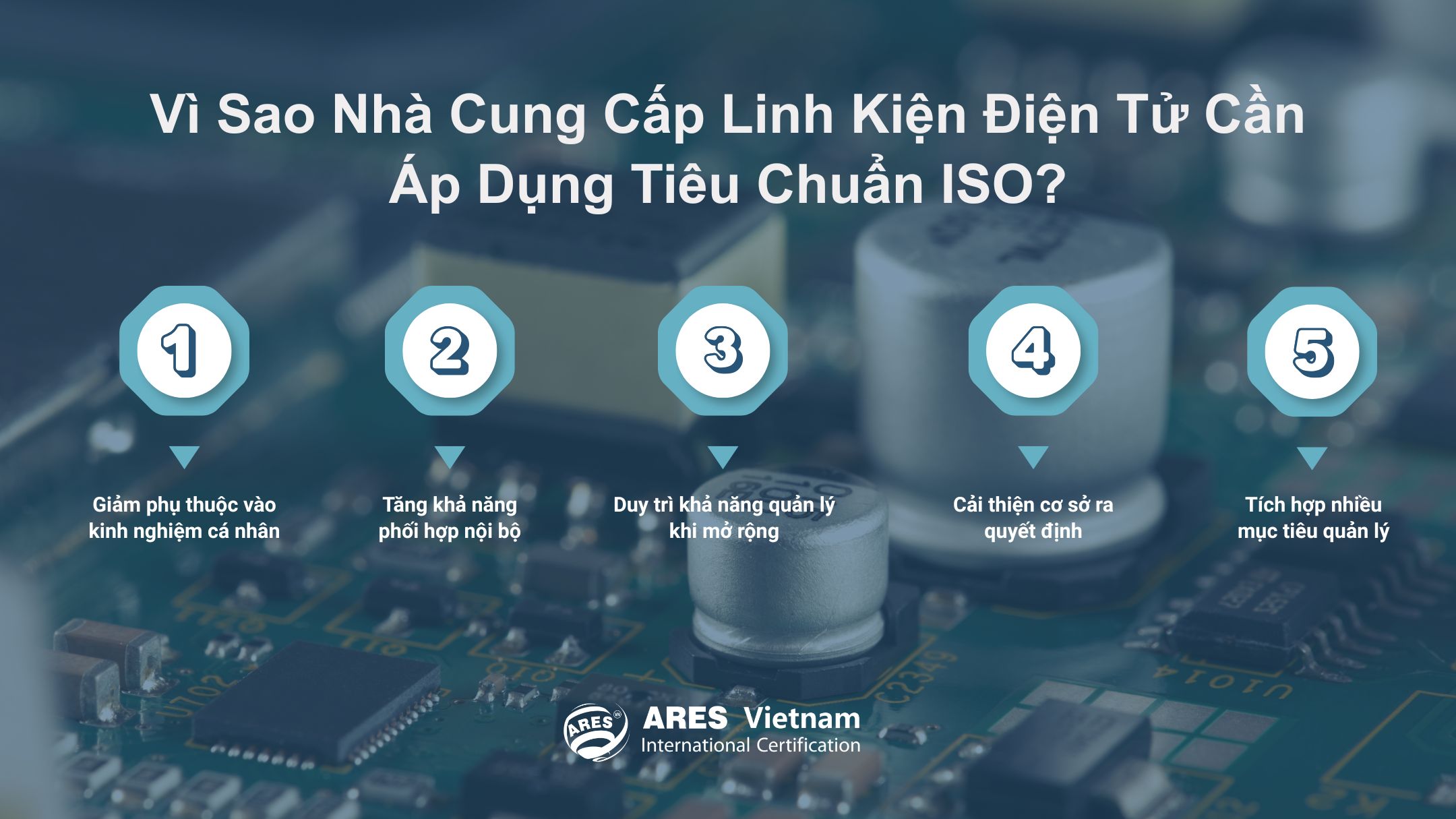
When selected and implemented appropriately, ISO standards can support electronic component suppliers in the following areas:
- Reducing dependence on individual experience: Establish standardized working methods across shifts, production lines, and personnel to minimize variations in daily operations.
- Strengthening cross-functional coordination: Improve collaboration among engineering, purchasing, production, quality, warehousing, and supporting departments through a unified management system.
- Maintaining effective control during business growth: Help businesses sustain management effectiveness as product portfolios expand, production lines are added, capacity increases, or new facilities are established.
- Supporting informed decision-making: Provide management with consistent and reliable data to monitor performance, identify issues, and allocate resources more effectively.
- Integrating multiple management objectives: Create a foundation for combining quality, environmental, occupational health and safety, energy, information security, and other management requirements within a single integrated management system.
It should be noted that management system certification does not automatically demonstrate that every electronic component complies with all applicable technical specifications or product regulations. Businesses must still perform the necessary inspections, testing, conformity assessment activities, and fulfill all applicable legal and regulatory obligations relevant to their products and target markets.
The Role of ISO Standards in the Electronic Components Industry
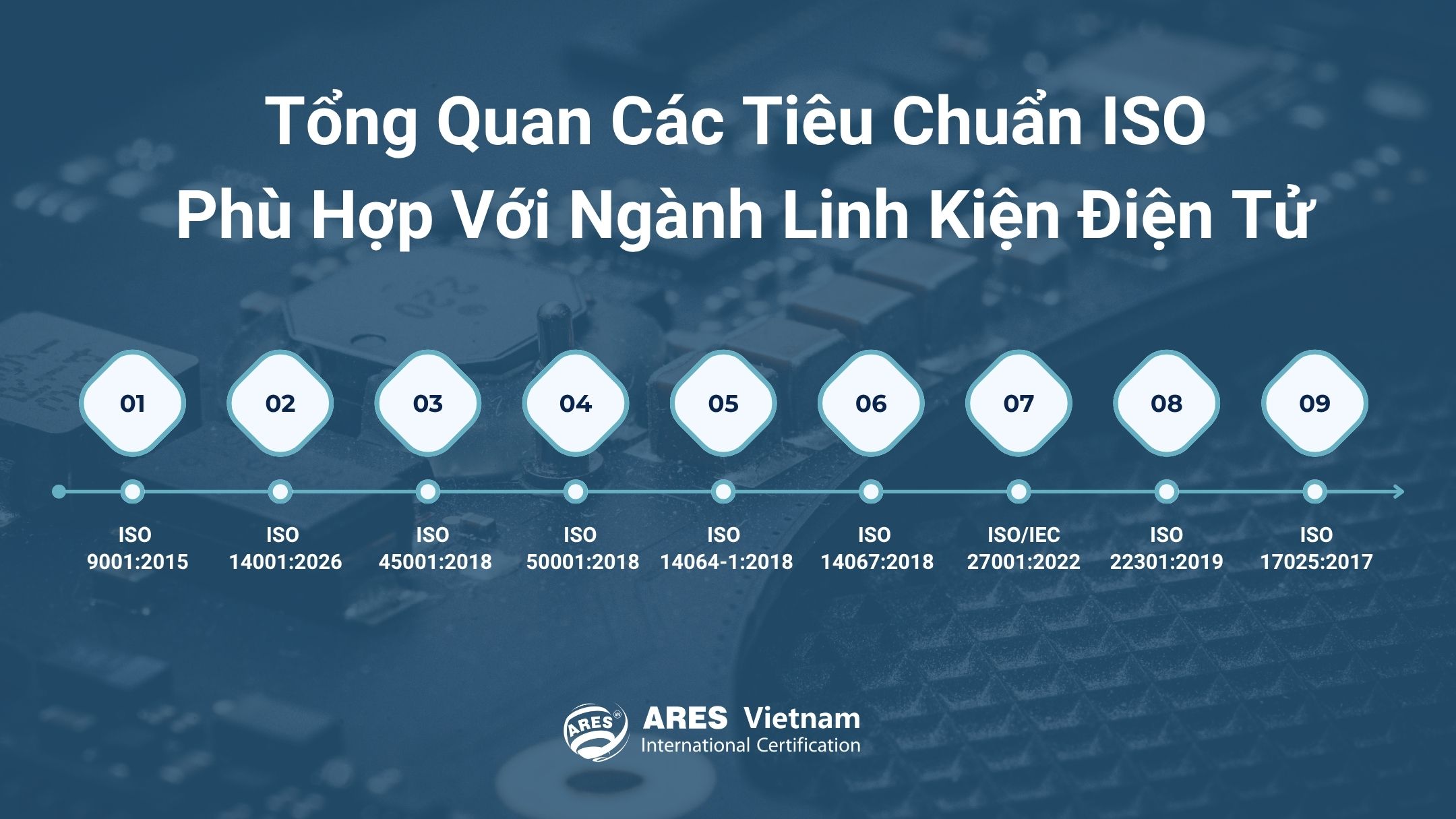
Each ISO standard focuses on a different aspect of organizational management. The table below summarizes the primary management focus of the ISO standards most commonly implemented in the electronic components industry.
| Standard | Management Focus |
| ISO 9001 | Product and process quality |
| ISO 14001 | Environmental aspects and environmental performance |
| ISO 45001 | Occupational health and safety |
| ISO/IEC 27001 | Information security |
| ISO 50001 | Energy performance |
| ISO 14064-1 | Organizational greenhouse gas inventory |
| ISO 14067 | Product carbon footprint |
| ISO 22301 | Business continuity |
| ISO/IEC 17025 | Testing and calibration laboratory competence |
ISO 9001 – Quality Management System
ISO 9001 provides a management framework that enables organizations to control their processes, maintain product consistency, and consistently meet agreed customer requirements.
For electronic component suppliers, a Quality Management System (QMS) supports the control of the following activities:
- Approval, evaluation, and control of suppliers and incoming materials.
- Control of engineering drawings and technical documentation.
- Management of design, specification, and process changes.
- Control of manufacturing, assembly, and packaging operations.
- Product identification and traceability by part number and production batch.
- Management of monitoring, measuring, and inspection equipment.
- Control of nonconforming products and returned goods.
- Analysis of customer complaints and implementation of corrective actions.
As of July 2026, ISO 9001:2015 remains the current edition of the standard. ISO 9001:2026 is currently in the publication process and is expected to be released in September 2026, replacing ISO 9001:2015. Organizations should continue maintaining their existing Quality Management System while monitoring the official transition guidance once the new edition is formally published.
ISO 14001 – Environmental Management System
ISO 14001 helps organizations identify environmental aspects, control their environmental impacts, and fulfill applicable compliance obligations.
For electronic component manufacturers and suppliers, ISO 14001 supports the management of environmental aspects such as:
- Chemicals and materials used in manufacturing.
- Hazardous waste, electronic waste, and discarded products.
- Wastewater, air emissions, and other sources of pollution.
- Packaging and packaging materials.
- Water consumption, material usage, and related environmental impacts.
- Environmental compliance obligations applicable to the facility.
- Environmental incidents, such as chemical leaks or spills.
ISO 14001:2026 was published on 15 April 2026, replacing the 2015 edition. The new version provides greater clarity on the consideration of environmental conditions, climate change, natural resources, biodiversity, ecosystems, and environmental performance when establishing and maintaining an Environmental Management System.
ISO 45001 – Occupational Health and Safety Management System
ISO 45001 helps organizations identify hazards, assess occupational health and safety (OH&S) risks, and establish appropriate control measures to protect workers.
In electronic component manufacturing, organizations should evaluate hazards associated with:
- Machinery and hazardous operating areas.
- Electric shock, arc flash, and electrostatic discharge (ESD).
- Welding, cutting, and other heat-generating operations.
- Chemicals, solvents, and cleaning agents.
- Welding fumes, dust, noise, and workplace ventilation.
- Working postures and repetitive tasks.
- Material handling, storage, and transportation.
- Fire, explosion, and emergency situations.
The level of control should be determined based on the organization’s manufacturing technologies, equipment, materials, and actual working conditions. Documented procedures alone are not sufficient. Safety measures must also be effectively implemented, monitored, and consistently maintained in day-to-day operations to ensure the Occupational Health and Safety Management System remains effective.
ISO/IEC 27001 – Information Security Management System
In the electronic components industry, engineering drawings, technical specifications, source code, research data, and other intellectual property assets represent valuable business information that requires appropriate protection. ISO/IEC 27001:2022 helps organizations manage information security risks while maintaining the confidentiality, integrity, and availability of information within the scope of the Information Security Management System (ISMS).
The standard supports organizations in managing and protecting activities such as:
- Receiving and storing unpublished engineering drawings, bills of materials (BOMs), technical specifications, or embedded software.
- Conducting research, product design, or development activities involving intellectual property.
- Integrating information systems or exchanging data with customers and parent companies.
- Managing product data within ERP, MES, or cloud-based platforms.
- Managing contractual confidentiality obligations related to product designs, technical data, and intellectual property.
Not every electronic component supplier requires ISO/IEC 27001. Organizations should consider implementing this standard when information security risks could affect customers, products, business operations, or contractual obligations.
ISO 50001 – Energy Management System
Many electronic component manufacturing facilities consume significant amounts of electricity to operate production lines, cleanrooms, HVAC systems, and supporting equipment. ISO 50001 helps organizations monitor and improve energy performance through a data-driven approach rather than focusing solely on energy conservation.
The standard supports organizations in managing areas such as:
- Energy-intensive production lines.
- Cleanrooms and HVAC systems.
- Compressed air systems, refrigeration systems, and auxiliary equipment.
- Ovens, heat-treatment furnaces, and other high-power equipment.
- Significant energy use (SEU) areas.
- Energy baselines and energy performance indicators.
- Energy performance improvement plans.
By monitoring and analyzing energy data, organizations can identify improvement opportunities and enhance long-term energy performance.
ISO 14064-1 – Organizational Greenhouse Gas Inventory
ISO 14064-1:2018 specifies principles and requirements for quantifying, managing, and reporting greenhouse gas (GHG) emissions and removals at the organizational level.
The standard supports organizations in:
- Defining organizational and operational inventory boundaries.
- Collecting and standardizing greenhouse gas data.
- Preparing greenhouse gas inventory reports.
- Monitoring emissions across facilities and reporting periods.
- Establishing greenhouse gas reduction objectives.
- Preparing data for greenhouse gas verification.
ISO 14064-1 focuses on managing greenhouse gas emissions at the organizational level, rather than determining the carbon footprint of individual products.
ISO 14067 – Product Carbon Footprint
While ISO 14064-1 focuses on greenhouse gas emissions at the organizational level, ISO 14067 specifies requirements and guidelines for quantifying and reporting the carbon footprint of individual products using a life cycle approach.
The standard supports organizations in:
- Determining the carbon footprint of a specific component or product family.
- Evaluating how design alternatives, material selections, or product versions influence a product’s carbon footprint.
- Providing product carbon data to meet customer requirements, export market expectations, or tender specifications.
- Identifying the life cycle stages that contribute most significantly to a product’s carbon footprint.
ISO 22301 – Business Continuity Management System
Disruptions to manufacturing or supply operations can directly affect delivery schedules and customer operations. ISO 22301 helps organizations prepare for, respond to, and recover from incidents that may interrupt business activities.
For electronic component manufacturers and suppliers, the standard supports the evaluation of scenarios such as:
- Raw material shortages caused by supply chain disruptions or the inability of critical suppliers to deliver.
- Failure of critical production equipment, tooling, or machinery.
- Disruptions to ERP, MES, or other information technology systems that affect business operations.
- Fires, floods, natural disasters, or other incidents that prevent manufacturing facilities from continuing operations.
- Extended power outages or interruptions to critical utility systems.
- Disruptions to transportation, logistics, or product distribution.
Establishing a business continuity plan enables organizations to shorten recovery time, minimize operational disruptions, and improve their ability to meet customer commitments.
ISO/IEC 17025 – Testing and Calibration Laboratory Competence
For organizations operating in-house testing or calibration laboratories, ISO/IEC 17025:2017 specifies the requirements for the competence, impartiality, and consistent operation of testing and calibration laboratories.
The standard may be applicable when the laboratory performs activities such as:
- Electrical performance testing.
- Component durability testing.
- Material analysis and testing.
- Dimensional measurement and tolerance verification.
- Environmental testing under specified conditions.
- Calibration of measuring equipment.
Unlike management system standards, ISO/IEC 17025 is used to demonstrate the technical competence of a testing or calibration laboratory within a defined scope of accreditation. Therefore, it should not be presented in the same manner as management system certifications that apply across an entire organization.
Recommended ISO Standards Based on Business Model
In many cases, organizations can begin with one or two core management system standards and gradually expand their integrated management system as their operations grow or market requirements evolve.
| Business Model | Core Standards | Additional Standards to Consider, Where Appropriate |
| Trading, importing, or distributing electronic components | ISO 9001 | ISO/IEC 27001 when managing technical data or confidential information; ISO 22301 when business continuity is critical to supply operations. |
| Manufacturing, processing, or assembling electronic components | ISO 9001, ISO 14001, ISO 45001 (depending on operational activities and actual risks) | ISO/IEC 27001 based on information security risks; ISO 50001 based on energy consumption; ISO 14064-1 and ISO 14067 based on carbon-related requirements; ISO 22301 based on business continuity needs; ISO/IEC 17025 when an in-house testing or calibration laboratory requires competence recognition. |
| Electronic component design and development | ISO 9001 | ISO/IEC 27001 when managing engineering drawings, source code, research data, or intellectual property. |
Frequently Asked Questions (FAQ)
| Question | Answer |
| What should an electronic component manufacturer prepare before applying for ISO certification? | The organization should first define the scope of the management system, assign responsibilities, establish the necessary controls, and maintain objective evidence demonstrating effective implementation. Before the certification audit, the management system should also undergo an internal audit and a management review. |
| Can a single certification cover multiple operating sites? | Yes. A certification may cover multiple sites provided they operate under the same management system and meet the applicable certification program requirements. The scope, functions, and relationships between the sites should be clearly defined before the certification audit. |
| If some manufacturing processes are outsourced, do they need to be included within the management system? | Yes. Outsourced processes that may affect product conformity or the organization’s ability to meet applicable requirements should remain under appropriate control. The extent of control depends on the associated risks, the competence of the external provider, and the nature of the outsourced activities. |
| Can an electronic component manufacturer expand its certification scope after obtaining ISO certification? | Yes. When new products, processes, operating sites, or business activities are introduced, the organization may apply to expand the scope of certification. The certification body will review the changes and determine whether additional audit activities are required. |
| Will changes to production lines or manufacturing technologies affect the management system? | Potentially. Electronic component manufacturers should evaluate how such changes may affect processes, product quality, environmental aspects, occupational health and safety, personnel competence, and existing control measures before they are implemented. |
| Is the certification required to be maintained after the initial certification audit? | Yes. After certification has been granted, the organization is expected to continue operating and improving the management system, address any nonconformities, and participate in surveillance and recertification audits in accordance with the certification program. Maintaining documentation without effective implementation may affect the validity of the certification. |
Conclusion
Selecting the right ISO standards from the outset not only enables organizations to use their resources more effectively but also establishes a solid foundation for integrating multiple management systems as business needs evolve. When a management system is designed and implemented with the appropriate focus, organizations are better positioned to satisfy market requirements, improve operational performance, and support long-term sustainable growth.
For organizations that are planning to implement ISO certification for electronic component manufacturing or supply operations, conducting an initial gap assessment and defining the appropriate certification scope at an early stage can significantly improve the efficiency of system implementation.
ARES Vietnam provides independent assessment and certification services for management systems applicable to organizations engaged in the manufacturing and supply of electronic components. Certification activities are conducted in accordance with the principles of independence, impartiality, transparency, and evidence-based assessment.
Organizations are welcome to contact ARES Vietnam for further information regarding the applicable certification scope, audit process, and certification programs that best align with their business operations.
Hotline: 085.3858.553
Email: service@aresvietnam.vn
Related Article: Which ISO Standards Are Applicable to the Garment Industry?
Related news

Circular 49/2026/TT-BCT Takes Effect Soon: Which Environmental Records Should Factories Review?
Read more

ARES Vietnam Conducts the Second ISO 9001:2015 Surveillance Audit at KAISER 1 & KAISER 2 (Vietnam)
Read more

National Single Window and ASEAN Single Window: What Documents Should Import–Export Businesses Prepare?
Read more

ARES Vietnam Awards ISO 9001:2015 Certification to Simona Leather Company Limited
Read more
ARES Vietnam Conducts ISO 9001:2015 Surveillance Audit at Simona Leather Company Limited
Read more