Is ISO 13485 Mandatory for Dental Crown Manufacturing? Requirements Under Decree No. 98/2021/ND-CP
Where a dental crown falls within the scope of medical devices and a dental laboratory qualifies as a medical device manufacturing establishment, the establishment must comply with ISO 13485 under Article 8(1) of Decree No. 98/2021/ND-CP.
However, businesses cannot automatically classify every entity described as a “dental laboratory” within this category. Businesses need to correctly determine the regulatory scope of the product and the laboratory’s actual role in the manufacturing process before identifying the relevant legal requirements.
This article clarifies these matters under Decree No. 98/2021/ND-CP, as amended and supplemented. The current provisions are referenced in accordance with Consolidated Document No. 08/VBHN-BYT** dated 6 March 2026**, and analyses the requirements applicable to manufacturing establishments and dental crown products in each relevant case.
Do Dental Crowns Fall Within the Scope of Medical Device Regulation?
Decree No. 98/2021/ND-CP does not determine whether a product is a medical device solely by its name. Whether a dental crown falls within the scope of medical devices must be assessed against the definition in Article 2(1), particularly the product’s intended purpose.
Under Article 2(1), a medical device must meet both of the following conditions: it is intended by the medical device owner to be used alone or in combination for one or more of the purposes specified in point (a); and it does not achieve its principal intended action in or on the human body through pharmacological, immunological or metabolic means. Where such means are used, they must only support the achievement of the intended purpose.
For dental prosthetic products, businesses should clarify:
- The purpose for which the product is intended to be used, as specified by the medical device owner;
- Whether that intended purpose involves compensating for injury or trauma, or examining, replacing, modifying or supporting anatomy and physiological processes;
- Whether the product uses pharmacological, immunological or metabolic means in or on the human body;
- If such means are used, whether they only support the intended purpose specified in Article 2(1)(a).
In practice, the Ministry of Health’s medical device management portal has published a number of dossiers for “metal-free ceramic teeth” classified as Class B medical devices. Nevertheless, businesses should not assume that all dental prosthetic products will receive the same classification. The assessment must still be based on the characteristics and intended purpose of each individual product.
When Must a Dental Laboratory Comply with ISO 13485?
Under Article 8(1) of Decree No. 98/2021/ND-CP, medical device manufacturing establishments must meet the ISO 13485 quality management system standard. Therefore, where a dental crown has been identified as a medical device and the laboratory performs the role of a manufacturing establishment in practice, it must meet this requirement.
The ISO 13485 obligation is therefore linked to the laboratory’s role in medical device manufacturing activities, rather than being determined solely by the term “dental laboratory” or by whether the laboratory receives orders and carries out contract work.
1. How to Determine a Laboratory’s Actual Role
Decree No. 98/2021/ND-CP does not set out a separate set of criteria for determining whether a dental laboratory is a manufacturing establishment. In practice, businesses may review the laboratory’s operations against the following workflow:
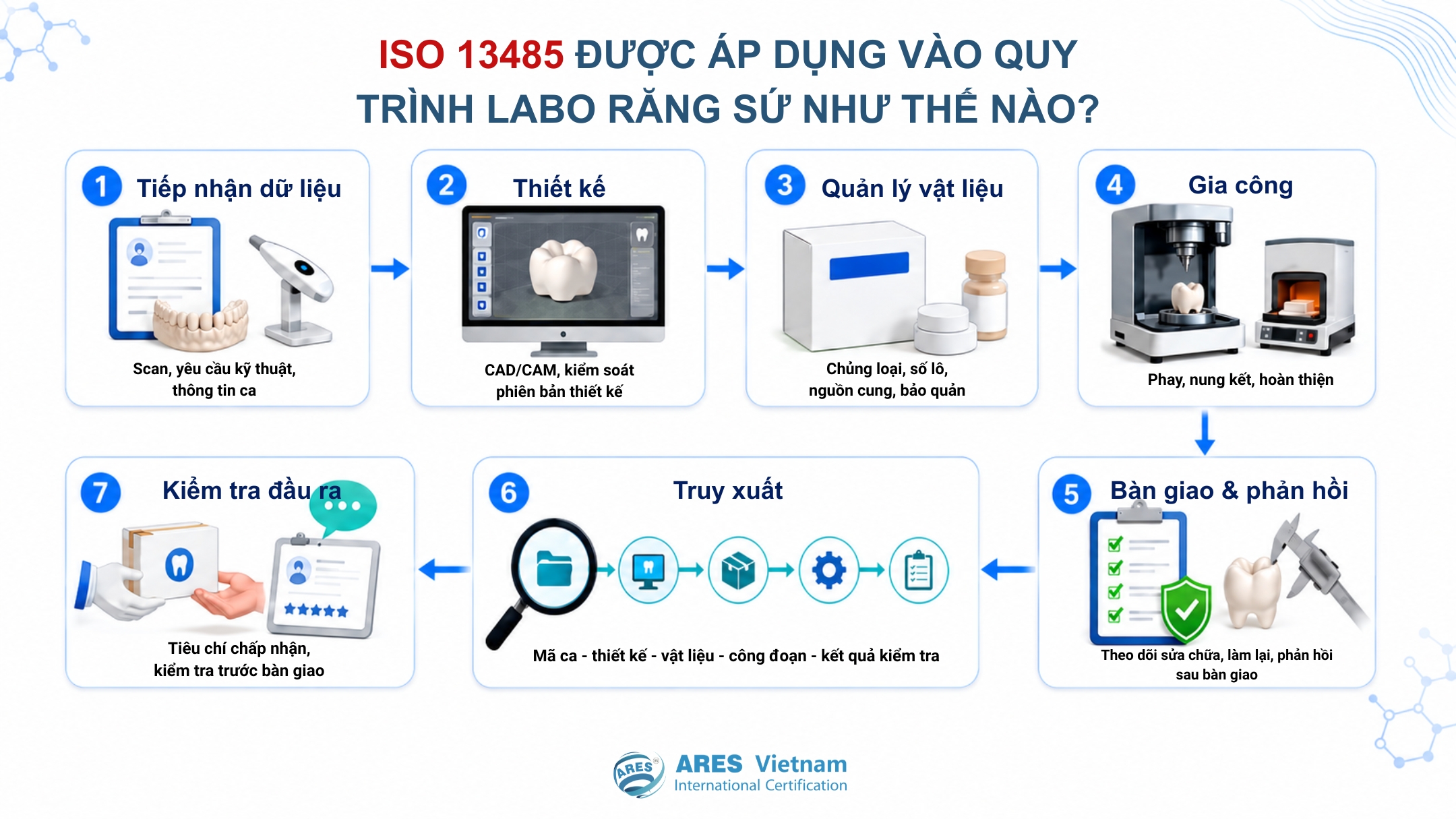
Data receipt → Design → CAD/CAM → Processing → Sintering → Finishing → Inspection → Handover
Depending on the operating model, businesses should clarify:
- Which stages are performed directly by the laboratory and which are outsourced;
- The actual location where manufacturing activities take place;
- The party responsible for the design, manufacture and finishing of the product;
- The party responsible for inspecting the product before handover.
These are practical review factors rather than a separate list of criteria prescribed by Decree No. 98. They help businesses clarify the laboratory’s role and scope of activities.
2. Which Parties Need to Be Distinguished?
During the review process, businesses should also avoid treating the manufacturing establishment, medical device owner and dossier holder as the same entity. Depending on the operational structure, these three roles may not belong to one organisation.
| Party | Points to Clarify |
| Manufacturing establishment | The entity that actually carries out medical device manufacturing activities and the location where such activities are undertaken. |
| Medical device owner | Refer to Article 2(5): the entity that supplies the device under a name, trademark, design, trade name or model code that it owns or controls, and bears responsibility for the design, manufacture, labelling, packaging, intended purpose and other related matters. |
| Organisation named in the declaration or marketing authorisation dossier | Refer to the entities permitted to make a declaration of applicable standards or apply for a marketing authorisation under Article 25. |
Clearly distinguishing these parties enables a laboratory to identify its role in the product manufacturing and regulatory chain correctly. Only where the laboratory qualifies in practice as a medical device manufacturing establishment should the business proceed to review ISO 13485, the declaration of eligibility to manufacture, and the manufacturing site requirements.
Is ISO 13485 Sufficient to Manufacture and Place Dental Crowns on the Market?
Once a laboratory has been identified as a medical device manufacturing establishment, the business should review three main areas: the declaration dossier for eligibility to manufacture, the manufacturing site, and the procedures applicable to each product.
These three areas are related but should be checked separately to avoid inconsistencies between the ISO dossier, establishment information and product dossiers.
1. ISO 13485 and the Declaration Dossier for Eligibility to Manufacture
Under Article 9 of Decree No. 98/2021/ND-CP, the declaration dossier for eligibility to manufacture includes:
- A declaration of eligibility to manufacture;
- A valid ISO 13485 quality management system certificate issued by a conformity assessment body in accordance with the law;
- Documents demonstrating compliance with the conditions in Article 8(2), where applicable.
During the review, businesses should check consistency between the entity named on the certificate, the ISO 13485 scope, the products being manufactured and the information contained in the declaration dossier.
Where manufacturing activities change, the business should assess the effect of those changes on the ISO 13485 certification scope and the declaration dossier, then make updates where required.
2. How Should the Manufacturing Site and Declaration Information Be Aligned?
Under Article 11, before commencing medical device manufacturing, the manufacturing establishment must submit its declaration dossier to the Department of Health where the manufacturing site is located. The manufacturing site is determined based on the address stated in the quality management system certificate.
Accordingly, a dental laboratory should compare:
- The address stated on the ISO 13485 certificate;
- The location where manufacturing is actually performed;
- The location stated in the declaration dossier for eligibility to manufacture.
If information in the declaration dossier changes, the manufacturing establishment must prepare a notice of change, attach the relevant documents and update those documents in the published declaration dossier within three working days from the date of the change.
In addition, where manufacturing sites are expanded or added, businesses should review the impact on both the ISO 13485 certification scope and the declaration dossier for eligibility to manufacture.
3. How Does Classification Determine the Product’s Marketing Procedure?
Holding ISO 13485 certification and having submitted a declaration of eligibility to manufacture does not replace the procedures applicable to each individual product.
Under Article 4, medical devices are classified into four classes—A, B, C and D—according to the potential risks associated with their technical design and manufacture. Businesses should not assume that all dental crown products fall within the same class. Classification must be determined for each product under the applicable requirements.
In addition, from 1 July 2026, the determination of risk level and related regulatory requirements for medical devices must also be reviewed against Circular No. 24/2026/TT-BYT and other relevant current regulations.
| Classification Result | Form of Marketing Number |
| Class A, B | Number of declaration of applicable standards |
| Class C, D | Marketing authorisation certificate number |
Under Article 26(2), for Class A and B medical devices, a valid ISO 13485 quality management system certificate at the time of dossier submission is also a component of the declaration dossier for applicable standards.
Where there is a change to the medical device owner, class, type, intended purpose, indication for use, manufacturing establishment or product code, the holder of the marketing number must repeat the declaration of applicable standards in accordance with Article 28(3).
Therefore, dental laboratories should monitor both the status of the manufacturing establishment dossier and the legal status of each product, rather than focusing solely on ISO 13485 certification.
How Is ISO 13485 Applied to Dental Laboratory Processes?
For dental laboratories, ISO 13485 should be applied across the actual flow of each manufacturing case—from data receipt and design to material use, processing, inspection and handover.
The priority is not the number of procedures or forms, but the ability to apply the system consistently and provide complete objective evidence when required.
1. Managing Data, Design and Changes
A dental restoration case typically begins with scan data, technical requirements, shade information and other details supplied by the dentist or clinic. The laboratory should clearly identify which data are used as inputs, who receives them and which version is transferred to design.
During processing, data or customer requirements may change. In such cases, the laboratory should identify the new version, record the changes and ensure that updated information reaches the relevant process stages.
Where the laboratory is responsible for design activities, records should enable identification of the person responsible, the design version and the results of review or approval before production begins. This helps prevent subsequent stages from continuing to use changed or no-longer-suitable data.
2. Monitoring Materials, Manufacturing and Outsourced Processes
Materials should be controlled in terms of supplier source, type, batch number, receiving status and storage conditions.
Equipment such as scanners, milling machines, sintering furnaces and related measuring or inspection equipment should also be managed in accordance with their intended use.
During manufacturing, the laboratory should control key parameters and criteria at stages such as CAD/CAM, milling, sintering and finishing.
Where any stage is outsourced, the laboratory should clearly define technical requirements, acceptance criteria and evidence of result control before further processing or product handover.
3. Ensuring Outputs, Traceability and Feedback Handling
Before handover, the laboratory should define acceptance criteria and retain inspection results appropriate to the characteristics of the product. Where a product does not meet requirements, any repair, adjustment or remake should be recorded and re-checked before release.
Traceability should also be maintained throughout the process. From a case reference number, the laboratory should be able to link the relevant design data, materials, process stages and inspection results.
Where feedback arises after handover, these data help the business identify the relevant product, investigate the cause and monitor corrective action. In this way, ISO 13485 operates as a practical management system rather than merely a set of records prepared for assessment.
What Should Dental Laboratories Prepare Before an ISO 13485 Certification Assessment?
Once the product scope and the establishment’s role have been clarified, the laboratory should focus on preparing evidence demonstrating that the ISO 13485 system is applied in actual operations.
| Area to Prepare | Evidence/Records to Review Before Assessment |
| Certification scope | Product portfolio, activities and sites intended to fall within the certification scope. |
| Process flow | Process map, departmental responsibilities and outsourced process stages. |
| Manufacturing records | Input data, design versions, production records and inspection results for selected actual cases. |
| Materials | Supplier records, material receipt records, batch information and storage conditions. |
| Outsourcing | Requirements issued to external providers, evidence of evaluation/control and incoming acceptance results. |
| Traceability and nonconformity handling | A traceability sample for an actual case, and records of repairs, remakes or feedback, where applicable. |
| Current system status | Identified gaps and the status of corrective actions before assessment. |
Preparation should focus on suitability and the ability to demonstrate implementation of the system, rather than simply checking the number of procedures or forms issued.
When Must a Dental Crown Manufacturing Establishment Hold ISO 13485?
Where a dental crown falls within the scope of medical devices and the dental laboratory is a medical device manufacturing establishment, it must meet ISO 13485 under Article 8. ISO 13485 is also a component of the declaration dossier for eligibility to manufacture; however, certification does not replace the classification and marketing procedures applicable to each product.
ARES Vietnam provides assessment and certification services for ISO 13485 to businesses operating in the medical device sector. Businesses may contact ARES Vietnam to discuss the certification scope, assessment locations and an appropriate assessment plan.
Frequently Asked Questions (FAQ)
| Question | Answer |
| Does every dental laboratory need ISO 13485? | The name “dental laboratory” does not automatically create an ISO 13485 requirement. However, where the laboratory manufactures products within the scope of medical devices and qualifies as a medical device manufacturing establishment, Article 8 requires it to meet ISO 13485. |
| Can dental crowns be placed on the market immediately once ISO 13485 is obtained? | No. ISO 13485 is a requirement for the manufacturing establishment; the product must still be classified and complete the applicable marketing procedure. |
| Can dental crowns automatically be classified as Class B medical devices? | No. Classification should not be presumed. It must be determined for each product in accordance with medical device classification requirements. |
| Does outsourcing certain stages affect ISO 13485? | It may. Outsourced processes that affect product conformity must be identified and controlled within the quality management system. |
| What should be reviewed when changing the manufacturing site? | The address on the quality management system certificate, actual manufacturing activities and information in the declaration dossier for eligibility to manufacture should be reviewed to make the required updates. |
| Does adding a new dental crown product line require the ISO 13485 scope to be reviewed? | It should be reviewed. The business should assess whether the new product falls within the existing certification scope and determine any impact on classification and the product’s marketing dossier. |
Related news

Circular 49/2026/TT-BCT Takes Effect Soon: Which Environmental Records Should Factories Review?
Read more

ARES Vietnam Conducts the Second ISO 9001:2015 Surveillance Audit at KAISER 1 & KAISER 2 (Vietnam)
Read more

National Single Window and ASEAN Single Window: What Documents Should Import–Export Businesses Prepare?
Read more
ARES Vietnam Awards ISO 9001:2015 Certification to Simona Leather Company Limited
Read more
ARES Vietnam Conducts ISO 9001:2015 Surveillance Audit at Simona Leather Company Limited
Read more