When Should A Business Upgrade Its Management System: From ISO 9001 to ISO 14001, ISO 45001, ISO 50001?
ISO 9001 helps organizations establish disciplined processes and control output quality. At a stable stage, this system effectively ensures consistency in products and services.
However, as a company enters a growth phase—expanding scale, increasing production, and integrating more deeply into supply chains—risks related to environmental impact, occupational safety, and costs begin to exceed the control and management capacity of a framework focused solely on quality.
In this context, expanding the ISO system is no longer about adding certifications but is a strategic decision to build specialized management pillars corresponding to specific operational pressures.
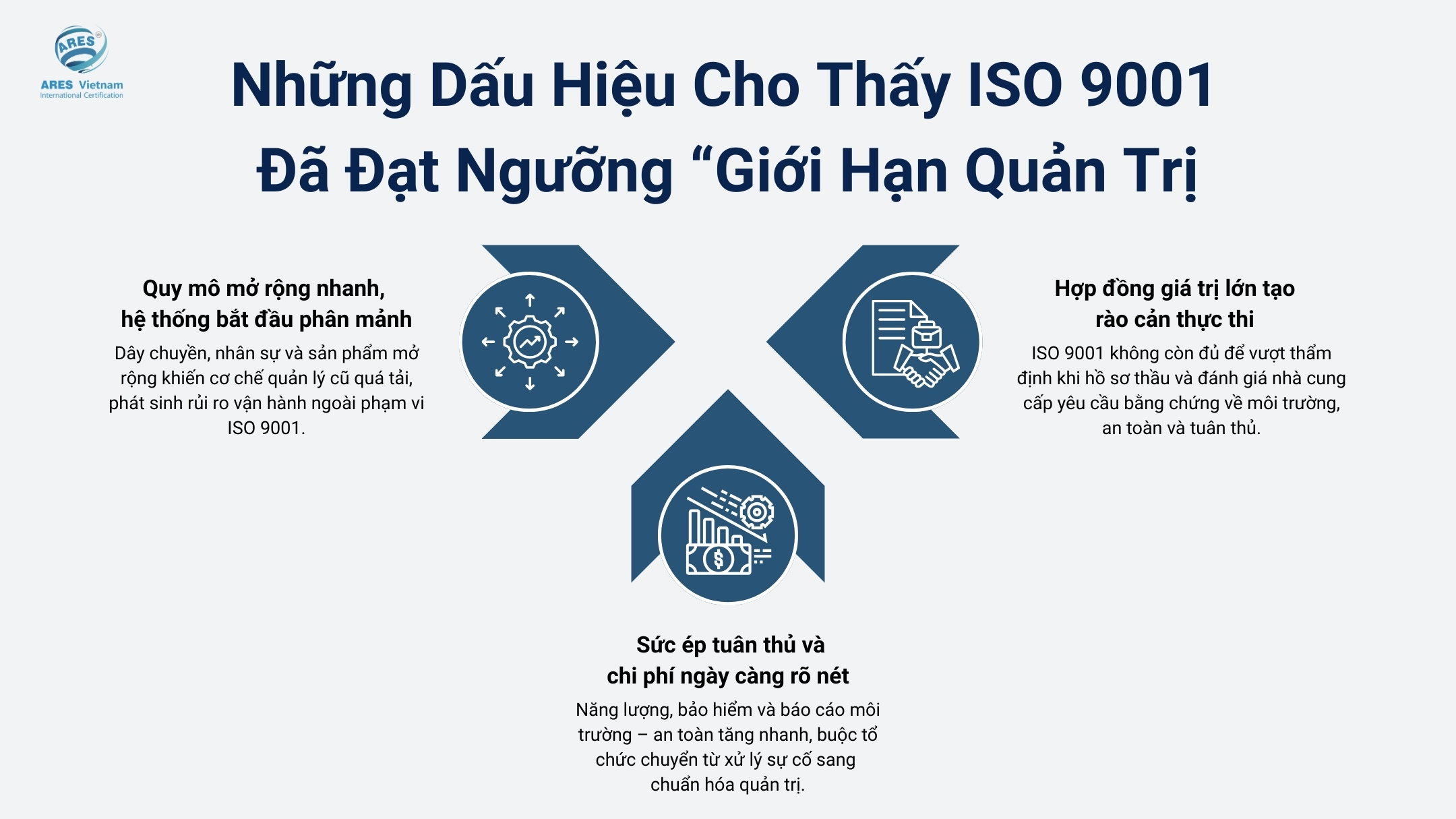
Signs That ISO 9001 Has Reached Its “Management Limit”
1. Rapid operational growth and fragmented control
As production lines, workforce, and product portfolios expand, mechanisms originally designed for smaller operations become overloaded, resulting in scattered information, unclear responsibilities, and recurring incidents.
This indicates that ISO 9001 maintains output stability but does not fully cover emerging risks during growth.
2. High-value contracts create operational barriers
When pursuing high-value contracts, organizations are evaluated not only on product quality but also on environmental management, occupational safety, and legal compliance. Tender documents and supplier assessments increasingly require verifiable data, processes, and evidence.
In practice, many companies performing well under ISO 9001 still struggle during supplier audits because their current structure lacks sufficient basis to demonstrate management beyond quality.
3. Increasing compliance pressure and costs
Alongside client requirements, legal compliance and ESG-related obligations are intensifying. Fluctuating energy costs, rising insurance premiums, and increasingly detailed environmental and safety reporting make operational costs less predictable.Without specialized mechanisms, companies often react only to incidents instead of proactively optimizing through standardized processes and data-driven management.
These signs do not indicate poor ISO 9001 implementation but highlight the need to address risks more deeply and strategically.
Signs that ISO 9001 has reached its “management limit”
When Should You Upgrade From ISO 9001 To Specialized Standards?
1.ISO 14001 – When environmental management becomes a market requirement
ISO 14001 is suitable for manufacturing, export-oriented, FDI, and industrial zone operations, where environmental requirements have shifted from recommendations to mandatory conditions.
Businesses should consider ISO 14001 if they notice:
◾Generation of waste, emissions, or effluents, but monitoring data remains scattered
◾Environmental documentation is frequently requested for updates or adjustments
◾Clients and partners demand evidence of environmental/ESG management at a data level
◾ISO 14001 appears as a screening criterion in supplier assessments
◾Rising environmental compliance costs and narrowing tolerance for legal risks
Added value compared to ISO 9001:
ISO 14001 establishes an independent environmental management pillar, enabling companies to manage legal risks, maintain market access, and meet high-compliance supply chain requirements.

ISO 14001 – When environmental management becomes a market requirement
2. ISO 45001 – When safety risks are directly tied to production growth
As scale expands, occupational safety becomes a critical factor for operational continuity. ISO 45001 is particularly relevant for manufacturing, construction, logistics, warehousing, and mechanical industries.
ISO 45001 becomes essential when:
◾Workforce grows rapidly, with multiple shifts, seasonal staff, or subcontractors
◾High-frequency machinery operation occurs without clear hazard identification or delegation
◾Recurrent workplace accidents or safety incidents drive compensation costs and disruptions
◾Occupational safety records are scrutinized in tenders and FDI partner assessments
Added value compared to ISO 9001:
ISO 45001 provides a specialized safety management system, shifting the organization from reactive incident handling to proactive risk management, reducing operational disruption, and enhancing competitiveness in high-safety-demand contracts.

ISO 45001 – When safety risks are directly tied to production growth
3. ISO 50001 – When energy becomes a strategic cost variable
For energy-intensive plants, energy is no longer an acceptable baseline cost but a direct factor affecting profit margins.
ISO 50001 is needed when:
◾Energy bills rise steadily, but consumption losses are not identifiable
◾Targets to save 5–10% of costs lack measurable mechanisms
◾Increased production amplifies any consumption discrepancies into higher costs
◾Markets begin evaluating suppliers based on energy efficiency
Added value compared to ISO 9001:
ISO 50001 integrates energy into operational management as a measurable and improvable metric, helping businesses optimize costs and strengthen competitive advantage.

ISO 50001 – When energy becomes a strategic cost variable
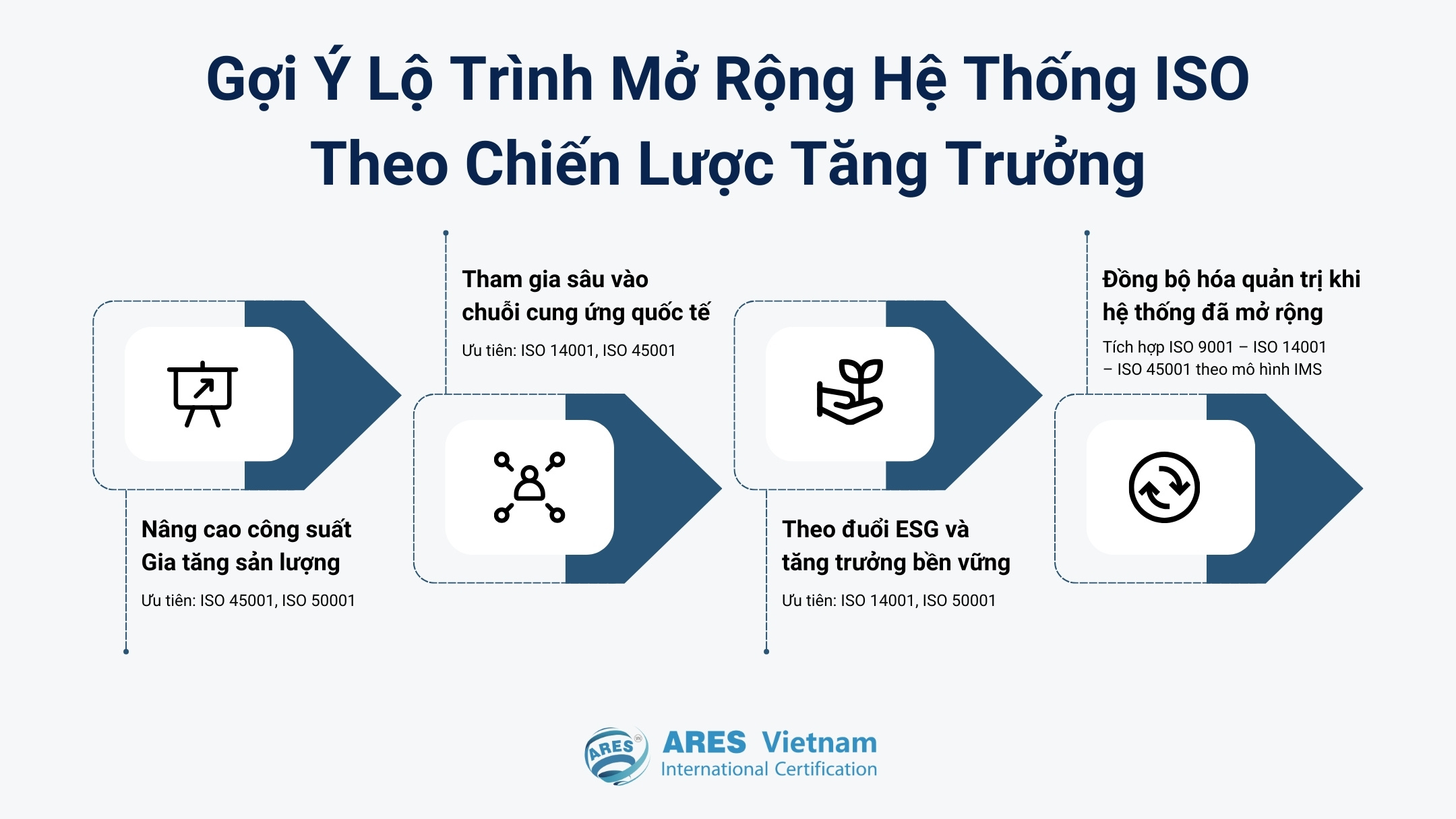
Suggested ISO Expansion Path Aligned With Growth Strategy
Based on experience in evaluating and implementing ISO across various manufacturing and service sectors, ARES Vietnam approaches ISO expansion as a strategic management design problem rather than simply adding certifications.
An effective roadmap begins by identifying core growth drivers and then selecting ISO standards to control risks arising from those drivers.
◾Capacity Expansion – Increasing Output (Priority: ISO 45001, ISO 50001)
When growth is driven by capacity expansion, risks shift away from product quality and focus instead on human safety and energy costs. Additional shifts, increased equipment, and higher operational intensity amplify occupational safety incidents and energy losses.
In this context, ISO 45001 helps standardize safety management by shift, equipment, and work location, while ISO 50001 establishes mechanisms to monitor, measure, and continuously improve energy efficiency in parallel with increased production.
Appropriate implementation approach: ISO 45001 first to stabilise the business situation, followed by ISO 50001 to review long-term costs.
◾Deeper Integration Into International Supply Chains( Priority: ISO 14001, ISO 45001)
When expanding into export markets or becoming a supplier for multinational corporations, management standards are no longer self-determined by the company. Environmental and safety requirements are often pre-defined within supplier evaluation criteria.
At this stage, ISO 14001 and ISO 45001 are not just compliance tools—they serve as entry requirements to pass supplier screenings and maintain long-term partnerships.
Appropriate implementation approach: Prioritise ISO 14001 if the primary pressure stems from environmental and ESG considerations; implement ISO 45001 concurrently when occupational health and safety records are a mandatory criterion in tendering.
◾Pursuing ESG Goals And Sustainable Growth (Priority: ISO 14001, ISO 50001)
For organizations pursuing ESG objectives, the challenge lies not in declaring commitments but in demonstrating measurable impact. Environmental performance and energy management become two core pillars in evaluations by investors, partners, and international clients.
ISO 14001 provides a framework for managing environmental impacts, while ISO 50001 transforms energy from a cost factor into a measurable and improvable management metric.
Appropriate implementation approach: Establish the ISO 14001 foundation first, then expand to ISO 50001 to strengthen ESG data in depth.
◾Governance Integration For Multiple ISO Systems (Integrated Management System (IMS) – ISO 9001 + ISO 14001 + ISO 45001)
When multiple ISO standards operate in parallel, conflicts, overlapping responsibilities, and maintenance costs arise.
An IMS integrates ISO 9001, ISO 14001, and ISO 45001 under a unified framework, aligning objectives, processes, and audit cycles, transforming “multiple systems” into a coherent operational structure.
Appropriate implementation approach: Review the maturity level of each area before integration, avoiding mechanical pairing.
Suggested ISO expansion path aligned with growth strategy
Designing An ISO Roadmap Based On Organizational Maturity
Upgrading from ISO 9001 to ISO 14001, ISO 45001, or ISO 50001 does not indicate weaknesses in the current system; it signals that the organization requires deeper, specialized management structures.
At this stage, selecting the appropriate standard is a strategic decision to sustain growth and proactively monitor challenges.
Before implementation, companies should quickly evaluate: operational risk level, market pressure, and energy cost proportion. This assessment guides which standard to prioritize within the next 6–12 months.
ARES Vietnam is ready to support companies in assessing current system maturity and designing an ISO upgrade roadmap tailored to specific growth strategies.
Related news
Important Update for Food Businesses: From 2026, HACCP, ISO 22000, and FSSC 22000 Will Not Replace the Food Safety Eligibility Certificate
Read more


Looking Back at the Journey of 2025 – A Year of Value and Trust
Read more
International ISO Certification Standards
Read more
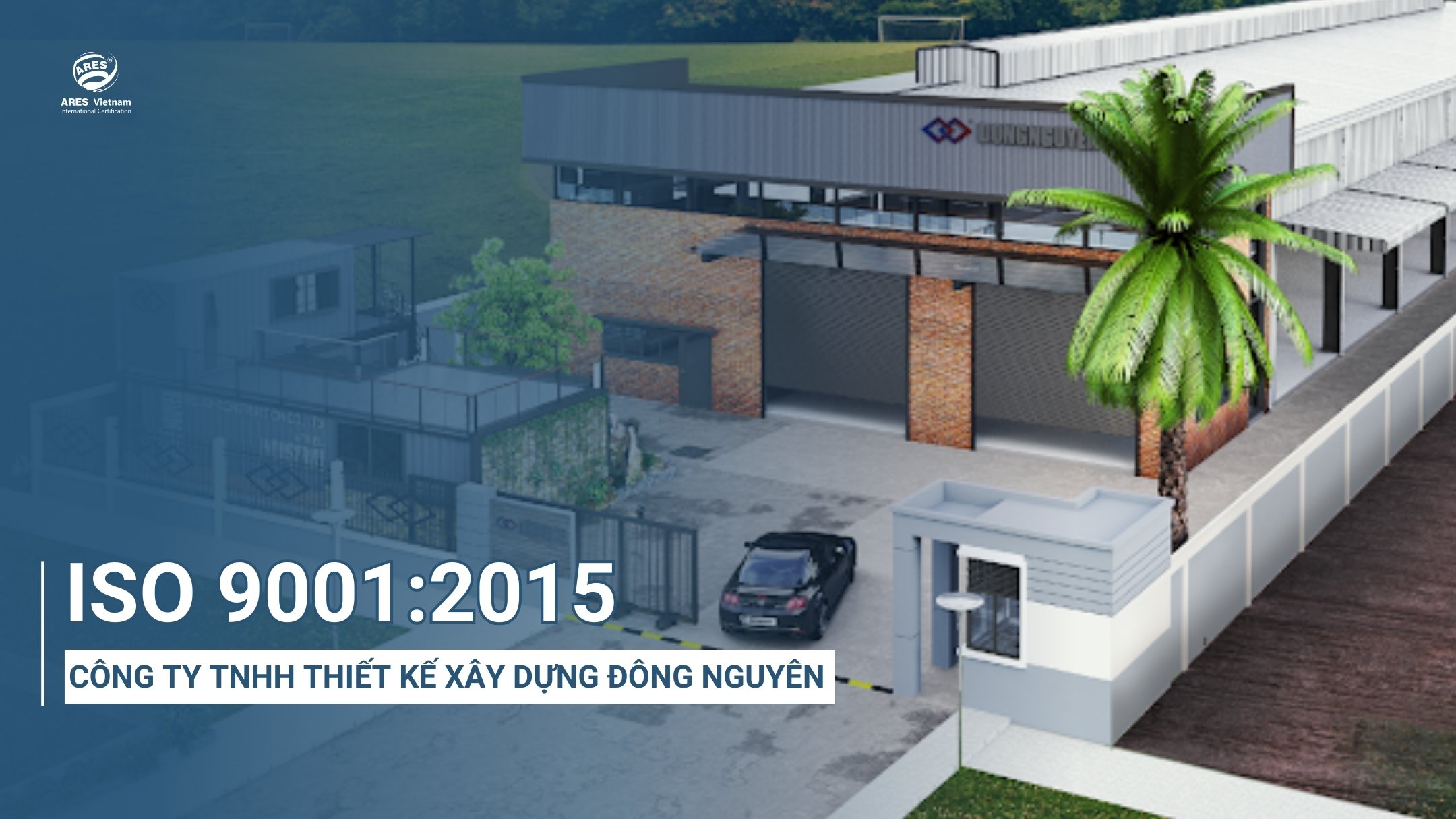
ARES Vietnam Awards ISO 9001:2015 Certification To Dong Nguyen Design Construction Co., Ltd.
Read more

Lunar New Year of Binh Ngo 2026 – Sustaining Values, Shaping Standards
Read more