ISO 45001 Preparation Checklist – A Practical Guide For Service & Logistics Companies
In the service and logistics sector, occupational safety and workforce efficiency are critical factors across all operations—from warehousing and dispatch to transportation and delivery. However, many companies still operate at a basic compliance level, responding only after accidents occur or when inspections are enforced.
Even when ISO 9001 is already in place, the absence of ISO 45001 – Occupational Health and Safety Management System (OHSMS) creates a significant gap. In practice, processes may be correct, but not necessarily safe. As a result, businesses face higher accident risks, operational disruptions, productivity losses, and missed international partnership opportunities.
To support a more proactive and structured approach, ARES Vietnam has developed a 6-step ISO 45001 preparation checklist, specifically designed for service and logistics companies, with the aim of building a safe, efficient, and sustainable working environment.
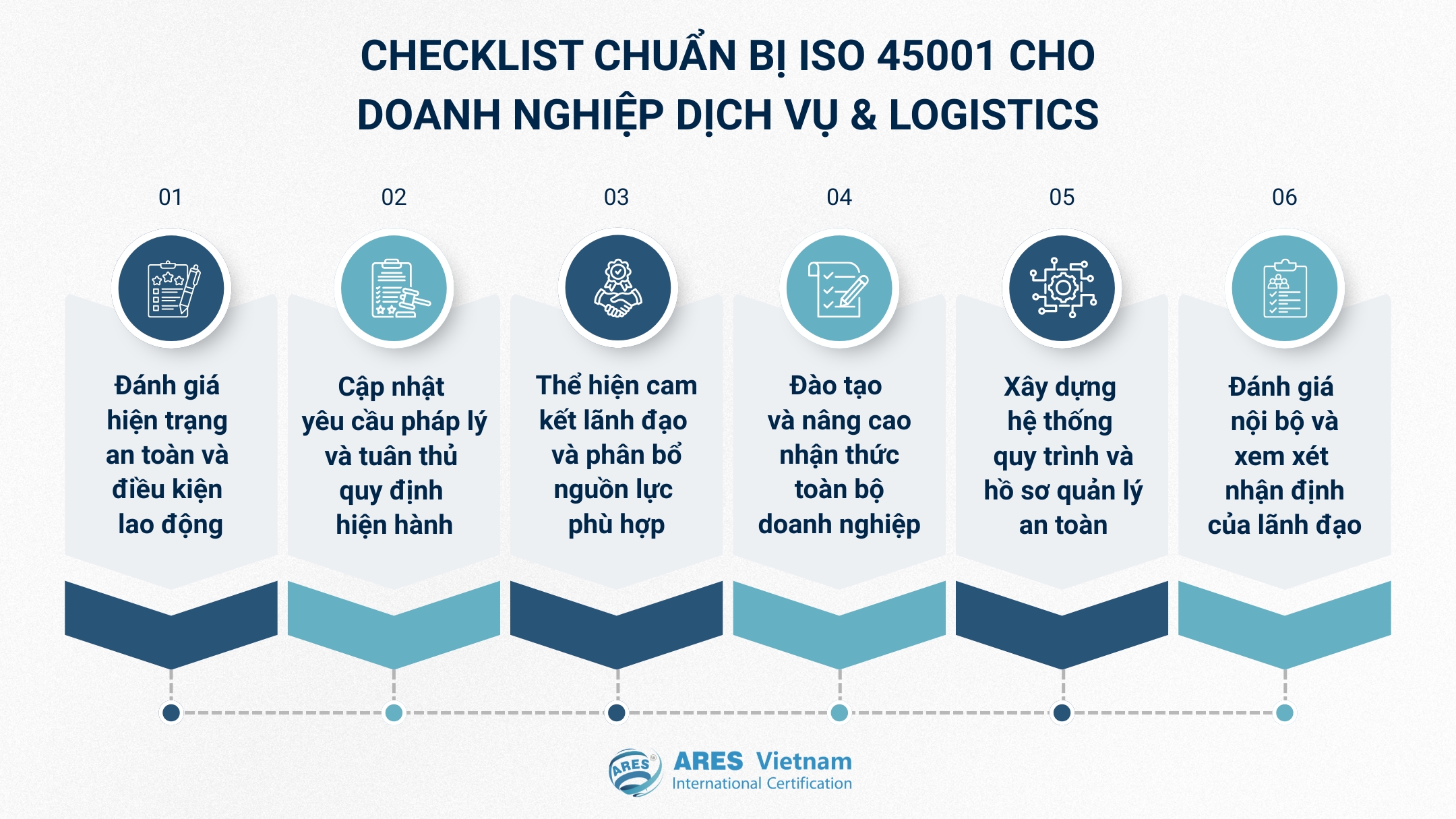
ISO 45001 preparation checklist – a practical guide for service & logistics companies
Step 1. Assess Current Occupational Safety And Working Conditions
Before implementation, companies should conduct a comprehensive occupational health and safety assessment (OHS Assessment). This evaluation should go beyond accident statistics and include compliance status, employee awareness, and actual working conditions.
Key review areas for the logistics sector include:
◼️Warehouse operation risks: forklifts, manual handling, working at height
◼️Transportation risks: vehicle safety, internal traffic control, delivery routes
◼️Working environment: noise, lighting, temperature, fire prevention systems
◼️Periodic inspection and maintenance of lifting equipment and machinery
The assessment results serve as essential input data. They help identify priority risks and define appropriate improvement plans before entering the certification phase.

Assess current occupational safety and working conditions
Step 2. Identify Legal Requirements And Ensure Regulatory Compliance
ISO 45001 requires organizations to identify, monitor, and regularly update applicable legal and regulatory requirements related to occupational safety and health.
Enterprises should therefore:
◼️Compile a list of all applicable regulations (Occupational Safety Law, Labor Law, fire safety regulations, etc.)
◼️Evaluate current compliance status
◼️Establish a mechanism for periodic legal updates and reviews
Legal compliance is not only a standard requirement. More importantly, it acts as a safeguard against legal exposure and reputational risks.

Identify legal requirements and ensure regulatory compliance
Step 3. Demonstrate Leadership Commitment And Allocate Appropriate Resources
Leadership plays a central role in ISO 45001. Commitment must be demonstrated through concrete actions, not merely formal approval.
Key actions include:
◼️Issuing an OHS policy aligned with the company’s development strategy
◼️Appointing an OHS responsible person or safety committee with direct reporting authority to top management
◼️Allocating budget for PPE, safety equipment, monitoring tools, and incident management systems
◼️Integrating safety performance indicators into frontline management evaluations
Strong leadership commitment is a decisive factor in ensuring that the system operates effectively rather than remaining a formality.

Demonstrate leadership commitment and allocate appropriate resources
Step 4. Train And Raise Awareness Across The Organization
Safety becomes a culture only when all employees understand and actively participate. In logistics, training should be tailored to job functions and associated risks.
Recommended training framework:
◼️Operational staff: hazard identification, first aid, emergency response procedures
◼️Frontline managers: risk assessment, work control, incident investigation
◼️Top management: integrating occupational safety into strategic planning
Each training program should include attendance records, assessments, and effectiveness evaluations. These are mandatory objective evidences during ISO 45001 certification audits.

Train and raise awareness across the organization
Step 5. Establish OHS Procedures And Management Records
Documented procedures form the backbone of the ISO 45001 system. Documentation must reflect actual operations, allow timely updates, and be practical for daily application.
Key procedure groups for logistics companies include:
◼️Hazard identification, risk assessment, and risk control
◼️Emergency preparedness and first aid
◼️Equipment maintenance, inspection, and PPE management
◼️Incident reporting, investigation, and corrective actions
◼️Contractor and service provider control
Important note: Avoid copying generic templates. Effective procedures are those designed based on real operational conditions, supported by implementation evidence and complete records.

Establish OHS procedures and management records
Step 6. Conduct Internal Audits And Management Review
Once the system is operational, organizations must perform regular internal audits to evaluate compliance and effectiveness.
Essential practices include:
◼️Developing an internal audit plan and audit checklist
◼️Analyzing audit results, identifying nonconformities, and implementing corrective actions
◼️Conducting management review meetings at least quarterly, or as appropriate to company size
◼️Integrating audit outcomes into the PDCA cycle for continual improvement
This is the “Check and Act” phase that ensures ISO 45001 functions as a living management system, not merely a set of internal documents.

Conduct internal audits and management review
Standardizing Safety For Sustainable Growth
The market increasingly demands clear evidence of occupational safety management. Service and logistics companies that prepare early gain tangible competitive advantages—from workforce retention and accident cost reduction to deeper integration into global supply chains.
If your organization is assessing ISO 45001 readiness or seeking a practical implementation roadmap, ARES Vietnam is ready to support you. Our consulting team has successfully accompanied numerous service and logistics companies across Vietnam in building effective and compliant ISO 45001 systems.
Related news
ISO And Compliance Trends In 2026 That Vietnamese Businesses Should Not Overlook
Read more


Important Update for Food Businesses: From 2026, HACCP, ISO 22000, and FSSC 22000 Will Not Replace the Food Safety Eligibility Certificate
Read more

Looking Back at the Journey of 2025 – A Year of Value and Trust
Read more
International ISO Certification Standards
Read more
ARES Vietnam Awards ISO 9001:2015 Certification To Dong Nguyen Design Construction Co., Ltd.
Read more