How Many People Are Needed to Implement ISO?
Throughout its journey of supporting Vietnamese enterprises, ARES Vietnam frequently receives one common question when companies consider implementing ISO:
◾Can a small company implement ISO?
◾If there is no dedicated ISO department, who will be responsible?
◾Does ISO implementation require hiring additional staff?
These concerns reflect a shared anxiety: many businesses fear that ISO will consume excessive manpower, disrupt daily operations, or generate unnecessary costs.
This article addresses those concerns. More importantly, it explains how enterprises can implement ISO effectively without increasing headcount, while optimizing existing resources to build a transparent, efficient, and cost-effective management system.

ARES Vietnam addresses enterprises’ questionon internal ISO staffing
1. Understanding Resource Requirements for ISO Implementation
A common misconception is that only large enterprises with dedicated QA or ISO departments are capable of meeting ISO requirements. In reality, ISO standards are designed for organizations of all sizes—even companies with only a few dozen employees.
Fundamentally, ISO is not about the number of people involved. Instead, it focuses on how resources are structured and allocated, including:
◾Who is responsible for defining and approving policies?
◾Who monitors, evaluates, and maintains control activities?
◾Who executes operations and reports performance data?
Once these roles are clearly defined and effectively coordinated, an organization can achieve ISO certification without adding personnel, while simultaneously improving transparency and operational efficiency.
As a result, the question of “how many people are enough” becomes less critical than how responsibilities are assigned and integrated within the ISO system.
2. Role-Based ISO Management – The Key to Operational Continuity
One of ISO’s greatest strengths lies in its role-based structure. This approach enables flexible implementation that aligns with real operational practices, rather than depending on departmental boundaries or staff size.
Under this model, each individual holds a clearly defined position within the management cycle: planning – execution – control – improvement. Consequently, ISO becomes embedded in daily operations, rather than functioning as a parallel system or an administrative burden.
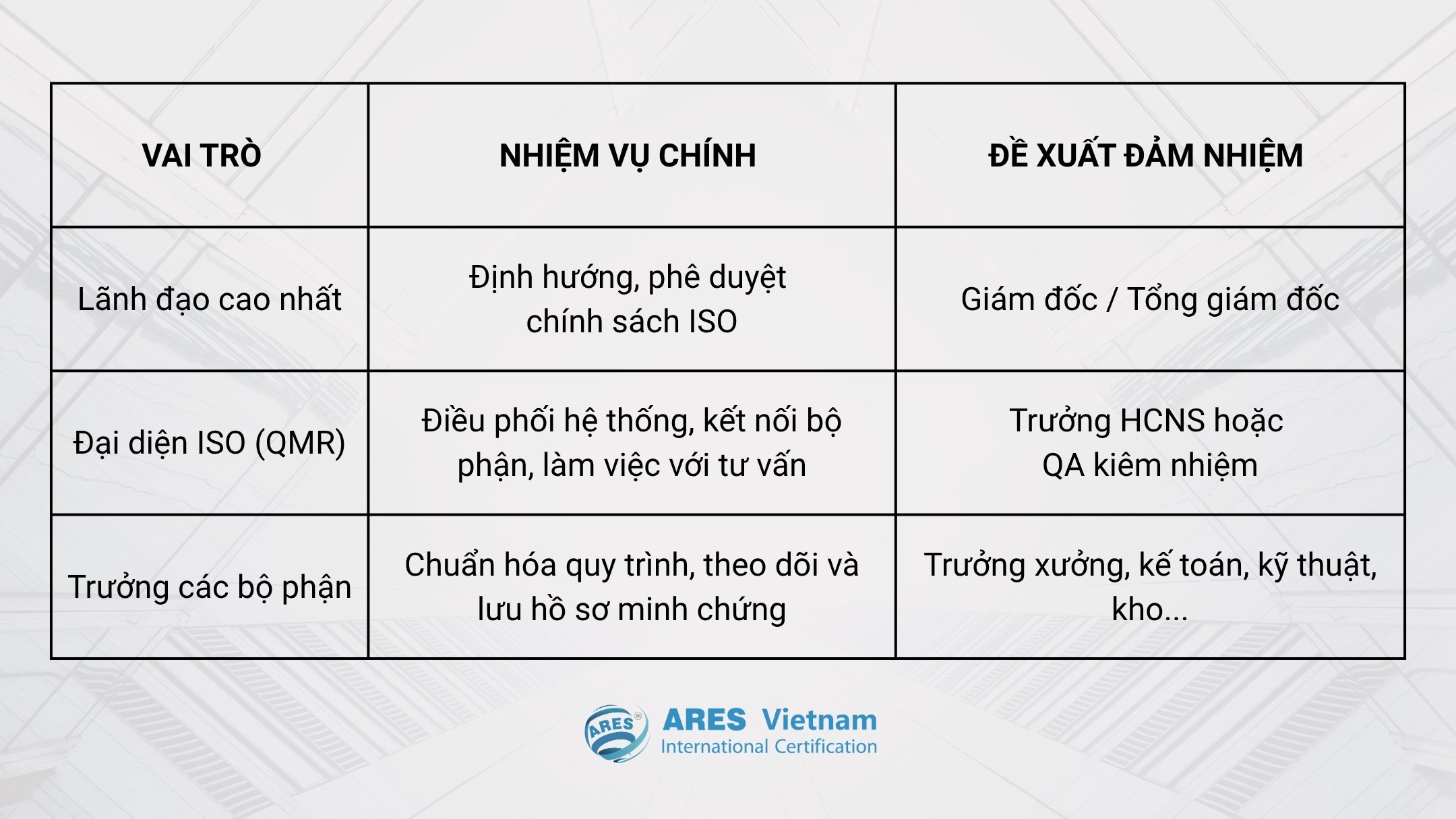
Minimum ISO staffing model – lean yet comprehensive
However, for these roles to work in harmony, organizations require a central coordination point: the ISO Management Representative (QMR). The QMR ensures that quality objectives and policies are implemented consistently. At the same time, information flows, task sequences, audits, and improvement activities are maintained according to defined cycles.
At the core of the management framework, a competent QMR accelerates implementation and transforms ISO into a practical strategic tool, where every process reflects the organization’s actual capability and level of maturity.
3. Effective ISO Implementation with Limited Resources, Together with ARES Vietnam
For small enterprises, the challenge is not a lack of manpower. Instead, it lies in maximizing and structuring existing teams efficiently. The following four solutions have helped many organizations implement ISO successfully while controlling costs:
1️⃣ Leverage existing personnel
ISO responsibilities are integrated into daily tasks. When individuals clearly understand their roles, ISO supports operations rather than creating additional workload.
2️⃣ Standardize documentation at the right level
Rather than developing excessive or complex procedures, organizations should focus on 8–10 core processes, such as production, quality control, training, internal audits, and document control. A streamlined system is easier to maintain and continuously improve.
3️⃣ Apply digital tools
ISO management software, cloud-based document storage, and electronic checklists can reduce paper-based documentation by up to 70%. As a result, audit preparation time is shortened and evidence remains consistent and traceable.
4️⃣ Partner with experienced consultants
Professional consultants help design an implementation roadmap aligned with the organization’s size and context. Consequently, core team members are trained systematically, errors are minimized, and implementation timelines can be reduced by 30–40%.

ARES Vietnam partners with businesses to implement ISO comprehensively
ISO implementation is not about expanding headcount or establishing a separate department. Instead, it is about structuring and optimizing existing resources. When roles are clearly defined, supported by a capable QMR and guided by experienced consultants, ISO becomes a transparent, practical management tool aligned with real operations.
For small enterprises, a core team of only 3–5 key personnel, combined with indirect involvement from department heads, is sufficient to implement ISO successfully, maintain stability, and ensure long-term sustainability.
Let ARES Vietnam accompany you. We provide tailored implementation roadmaps, team training, and hands-on ISO support—helping your management system operate smoothly and remain fully prepared for certification audits.
Related news
Important Update for Food Businesses: From 2026, HACCP, ISO 22000, and FSSC 22000 Will Not Replace the Food Safety Eligibility Certificate
Read more


Looking Back at the Journey of 2025 – A Year of Value and Trust
Read more
International ISO Certification Standards
Read more
ARES Vietnam Awards ISO 9001:2015 Certification To Dong Nguyen Design Construction Co., Ltd.
Read more

Lunar New Year of Binh Ngo 2026 – Sustaining Values, Shaping Standards
Read more